
AG-S3: Redefining Privacy and Scalability in Social Network Computing
Computing in social networks
The paper defines and solves the S3 Problem (Scalable Secure computing in a Social network), focusing on decentralized aggregation functions. It introduces AG-S3, a protocol that achieves SOTA performance in balancing differential privacy-like anonymity, scalability, and Byzantine-resilient accuracy without relying on heavy cryptographic primitives.
Executive Summary
In an era where centralized platforms like Facebook or Amazon Mechanical Turk hold a monopoly over user data, the demand for Decentralized Secure Computing has never been higher. However, the "trilemma" of balancing Scalability, Security (Accuracy), and Privacy has historically forced researchers toward expensive cryptographic solutions.
This paper introduces the S3 Problem and provides a breakthrough solution: AG-S3. By leveraging the "Reputation Concern" inherent in social human-based networks, the authors prove that we can achieve secure distributed aggregation with complexity—all without relying on heavy encryption.
The Core Conflict: Why Decentralization is Hard
Existing methods (Prior Work) often fail in two extremes:
- Cryptography (SMPC): Offers high accuracy and privacy but crashes under the weight of complexity.
- Differential Privacy: Protects the "average" user but fails in rare or "trivial" input configurations (e.g., when almost everyone votes the same way).
The authors' key insight is that Social Networks are distinct. Nodes are users who value their reputation. By creating a system where misbehavior leads to "public tagging" (Social Evidence), we can constrain rational adversaries more effectively than assuming random Byzantine behavior.
Methodology: The AG-S3 Architecture
The protocol rests on three pillars:
- Structured Ring Overlay: Nodes are clustered into offices on a ring. Each node communicates only with officemates and specific "proxies" in upcoming groups.
- Homomorphic Secret Sharing: To hide an input , a node generates shares such that their sum equals . Most shares are random noise pairs ( and its inverse ), ensuring the total aggregate remains correct while individual shares reveal nothing.
- Distributed Verification: Rather than verifying every bit, officemates perform distance-based checks. If a reported aggregate deviates too far from the expected diameter , the node is tagged as faulty.
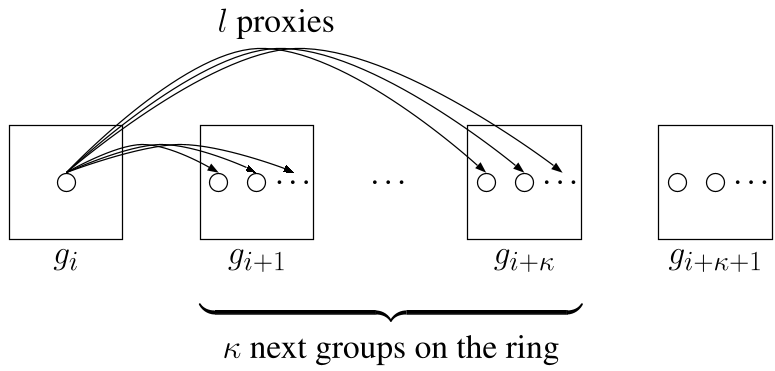
The figure above illustrates the "Sharing Phase," where inputs are distributed across proxies in multiple groups ( groups, each with proxies) to ensure no single group can reconstruct a user's original input.
Mathematical Intuition: The Reduction Theorem
One of the most powerful contributions of this paper is Theorem 1. The authors prove that any "regular" (Lipschitz-continuous) function can be reduced to the problem of Component-wise Addition.
If we can sum vectors accurately and privately, we can compute almost anything from polls to complex social metrics by representing multisets as compact integer vectors.
Experimental Results & Accuracy
The protocol was tested against a coalition of faulty nodes.
- Scalability: Both message and spatial complexity stay within , making it viable for networks with millions of users.
- Byzantine Resilience: Even if nodes are malicious, the error remains negligible relative to the total population.

As shown in the data flow, the "Forwarding Phase" uses a triple-pass token system. If a malicious coalition tries to corrupt the result during transit, the localized verification across the ring structure will likely trigger a reputation tag.
Critical Analysis & Future Outlook
AG-S3 is a significant step forward because it acknowledges the human element of computing. However, it has limitations:
- The "Rational" Assumption: The protocol assumes nodes are rational and fear reputation loss. A "Kamikaze" attacker who doesn't care about their profile could still cause local disruptions.
- Static Overlays: The current proof relies on a randomly assigned static overlay. Future work must address highly dynamic social networks where users join and leave frequently.
Takeaway: This paper proves that privacy doesn't always require math-heavy silos; sometimes, the social fabric itself is the best security layer we have.