
MCB: Bridging the Semantic Gap with Interactive Multi-Concept Browsing
Concept based interactive retrieval for social environment
The paper introduces the Multi-Concept Browsing (MCB) framework, an interactive retrieval system designed for social media environments. It utilizes a mid-level semantic feature bridge (e.g., "grass," "water") to help users construct complex high-level queries (e.g., "rural garden") through an innovative visualization interface, significantly outperforming traditional SVM baselines.
TL;DR
The explosive growth of social media has outpaced the ability of static machine learning models to index subjective, high-level concepts. This paper presents the Multi-Concept Browsing (MCB) framework, which empowers users to build complex queries (like "rural garden") by combining simple, automated mid-level tags (like "grass," "flower," and "water"). By involving human cognition in the loop, MCB achieves up to a 20x performance boost over standard automated baselines for complex queries.
The "Semantic Gap" and the Social Media Dilemma
In the era of Flickr and Facebook, content is no longer confined to specific domains. Traditional Content-Based Image Retrieval (CBIR) systems suffer from the Semantic Gap—the disconnect between low-level pixels and high-level human meaning.
The authors argue that:
- Direct Mapping is Hard: Going from pixels to "Modern City View" is error-prone.
- Scalability Issues: Training a new classifier for every possible social tag is impossible.
- Human Perspective: High-level queries are subjective and change based on context.
Methodology: Mid-Level Features as a Crossover
Instead of forcing a model to understand "Wildlife," the researchers train robust classifiers for Mid-Level Semantic Features—objects like "elephant," "lion," or "grass."
The Interactive Workflow
- Automated Indexing: Images are pre-processed using SVM or Multi-Feature (MF) classifiers to detect primitive concepts.
- Visual Query Specification: Users select 2-3 mid-level concepts from a grid.
- Dynamic Filtering: The system identifies the intersection of these concepts.
- Navigation: A Fisheye Distortion interface allows users to zoom into specific clusters while maintaining global context.
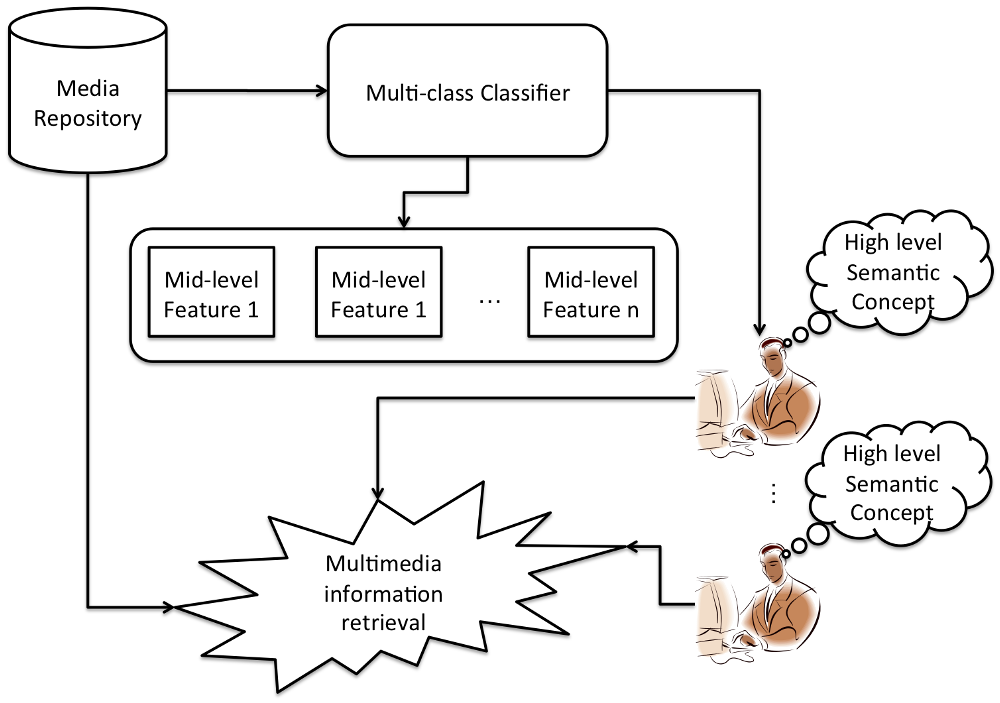 The MCB interface showing the concept selection grid and the result space.
Experiments: Superior Accuracy through Interaction
The authors compared MCB against a standard SVM baseline (trained on 10%, 30%, and 50% of the data) and a Particle Swarm Optimization-based Relevance Feedback (RF) system.
Key Results:
- Complex Concepts: For "Flower fields," MCB reached an F-measure of 1.0, while the best SVM only reached 0.055.
- Precision vs. Automation: MCB consistently outperformed automated systems in categories like "Waterfall" and "City Street" because humans are better at identifying the relationship between elements (e.g., water + rocks = waterfall).
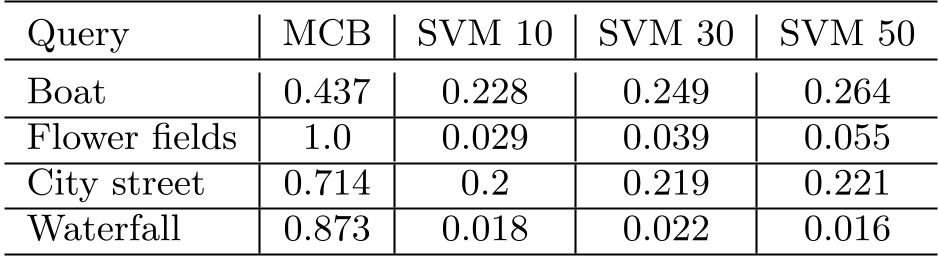 Quantitative comparison showing MCB's massive lead over SVM baselines.
Deep Insight: Why Interaction Trumps Pure Search
The core philosophy here is that retrieval is an exploration, not just a result. By providing a "Concept Map" and a "Chart Visualization," the system gives the user feedback on why certain images were shown. This transparency allows the user to refine their mental model and the query simultaneously.
While pure automated indexing struggles with "visual consistency," the MCB framework leverages the fact that even if a classifier is only 70% accurate, a human can quickly filter out the 30% noise if the visualization is intuitive.
Future Outlook and Limitations
The primary limitation identified was the dependency on the quality of mid-level classifiers. For example, the system struggled with the "Boat" concept because the underlying "Sky" and "Water" detectors were less accurate in that specific dataset.
The authors envision this framework evolving into a gaming environment (similar to the ESP game) to crowdsource even better annotations, further bridging the gap between social peers and massive data archives.
Conclusion
This paper serves as a vital reminder that in the age of Big Data, the most powerful "algorithm" is often the synergy between machine efficiency and human intuition. MCB provides a blueprint for scalable, user-centric retrieval that remains relevant in our increasingly visual world.