
Concept Graph Learning: Bridging the Gap in Global Education Prerequisite Discovery
Concept Graph Learning from Educational Data
The paper introduces Concept Graph Learning (CGL), a novel framework for automatically inducing a directed universal concept graph from educational course data. By projecting course-level prerequisite links onto a semantic concept space, the method achieves SOTA performance in predicting unobserved prerequisites within and across different universities.
TL;DR
Researchers from Carnegie Mellon University have developed Concept Graph Learning (CGL), a framework that solves the "Curriculum Mapping" problem. By learning how fundamental concepts (like "Eigenvalues") must be sequenced, the system can automatically predict which courses are prerequisites for others—even if those courses come from entirely different universities or MOOC platforms.
Context: The Fragmentation of Online Learning
In the era of MOOCs and global academic mobility, students face a "paradox of choice." Is Intro to Data Mining at MIT the same as Applied Machine Learning at Stanford? Which one should you take first? Traditionally, these dependencies are locked within university silos. This paper seeks to build a Universal Concept Graph that acts as a translator between any two educational offerings.
The Core Insight: Concepts as the "Interlingua"
The authors realized that while course IDs are unique to institutions, the concepts taught are universal. By mapping courses to a shared concept space (using words or Wikipedia categories), they created a bridge.
If Course A (MIT) teaches "Partial Differential Equations" and Course B (Caltech) requires "Ordinary Differential Equations," the system learns the link between the concepts first, then projects that knowledge back to the courses.
Methodology: CGL.Rank
The architecture involves two layers:
- Course Level: Observed prerequisite links (e.g., 18.01 is a prerequisite for 18.02).
- Concept Level: A hidden directed graph where represents the strength of the dependency between concept and .
The team formulated this as a Learning-to-Rank problem. Instead of just classifying if a link exists, the model learns to rank true prerequisites higher than unrelated courses.
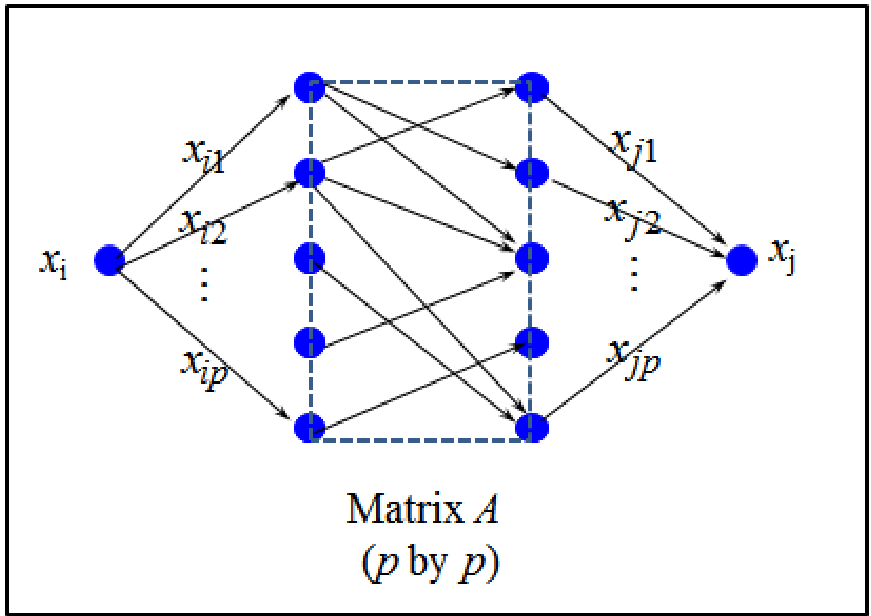 Figure 1: How course links are decomposed via the concept dependency matrix A.
To make this scalable (handling over 237 million potential concept-to-concept links), they used Nesterov’s accelerated gradient descent and a mathematical reformulation that reduced the parameter space from to , where is the number of courses.
Experimental Validation
The researchers tested their model on real-world data from MIT, Caltech, CMU, and Princeton.
Within-University Performance
CGL.Rank consistently outperformed standard SVM classifiers and Nearest Neighbor (kNN) approaches.
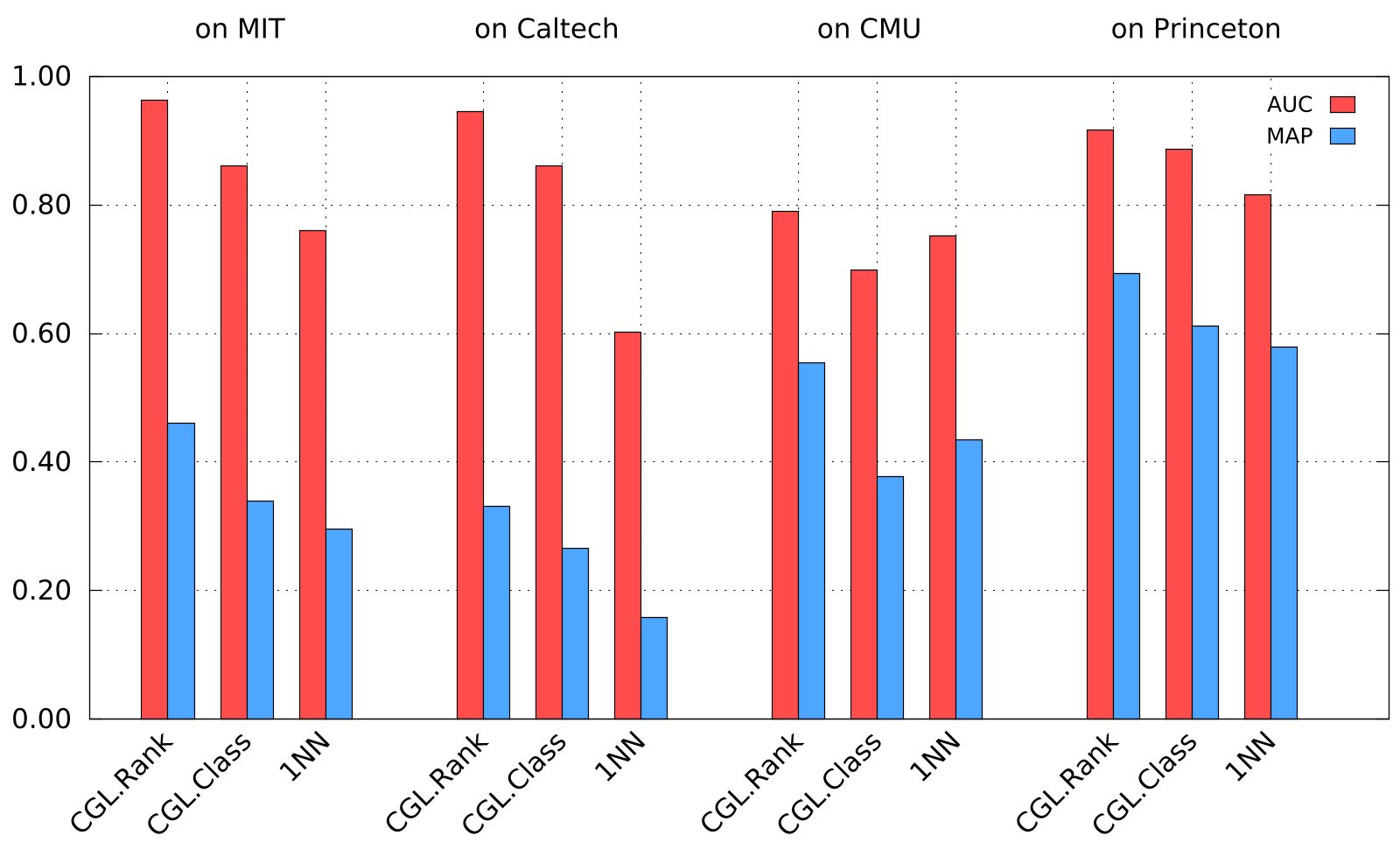 Figure 2: CGL.Rank dominates in Mean Average Precision (MAP) across multiple institutions.
The Transfer Learning Breakthrough
The most impressive result was Cross-University Transfer. A model trained exclusively on MIT’s curriculum could predict prerequisite links for Caltech courses with significant accuracy. This proves that the "Concept Interlingua" actually captured the universal logic of academic progression.
| Representation | MIT AUC | Caltech AUC |
|---|---|---|
| Word-based | 0.96 | 0.95 |
| Wikipedia Categories | 0.93 | 0.93 |
Critical Insights & Future Outlook
While the system is highly effective, the authors noted some "common sense" errors (e.g., linking Extrasolar Planets as a prerequisite for Chaos Theory). However, the overall framework provides:
- Scalability: Processes thousands of courses in minutes.
- Versatility: Works with raw text, Wikipedia categories, or even Word Embeddings.
- Utility: Can be used for automated curriculum design and personalized student advisors.
The next frontier? Cross-language transfer. Imagine using a concept graph to link a Chinese Data Science syllabus with an English Statistics course seamlessly. CGL marks a major step toward a unified, global knowledge map.
Conclusion
This work transforms educational data mining from a simple classification task into a sophisticated graph-learning challenge. By looking "under the hood" of course descriptions into the underlying concepts, CGL provides a roadmap for the future of decentralized, global education.