
CKMN: Bridging the Semantic Gap in Video Event Recognition with Concept Mining
Towards More Explainability: Concept Knowledge Mining Network for Event Recognition
The paper introduces the Concept Knowledge Mining Network (CKMN) for event recognition in untrimmed videos. It utilizes domain-specific detectors (scene, object, action) and refines their outputs through intra-domain temporal mining and inter-domain co-attention, achieving SOTA results on FCVID and ActivityNet.
TL;DR
Recognizing events in "untrimmed" (long, unedited) videos is notoriously difficult because the "event" is a high-level abstraction spread across time. CKMN (Concept Knowledge Mining Network) moves away from purely "black-box" visual features. Instead, it treats videos as a collection of evolving concepts (Scenes, Objects, Actions) and uses specialized neural modules—IaCKM and IrCKM—to "mine" the temporal patterns and cross-domain relationships between these concepts. The result? A State-of-the-Art performance that you can actually understand.
The Problem: Why Simple Concept Detection Fails
Most prior works either jump straight from pixels to labels (losing interpretability) or detect concepts and simply average them. However, video events are structured:
- Temporal Variance: In a "Birthday Party," the Scene (parlor) might last 10 minutes, while the Action (blowing candles) lasts 5 seconds. Simple pooling washes out these short-lived but critical cues.
- Domain Interaction: An "active" object (like a soccer ball) is more relevant when paired with a specific action (kicking). Generic detectors often miss these contextual synergies.
Methodology: The Architecture of Reasoning
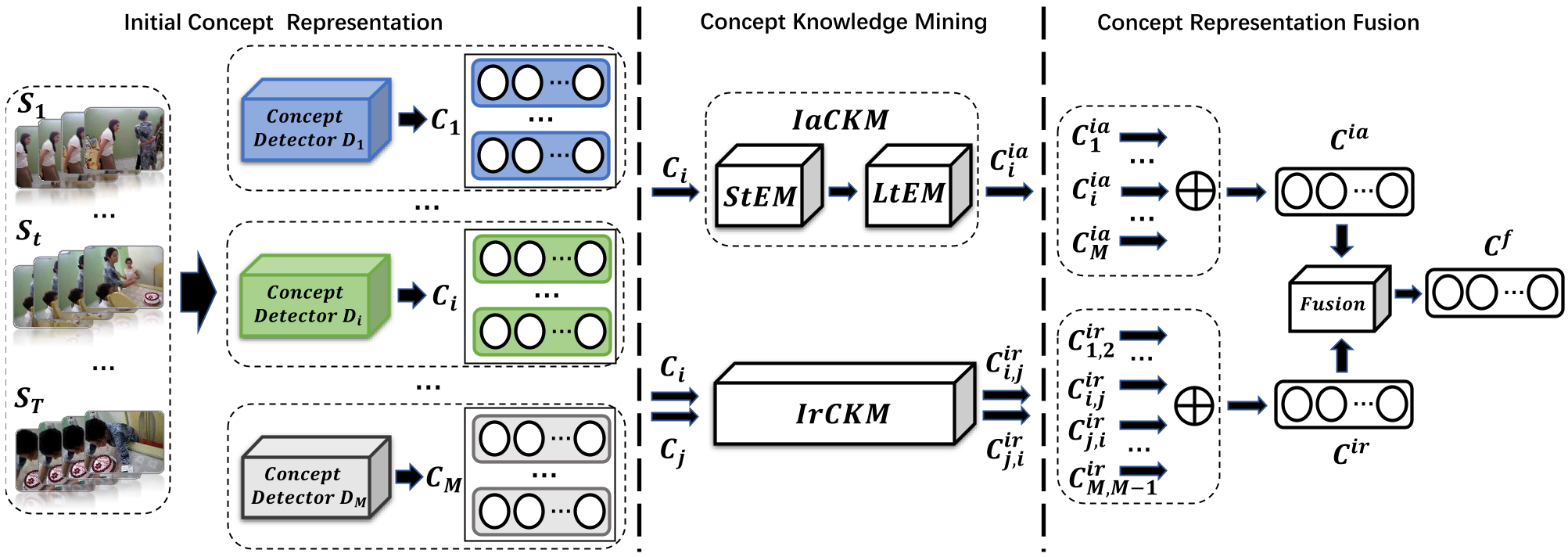
The CKMN architecture (shown below) converts a video into a sequence of concept probabilities and then processes them through two distinct "mining" layers.
1. IaCKM: Intra-domain Knowledge Mining
This module addresses the Temporal Variance problem. It uses two sub-components:
- StEM (Short-term Existence Mining): Uses Dilated Temporal Pyramid Convolutions to capture concepts that flash by quickly.
- LtEM (Long-term Existence Mining): Employs Temporal Self-Attention to identify concepts that provide a persistent background context.
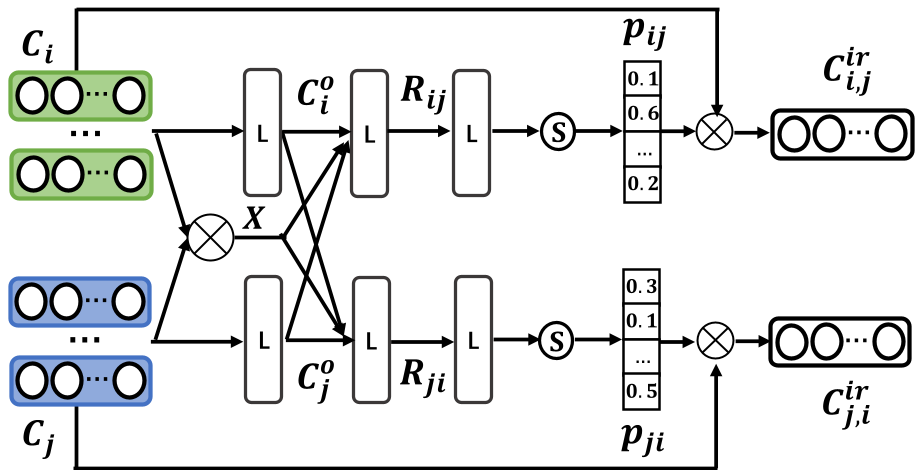
2. IrCKM: Inter-domain Knowledge Mining
This module handles Domain Interaction. Using a Co-Attention style learning, the network allows one domain (e.g., Scene) to act as a "query" to filter the most relevant segments in another domain (e.g., Object). For example, if the scene is "Kitchen," the IrCKM will prioritize "Coffee Pot" detections over "Soccer Ball" detections.
Experiments and Results
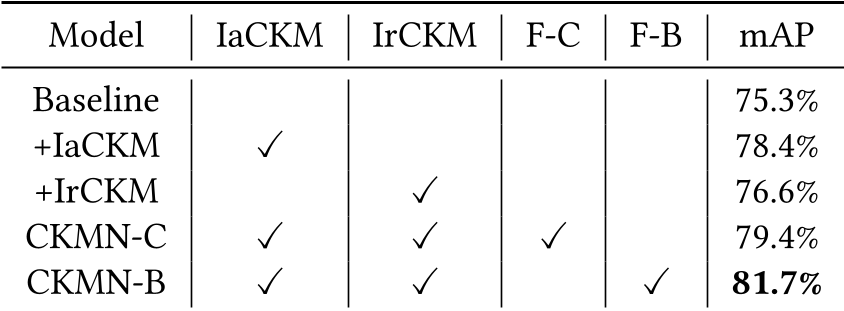
The authors tested CKMN on the FCVID and ActivityNet datasets. The results were clear: explicitly modeling concept relationships outperforms just "adding more data."
- SOTA Performance: CKMN outperformed the previous best concept-based method (OSF) by 5.2% mAP on FCVID, despite using significantly fewer concept categories (1,765 vs 20,000+).
- Bilinear Fusion: The study found that using Bilinear Pooling to merge the mined knowledge was superior to simple concatenation, as it captures the multiplicative interactions between domains.
Explainability: Seeing What the Model Sees
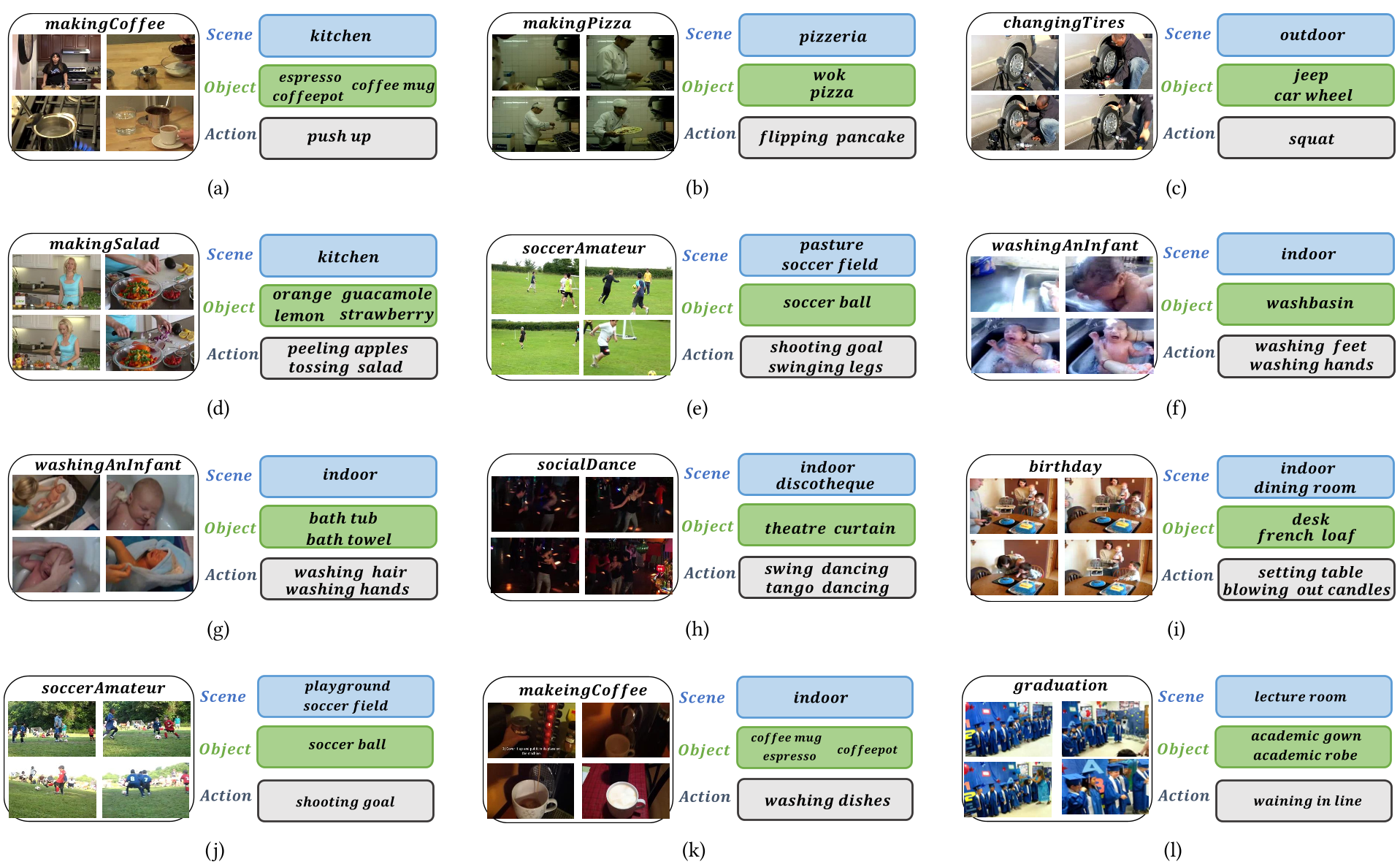
One of the strongest arguments for CKMN is its transparency. Instead of a single "Event Score," the model can output the specific concepts that led to the prediction.
For an event like "SoccerAmateur," the model highlights the co-occurrence of the "Soccer Field" (Scene), the "Soccer Ball" (Object), and "Swinging Legs" (Action). This "Evidence Recounting" is essential for real-world applications like video search and automated security.
Conclusion and Future Outlook
CKMN proves that structured, middle-level semantic reasoning is a powerful tool for video understanding. By mining the "how" and "when" concepts occur, the network achieves high accuracy with much better interpretability.
Limitations: The model still relies on pre-trained concept detectors. A potential future direction includes "End-to-End" discovery where the model learns to define its own relevant concepts dynamically based on the event context.