
Fuzzy Social Relational Networks: Bridging Linguistic Intuition and Network Science
Concept Representation and Database Structures in Fuzzy Social Relational Networks
The paper introduces a framework for Fuzzy Social Relational Networks by integrating Zadeh's "Computing with Words" (CWW) with fuzzy graph theory. It establishes a machine-computable bridge between linguistic human descriptions (e.g., "strong connections," "short paths") and formal network properties to analyze weighted social structures.
TL;DR
Ronald R. Yager presents a sophisticated framework that allows social network analysts to query networks using natural language. By treating social connections as fuzzy relationships and nodes as attribute vectors, the paper provides a mathematical infrastructure for "Computing with Words" in the context of criminal, terrorist, and digital social networks.
The Core Motivation: The Imprecision of Human Connection
In the real world, relationships aren't binary. We aren't just "friends" or "not friends"; we have "strong ties," "weak acquaintances," and "trusted colleagues." Traditional Social Network Analysis (SNA) often struggles with this nuance.
The author identifies two primary gaps:
- Weighting: The need for fuzzy graphs where edge weights represent the degree of relationship.
- Semantic Gap: The disconnect between an analyst saying "find a group of people with strong, direct ties" and the underlying mathematical matrix operations.
Methodology: Computing with Words (CWW)
The brilliance of this paper lies in its use of Fuzzy Sets as a lingua franca between humans and machines.
1. Linguistic Vocabularies
The analyst defines terms like "Strong" or "Short" as fuzzy subsets. For example, a "Short" path isn't just a path of length 1; it's a fuzzy membership function where length 1 has a membership of 1.0, length 2 has 0.8, and so on.
2. Redefining the Clique
In crisp graph theory, a clique is a subset where everyone is connected. Yager proposes a Fuzzy Clique based on two linguistic criteria:
- C1: All elements are connected by a short, strong path.
- C2: No element outside the clique has a strong connection to those inside.
Using the Sugeno Integral, the degree of satisfaction for a "short strong connection" between two nodes and is calculated as: Where is the fuzzy set "Short" and is "Strong".
 Fig 1. The bridge between human vocabulary and the formal network model.
Experiments & Results: Social Network Database Theory
The author introduces vector-valued nodes, where each node (person) has attributes like age, nationality, or income. This transforms the network into a searchable database.
Querying the Network
Instead of complex SQL joins, we can ask: "Does Person X have a strong connection to a young person in South America?"
The truth value of this query is derived by intersecting the fuzzy sets:
eq j} [SA(U_1(x_i)) \wedge Young(U_2(x_i)) \wedge Strong(R^n(x_i, x_j))]$$ ### Centrality Reimagined Traditional centrality counts edges. Yager’s fuzzy centrality counts the "number of strong connections," preventing a "large number of weak connections" from artificially inflating a node's importance—a critical distinction when identifying leaders in clandestine cells. 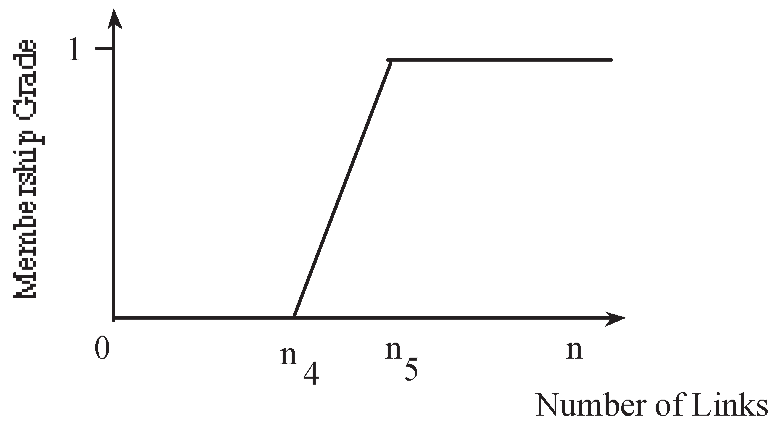 *Fig 2. Semantics of 'Short' path as a fuzzy membership function.* ## Critical Insight & Conclusion ### Takeaway Yager’s work is a foundational step toward **Intelligent Social Network Analysis**. It moves the field away from rigid graph metrics toward a more human-centric, "granular" understanding of social dynamics. ### Limitations * **Computational Complexity**: Calculating $R^n$ (the strongest path of any length) for massive graphs (millions of nodes) using fuzzy composition can be computationally expensive. * **Subjectivity**: The definition of the "communal vocabulary" is subjective and requires expert domain knowledge to calibrate the fuzzy membership functions correctly. ### Future Outlook This theory paves the way for AI agents that can "understand" social contexts much like human analysts do, potentially revolutionizing how we monitor community health or disrupt harmful organizational structures.