
Concept Stability: A New Lens for Detecting Isolated Communities in Dynamic Networks
Concept Stability Based Isolated Maximal Cliques Detection in Dynamic Social Networks
This paper introduces a novel approach for detecting "Isolated Maximal Cliques" in dynamic social networks by leveraging Formal Concept Analysis (FCA) and Concept Stability. The method aims to identify abnormal user groups (e.g., "water armies" or fake accounts) by mapping network structures to formal concepts and measuring their stability to filter out noise and capture isolated clusters.
TL;DR
In the fight against "water armies" and fake news, identifying isolated groups of abnormal users is critical. This paper proposes a method to detect Isolated Maximal Cliques using Formal Concept Analysis (FCA) and Concept Stability. By converting social graphs into concept lattices, the researchers found a mathematical signature that identifies perfectly isolated groups, achieving 100% precision in detecting larger cliques within dynamic environments.
Background & Motivation: The "Isolated" Threat
Modern social network security has moved beyond digital viruses to "real-world" influence operations. Abnormal users—fake accounts, phishing bots, and malicious commentators—tend to exhibit two specific behaviors:
- They maintain heavy internal connections.
- They rarely interact with the "normal" population.
Mathematically, these groups form Isolated Maximal Cliques. However, detecting these in a dynamic setting (where users join/leave and relationships change) is computationally expensive and plagued by noise. The authors hypothesize that Formal Concept Analysis, a category-theoretic approach to data, can reveal these structures more elegantly than pure graph-theoretic searches.
Methodology: Bridging Lattices and Graphs
The core innovation lies in mapping a social network to a Formal Context using a modified adjacency matrix.
1. From Graph to Concept
The paper utilizes the concept of an Equiconcept—a state where the set of objects and their shared attributes are identical. In the context of a social graph, an equiconcept represents a Maximal Clique.
2. Measuring Stability
The breakthrough is the application of Concept Stability. It measures how much a concept depends on specific objects in its extent. The authors prove a crucial theorem:
"A maximal clique is isolated if and only if its corresponding equiconcept has a stability value exactly equal to ."
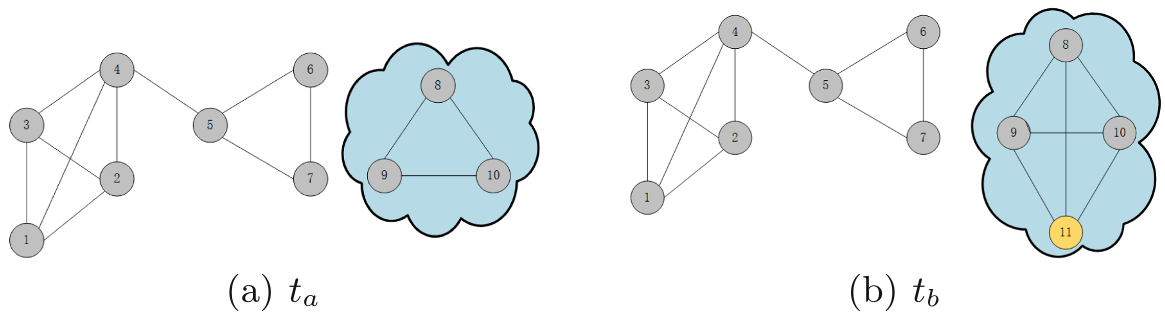 Figure 1: Workflow showing the transition from a dynamic topology (left) to the identification of isolated components over time.
3. The Algorithm (CS-IMCD)
The proposed algorithm (Algorithm 1) follows a two-stage process:
- Stage 1: Construct a formal context from the modified adjacency matrix and generate the concept lattice.
- Stage 2: Iterate through the lattice to identify equiconcepts and calculate their stability using the DFSP algorithm (the state-of-the-art for stability computation).
Experimental Validation
The authors tested their approach on two diverse datasets: the Dolphin Social Network (62 nodes) and a College Football Network.
Key Findings:
- High Precision: As the size of the clique (k) increases, the algorithm becomes increasingly accurate. For , the precision and recall hit a perfect 1.0.
- Dynamic Robustness: The method successfully tracked the evolution of cliques as new nodes were added or modified in synthetic sets.
- Efficiency: By using stability as a filter, the system effectively ignores "noisy" concepts that do not represent true isolated communities.
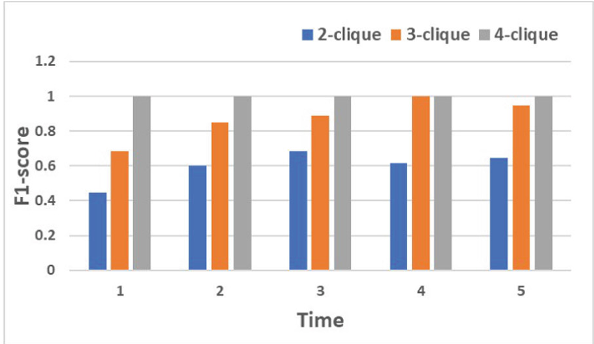 Figure 2: Performance metrics showing the stability of detection across different time intervals (t) and clique sizes (k).
Critical Insight & Practical Value
The primary value of this research is the theoretical bridge it builds. While graph theory deals with raw connectivity, FCA deals with the "logic" of relationships.
Why this works: Traditional clique detection is often "brute force." Using Concept Stability allows the algorithm to essentially "zoom in" on the most robust and isolated structural signatures. For product teams working on Trust and Safety, this offers a way to mathematically prove why a specific group of accounts is "suspiciously isolated" from the rest of the platform.
Limitations & Future Work
While highly effective for "perfectly isolated" cliques, the paper notes that real-world social networks are rarely so clean. Most abnormal users have some edges connecting to normal users. Future Outlook: The next step in this research lineage would be to relax the "isolation" constraint—perhaps detecting "quasi-isolated" cliques by applying a stability threshold rather than an exact value. This would make the system more resilient to "tactical" bots designed to blend into the normal population.
Conclusion
By combining the rigors of Formal Concept Analysis with dynamic network analysis, this work provides a robust mathematical framework for outlier mining. It shifts the focus from "finding cliques" to "verifying their stability," a vital distinction for modern network security.