
Bridging the Gap: The AI and Law Landscape (AILL) Framework
Toward a Conceptual Framework for Understanding AI Action and Legal Reaction
This paper introduces the AI and Law Landscape (AILL), a cross-disciplinary conceptual framework designed to bridge the gap between AI engineering and legal reasoning. It establishes a unified vocabulary and a "Conceptual Legal Analysis Equation" (CLAE) to help stakeholders navigate liability and agency in autonomous systems.
TL;DR
As AI systems transition from static tools to autonomous agents, the definition of "agency" becomes a legal battlefield. This paper introduces the AI and Law Landscape (AILL), a conceptual bridge designed to help AI engineers and lawyers speak the same language. By introducing a formal equation for liability, the authors provide a toolkit for navigating the socio-technical implications of autonomous decision-making.
The "Agency" Conflict: A Semantic Divide
The most striking insight of the paper is the fundamental disagreement over the word "Agent."
- To an AI Designer, an agent is a context-aware, adaptive computational component (e.g., a reinforcement learning model).
- To a Legal Reasoner, an agent is a separate legal entity acting on behalf of a principal, requiring "consent" and often "legal personality."
This discrepancy creates a dangerous vacuum: who is responsible when an AI "agent" makes a decision that causes harm? Current legal systems are tied to physical jurisdictions, whereas AI is geographically agnostic, making traditional "torts" (legal wrongs) difficult to pin down.
Methodology: The AILL and the Liability Equation
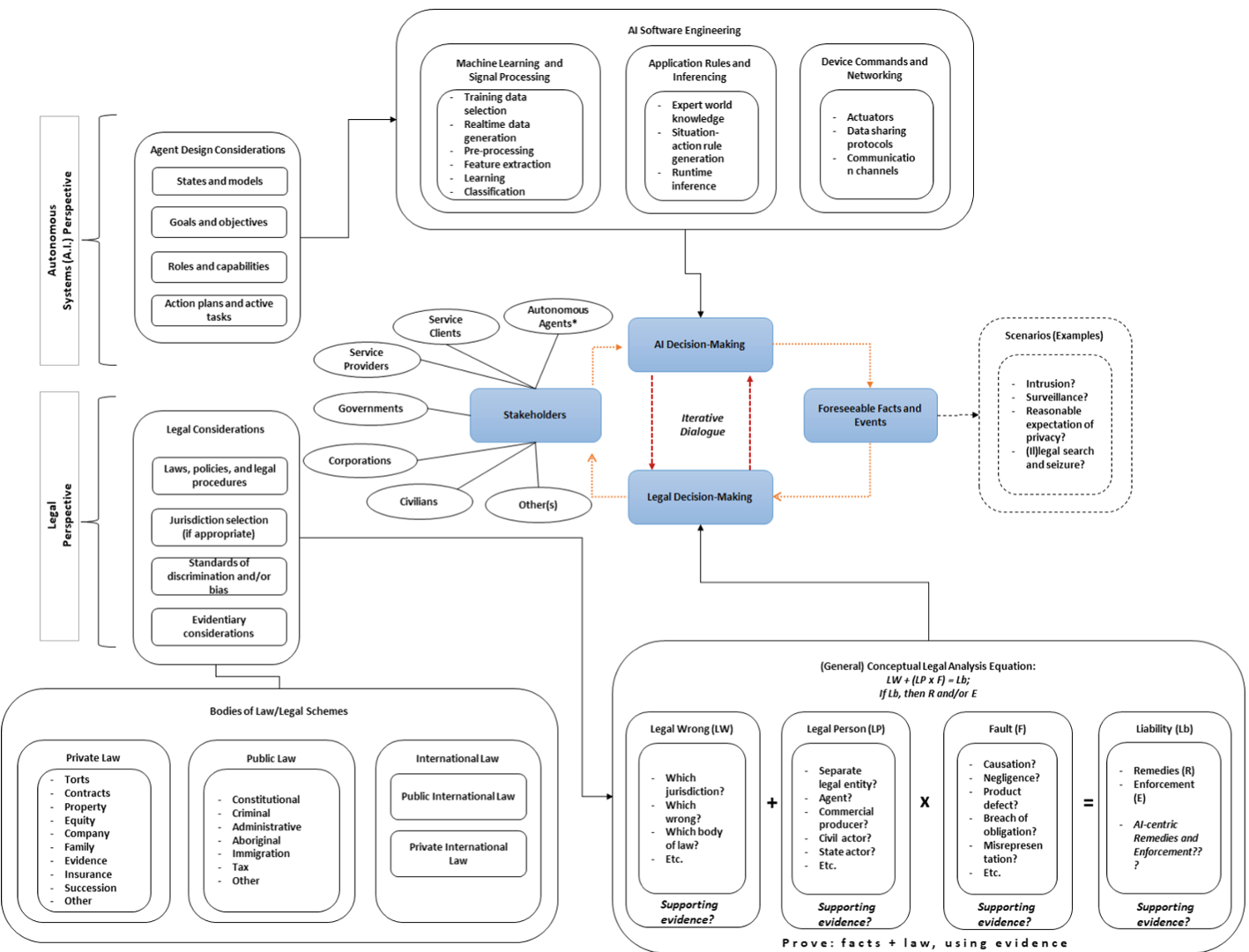
The core contribution of this work is a dual-layered framework. First, the AI and Law Landscape (AILL) visualizes the feedback loop between system design and legal response.

The second layer is the Conceptual Legal Analysis Equation (CLAE), which decomposes the abstract concept of "responsibility" into a logical formula:
Where:
- LW (Legal Wrong): The specific violation within a jurisdiction.
- LP (Legal Person): The entity held responsible (Human, Corporation, or potentially the AI).
- F (Fault): The proof of negligence or defect.
- Lb (Liability): The final legal accountability.
Deep Dive: The Case of "Legal Personality"
The paper uses the high-profile case of Sophia, the robot granted citizenship by Saudi Arabia, to challenge our assumptions. If an AI has citizenship, does it have the "Legal Personality" required to satisfy the variable in the equation?
If the AI is not a legal person, the paper argues we must trace the "Fault" back to:
- Service Providers: Who deployed the agent?
- Corporations: Who profited from the sale?
- Designers: Did the algorithm contain inherent bias or "product defects"?
Critical Insight & Conclusion
This paper functions as a "Rosetta Stone" for two siloed disciplines. The most significant takeaway is that legal considerations are not just external regulations; they are design constraints.
However, the framework remains high-level. The actual implementation of a "court order to re-write a specific algorithm" (as suggested in the conclusion) poses massive technical challenges regarding neural network interpretability.
Future Outlook: We are moving toward a world where AI code audits will be as standard as safety inspections. Frameworks like AILL are the first step in creating "Law-Aware" AI that can operate safely within human societal boundaries.