
Distilling the Mesh: Creating Conceptual Synopses for Decentralized Social Data Networks
Conceptual Synopses of Semantics in Social Networks Sharing Structured Data
The paper introduces a methodology for generating Conceptual Synopses and mediating global schemas in social networks sharing structured relational data. It proposes a semi-automated framework to deduce semantics from local schemas and mappings, achieving a unified "semantic map" that facilitates data discovery and integration without requiring a pre-defined global ontology.
TL;DR
This paper addresses the "semantic discovery" problem in social overlay networks sharing relational data. The authors propose a system to automatically extract and merge the core concepts of local schemas into a Conceptual Synopsis—a graph-based summary. By distilling these graphs into a global mediating schema and applying compression to prune "rare" data structures, they provide a lightweight way for new participants to understand a network's content without needing a master ontology.
Executive Summary
In the realm of P2P data sharing, we often face a paradox: participants want to share structured data (SQL/Relational), but the network itself is unstructured and social. There is no "Grand Librarian" to define a global schema. This work sits precisely at the intersection of Database Schema Integration and Ontology Matching. It provides a roadmap for turning messy, individual relational schemas into a clean, hierarchical summary of what a network "knows."
The Problem: The Semantic Gap in Social Networks
When nodes join a social network to share data, they currently rely on manual mappings to understand their neighbors. This is problematic for two reasons:
- Discovery Difficulty: A new member doesn't know which "social group" fits their data semantics without manually checking every schema.
- Information Loss: Successive query rewriting across multiple "acquaintances" leads to query loss.
Prior works focused on rigid structural matching (enforcing foreign keys) or required a complete OWL ontology upfront. The authors argue that semantics should instead be deduced from the existing mappings and schema metadata, allowing the "social" structure of the network to reveal its own taxonomy.
Methodology: From Tables to Taxonomy
The core innovation is a multi-step pipeline to extract a "Shared Meaning" graph:
1. The Conceptual Synopsis
Each schema is translated into a graph where:
- Vertices: Represent relations (tables) and attributes.
- Edges: Represent four specific semantic relations:
ID(identical),ISA(specialization),HASA(part-of), andREL(general association).
2. Deducing Meaning from Mappings
Instead of asking humans to label everything, the system uses "Deduction Rules." For example:
- If two tables share the same primary key but one has a
WHERE Role='Student'filter, the system automatically infers an ISA (Student is-a Person) relationship. - If two tables share all attributes, they are marked as ID.
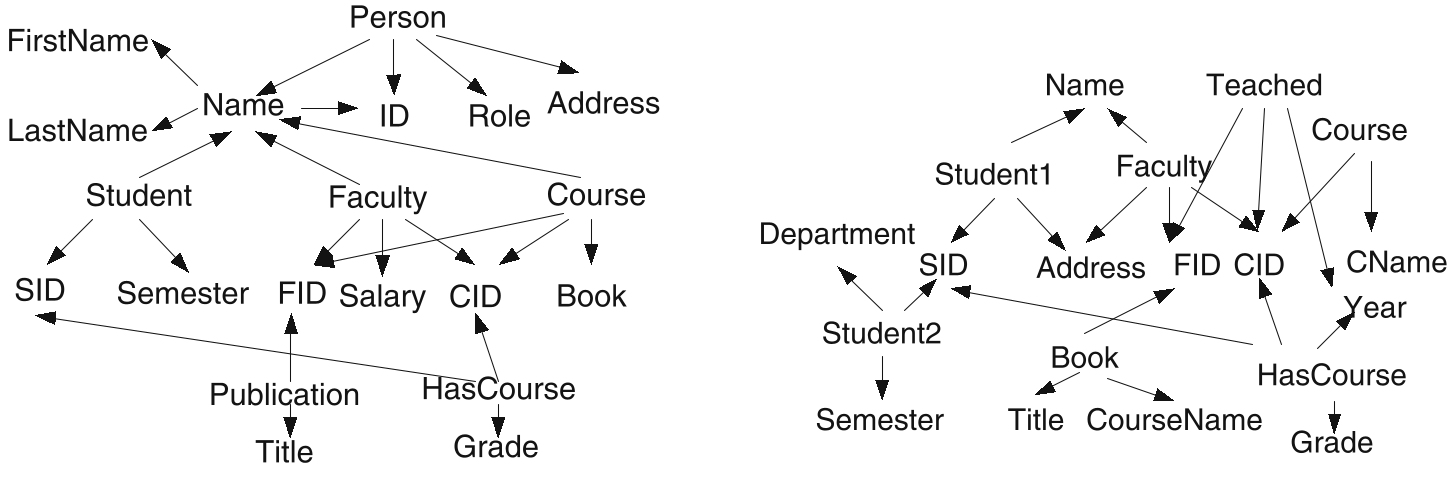 Figure: The merging of two university concept graphs using deduced correspondences.
3. Compression: The "Popularity" Filter
A raw merged graph can be massive. The authors introduce a compression algorithm that removes infrequent concepts. The rationale is professional and pragmatic: a global mediator should favor recall for popular concepts over the inclusion of rare, local details that only confuse new members.
Experiments & Critical Insights
The authors tested their method on Hospital and University datasets (100 schemas total).
Key Finding: As the network becomes more diverse (lower participant similarity), compression actually increases the quality of the global schema. By removing "outlier" tables, the mediating schema becomes a more accurate reflection of the "average" member's data.
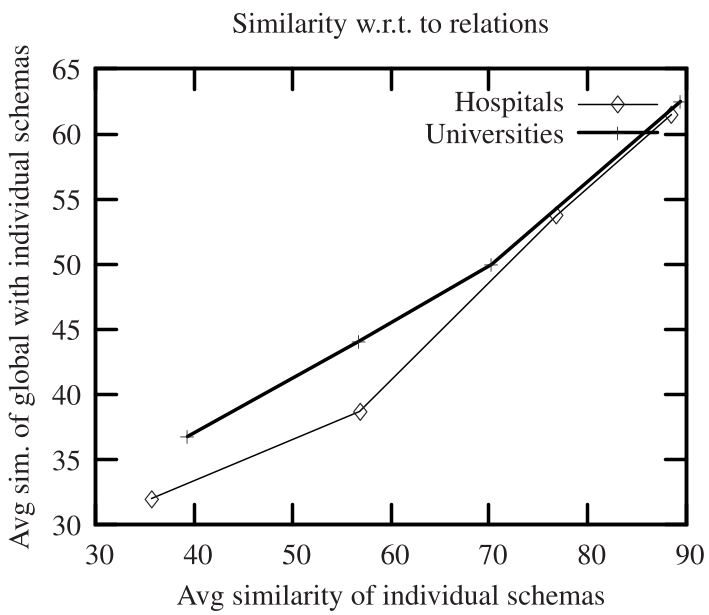 Figure: The gain and loss in similarity. Note how compressed schemas maintain higher similarity levels for dissimilar networks.
Internal Limitations
The system's accuracy is heavily dependent on the quality of initial mappings. As the authors admit, if a member mistakenly maps "CourseName" as a specialization of "Name" (implying names of people), the synopsis will inherit this "semantic drift."
Conclusion: A Bottom-Up Future
The value of this research lies in its Inductive Bias: it assumes that the network's global structure already exists implicitly in the local mappings and only needs to be "distilled." For modern engineers working on decentralized Web3 protocols or federated data meshes, this work provides an early, rigorous foundation for how we might build "self-organizing" data catalogs.
Takeaway for the reader: When building decentralized systems, don't force a global schema. Build tools to let the global schema emerge from the local interactions.