
Decoding Social Influence: Concise Network Representation via Flow Hierarchy
A Concise Social Network Representation with Flow Hierarchy Using Frequent Interactions
This paper introduces a novel framework for creating concise social network representations by extracting impactful users through frequent interactions and organizing them into a flow hierarchy. The authors propose two methods—Heuristic-based Edge Traversal and Agony Minimization—to derive Directed Acyclic Graphs (DAGs) that identify functional roles like leaders, disseminators, and followers.
TL;DR
Social networks are massive and noisy. Most users are "lurkers," while a few drive the conversation. This paper proposes a method to strip away the noise by focusing on frequent interactions over time and organizing the "impactful" users into a Flow Hierarchy. The result is a concise, DAG-based representation that reveals hidden leaders and information bottlenecks that traditional metrics like PageRank might overlook.
Background Positioning
In the landscape of Network Science, this work moves beyond simple centrality-based ranking (Order Hierarchy) toward Flow-based Hierarchy. It bridges the gap between temporal data mining and structural graph analysis, offering a practical way to compress massive graphs without losing their core influence dynamics.
The Problem: The Noise of Spontaneous Popularity
Global social networks are growing too fast for traditional analytics. Most current user-ranking algorithms suffer from two fatal flaws:
- Computational Bloat: They try to process every single interaction, most of which are insignificant "one-offs."
- Snapshot Bias: They value raw numbers (like total retweets) but ignore persistence. A spam bot might get 10,000 retweets in an hour and appear "impactful," whereas a true thought leader maintains a steady flow of interaction over years.
The authors argue that interaction frequency—the number of distinct time frames in which two users interact—is a better proxy for impact than total volume.
Methodology: From Chaos to Hierarchy
The authors propose a two-stage pipeline: Filtering and Structuring.
1. Extracting Impactful Interactions
They divide the interaction log into time frames (e.g., days for Twitter, years for Citations). Only user pairs that interact across a minimum number of time frames () are kept. This exploits the Power Law distribution: a tiny fraction of users generates the majority of "long-term" interaction.
2. Deriving the Hierarchy
Since social networks contain cycles (A retweets B, B retweets A), they aren't naturally hierarchical. The paper presents two ways to force a Directed Acyclic Graph (DAG):
- Heuristic-based Miner: A greedy approach that sorts interactions by support and weight, building the hierarchy level-by-level based on the strongest paths.
- Agony-based Miner: Based on the concept of "Agony Minimization," this method assigns ranks to users such that the "pain" (edges going from a higher rank to a lower rank) is minimized.
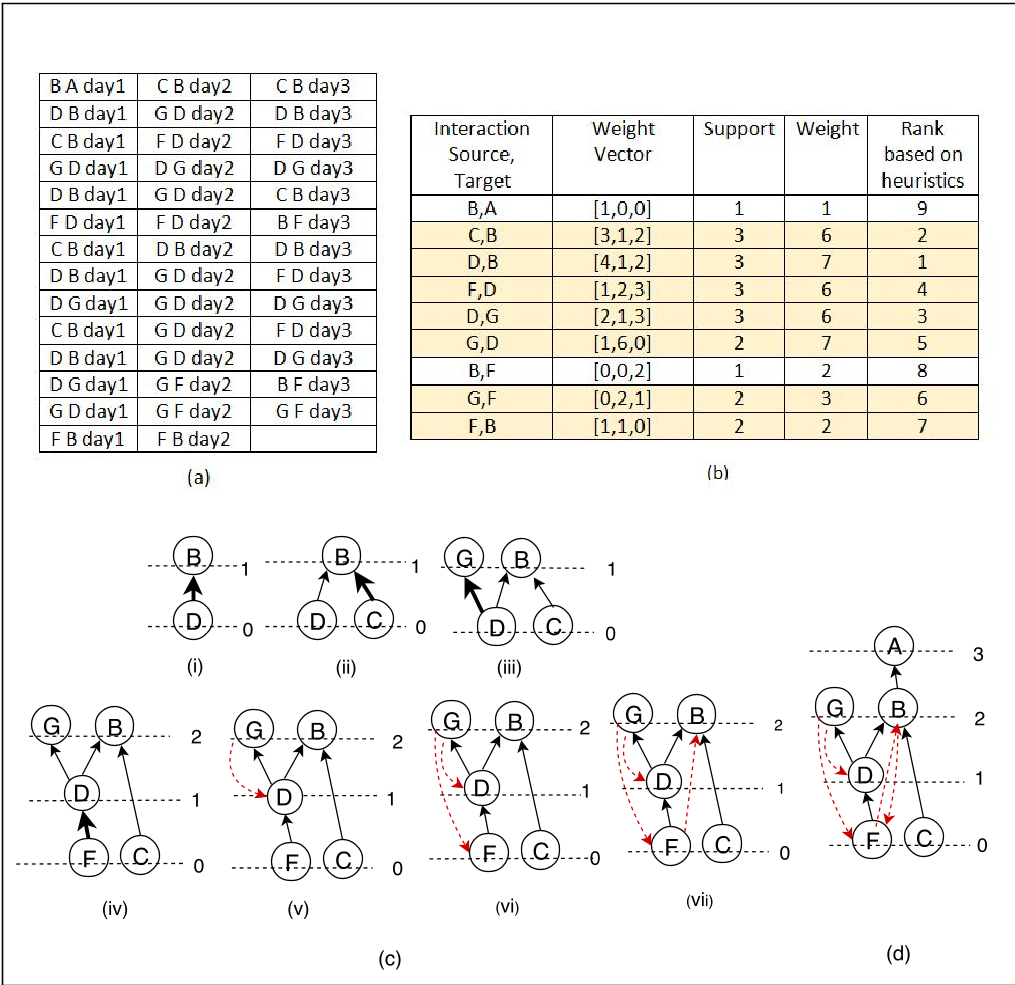 The figure above illustrates how raw time-stamped interactions are filtered by frequency and then structured into a clear, tiered hierarchy.
Experiments: Quality over Quantity
The researchers tested their methods on three datasets: Citations (Academic), RT-NMD (Retweets on debt claims), and RT-ME (Retweets on marriage equality).
Key Insight: The "Hidden Leader"
In the Citation network, the hierarchy often aligned with the H-index. However, it revealed fascinating anomalies: authors with a low H-index who appeared at the top of the hierarchy. Why? Because they were being cited by established "superstars" frequently. These are emerging leaders—a insight that a flat H-index list could never provide.
Quantitative Success
- Conciseness: By setting a high frequency threshold (), they removed up to 99% of nodes in retweet networks.
- Coverage: Despite this massive reduction, the remaining "leaders" at the top of the hierarchy were still reachable from over 60% of the original network.
 Table IV shows how Flow Hierarchy levels provide a more nuanced view of roles (IT Consultant vs. Journalist) than raw PageRank or Hub scores.
Critical Insight & Conclusion
This paper's core contribution is the shift from Global Statistics to Localized Flow. By focusing on the consistency of pairwise interactions, the authors effectively "denoise" the social graph.
Takeaways:
- For Marketers: Don't just look for high-follower accounts; look for the "Information Disseminators" in the middle levels of a flow hierarchy who bridge different clusters.
- For Researchers: Flow hierarchy is a powerful tool for discovering functional roles (initiators vs. followers) in any directed network.
Limitations: The choice of time frame () and threshold () is still somewhat heuristic. While the authors propose an automated method, domain knowledge remains critical to ensuring the hierarchy reflects "meaningful" interaction rather than just scheduled system pings.
Future Work: The authors aim to integrate this concise representation into Role Mining algorithms, which could revolutionize how we identify stakeholders in disaster management or political campaigns.