
CO2Jump: Achieving "Thinking-while-Drawing" via Coupled Markov Jump Processes
Concurrent Image Understanding and Generation: Self-Correcting Coupled Markov Jump Processes
The paper introduces Self-Correcting Coupled Markov Jump Processes (SC-CMJP), a framework for concurrent image understanding and generation using Masked Diffusion Models (MDMs). By employing the training-free CO2Jump sampler, the system achieves synchronized multimodal generation where text reasoning and image synthesis actively negotiate and self-correct through cross-modal attention.
TL;DR
Human teachers don't just speak and then draw; they do both simultaneously, each modality refining the other. CO2Jump (Self-COrrecting COupled Jump) brings this synergy to AI. By treating image and text generation as a Coupled Markov Jump Process, the model can revise its text reasoning if the image doesn't fit, and vice versa. This training-free sampler outperforms existing methods in image editing and complex visual reasoning (like solving Nonograms and Mazes).
The "Modality Drift" Problem
Current Masked Diffusion Models (MDMs) are great at parallel generation, but they suffer from a fatal flaw: Independence. During the denoising process, the text branch might decide to describe a "blue car," while the image branch starts rendering a "red truck."
- Interleaved Isolation: Most samplers only look at the previous step's history. They don't know what the other modality is deciding right now.
- Irreversibility: In standard MDMs, once a token is "unmasked" (committed), it's stuck. There is no way to take it back if a contradiction is discovered later.
Methodology: The Core of SC-CMJP
The researchers reimagined the reverse diffusion process as a unified birth-death system. Instead of simply revealing tokens, they allow them to "die" (be remasked) based on Coupled Confidence.
1. The Chain-Rule Factorization
The secret sauce is how the model calculates the probability of the next state. Instead of , they split it into:
- Text Update: Based on current self-confidence.
- Image Update: Conditioned on the latest text decisions within the same step.
2. Cross-Modal Negotiation & Dynamic Trust
To avoid expensive second forward passes, CO2Jump uses the model's own cross-modal attention to propagate confidence.
- Gate: An entropy-based gate determines who to trust. If the image is chaotic (high entropy), it defers to the text ().
- Coupled Score: The image tokens are scored by a mixture of their own belief and what the text "thinks" about that specific spatial location.
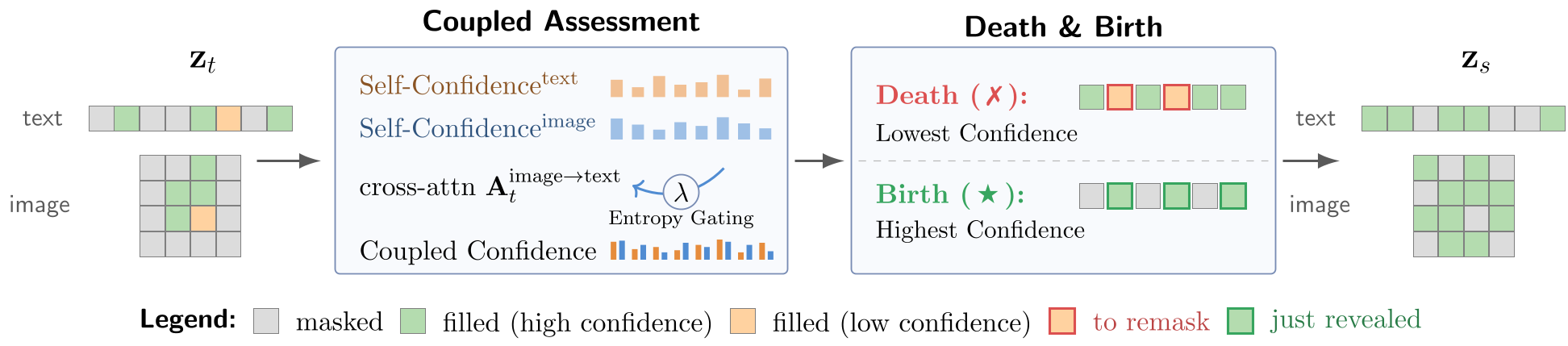 Figure 1: The CO2Jump sampler logic. Note how text confidence is propagated to image positions via attention to create a unified score.
Experimental Breakthroughs
The authors tested this on three massive new datasets: JEdit-1M (Editing), JMaze-200K, and JNono-200K.
Visual Reasoning: Solving Logic Puzzles
In Mazes and Nonograms, text and image are logically interlocked. CO2Jump was the only sampler where the text's coordinate path matched the image's blue line perfectly. Baselines often had the text solve the puzzle correctly while the image branch "hallucinated" a different path.
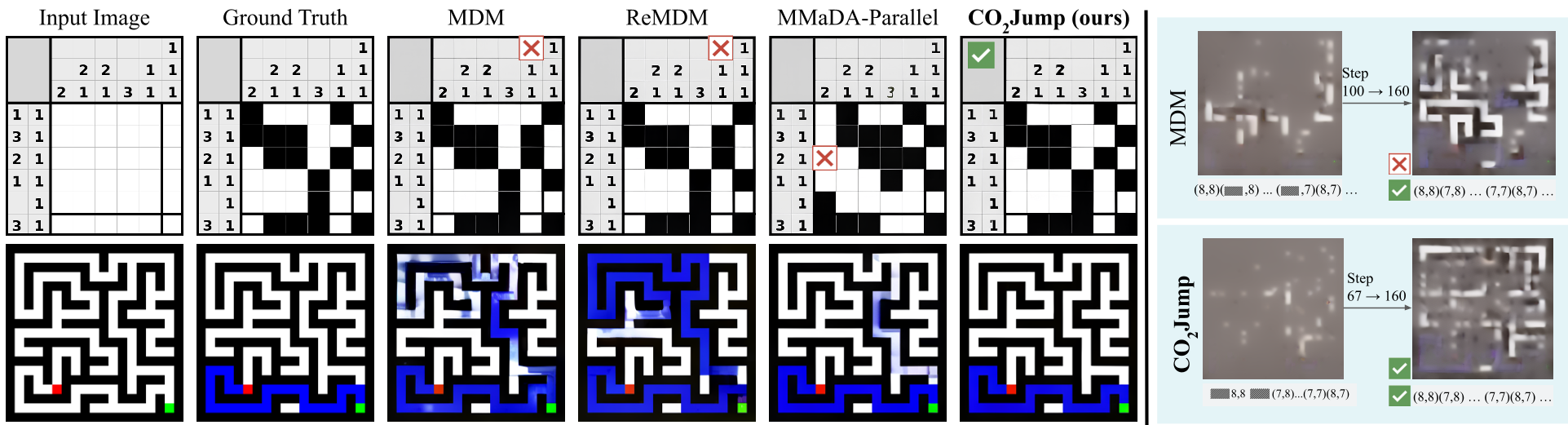 Figure 2: Qualitative samples. Unlike baselines (marked with red Xs), CO2Jump satisfies all logical constraints in Nonograms and Mazes.
Scaling and Ablation
A key finding is that CO2Jump scales monotonically. While other samplers hit a ceiling or even get worse with more denoising steps (NFE), CO2Jump keeps improving because the cross-modal coupling compounds its benefits over time.
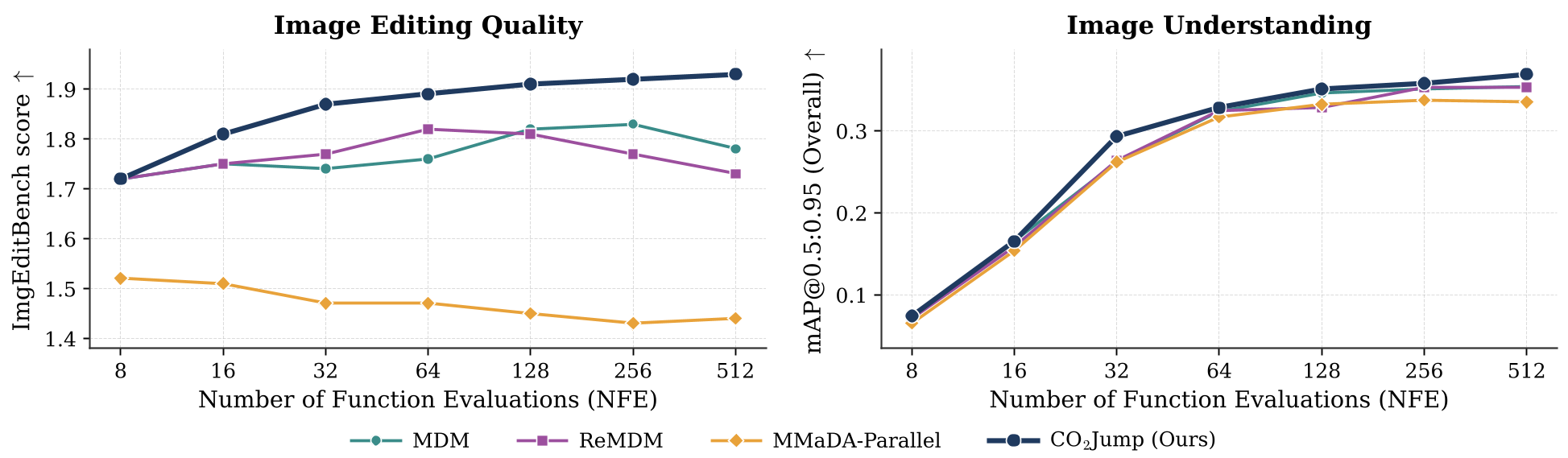 Figure 3: Performance vs. Denoising Steps. CO2Jump (blue) is the only method that doesn't plateau at high NFE.
Critical Insight: Why it Works
The "Self-Correction" (Remasking) is the hero here. The authors tracked where the "Death Jumps" occurred. They found a significant "hotspot" where the image was locally confident but the text branch disagreed. In these moments, CO2Jump kills the conflicting image tokens and regenerates them to align with the text reasoning. This is the first time a sampler has used cross-modal contradiction as a trigger for self-correction.
Conclusion & Future Outlook
SC-CMJP proves that we don't need a separate "Verifier" model to fix multimodal errors. The signals are already inside the frozen Transformer—we just need the right stochastic process to extract them. While this paper focuses on text and images, the framework is modality-agnostic. We could soon see this applied to synchronized video-audio generation or real-time robot trajectory planning where "thinking" and "acting" are truly coupled.