
The paper introduces Conditional Diffusion Sampling (CDS), a training-free framework for sampling from unnormalized multimodal distributions. It combines Parallel Tempering (PT) with a novel "Conditional Interpolant" mechanism, achieving state-of-the-art (SOTA) performance across diverse benchmarks including molecular dynamics and Bayesian Neural Networks.
TL;DR
Conditional Diffusion Sampling (CDS) is a new paradigm for sampling from complex, unnormalized distributions. It bypasses the "training bottleneck" of typical diffusion samplers by using Conditional Interpolants—a mathematical trick that provides closed-form transport dynamics. By combining the global search capability of Parallel Tempering with the local precision of SDE integration, CDS sets a new SOTA for sampling efficiency in tasks ranging from molecular peptide folding to Bayesian Neural Networks.
Problem & Motivation: The Gap Between MCMC and Diffusion
In the machine learning and physical sciences landscape, we often need to sample from a density that we can evaluate but cannot normalize (e.g., the Boltzmann distribution of a protein).
Historically, we have had two choices:
- Parallel Tempering (PT): Robust but sensitive to the "overlap" between distributions. If the target is too different from the reference, becomes sluggish.
- Diffusion/Flow Samplers: Extremely fast at inference but require a massive "up-front" cost to train a neural network to learn the score function of the target.
The authors of CDS asked a brilliant question: Can we get the continuous transport benefits of diffusion without the training cost of neural networks?
Methodology: The Power of Conditional Interpolants
The core innovation is the Conditional Interpolant. Instead of trying to learn the marginal score of a diffusion process (which is hard and requires training), CDS conditions the process on a reference point .
1. The Closed-Form Advantage
By defining a map (like a linear interpolation ), the authors derived a transport SDE where the drift and score terms are exact and closed-form. You don't need to train a model; you just plug in the gradient of your target log-density.
2. The Two-Stage Workflow
As shown in the architecture below, CDS doesn't start at (where a singularity exists).
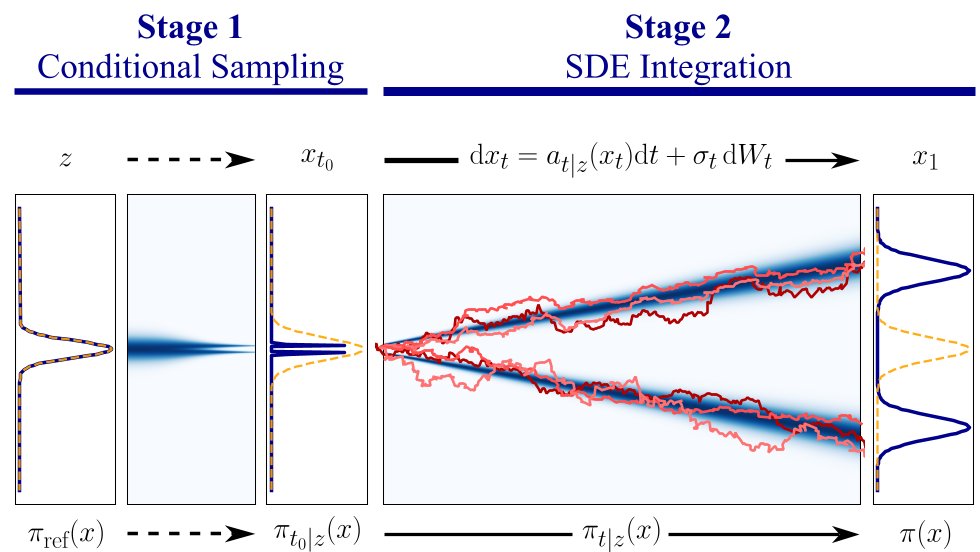
- Stage 1 (Global Exploration): Use PT to sample an intermediate distribution at a very small time . Becuase this distribution is highly concentrated around the reference point , PT is incredibly efficient at swapping and exploring modes.
- Stage 2 (Local Refinement): Use the exact SDE to "push" those samples from to the final target at . This stage acts as a continuous corrector, refining the samples into high-density regions.
Experiments: Superior Trade-offs
The researchers tested CDS against heavyweights like Non-Reversible PT (NRPT) and Diffusive Gibbs Sampling (DiGS) across tasks like Alanine Dipeptide (molecular dynamics) and high-dimensional Bayesian Neural Networks (D=550).
Performance Highlights
- Accuracy: On the Alanine Dipeptide task, CDS was one of the only methods to correctly capture the metastable modes within a strict computational budget.
- Efficiency: In the Bayesian Neural Network task, CDS provided significantly lower test NLL compared to standard HMC and MALA, proving its ability to navigate complex, high-dimensional posterior landscapes.
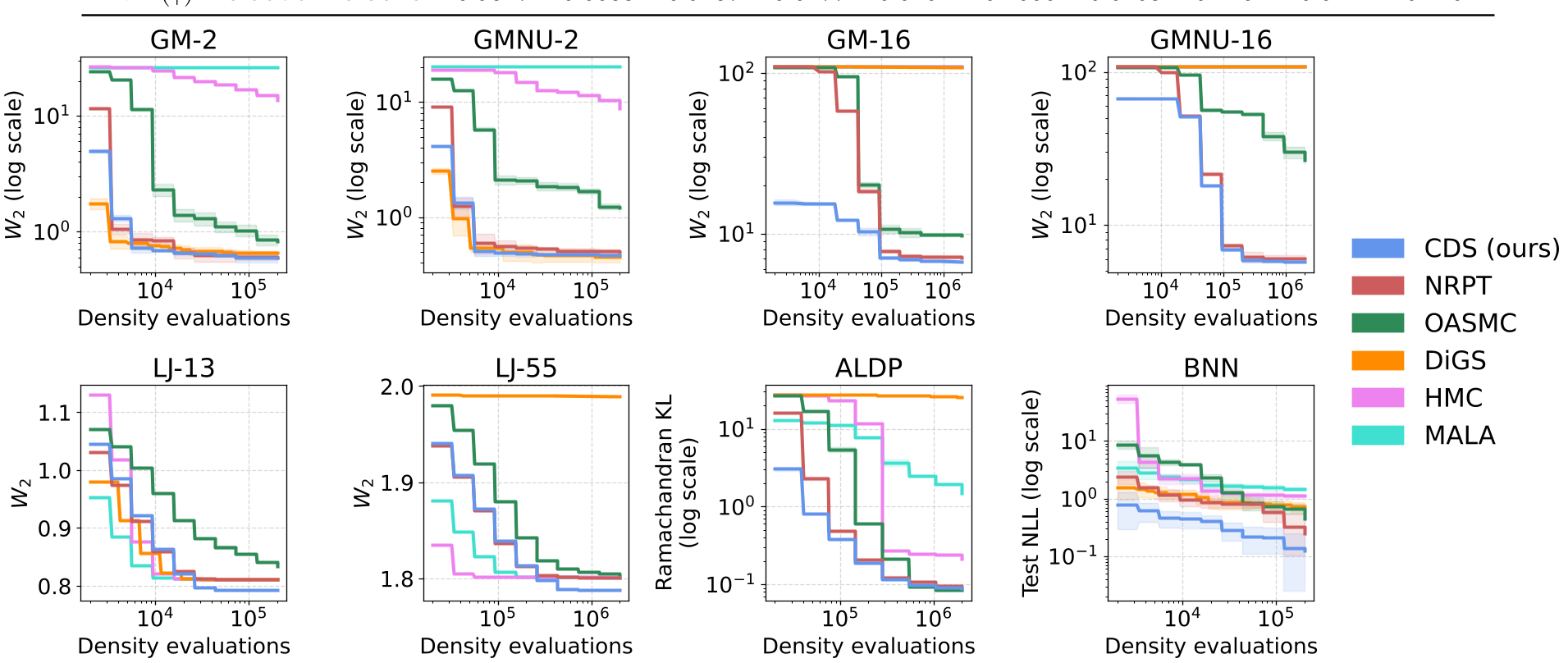
As shown in the Pareto fronts above, CDS (blue line) consistently stays at the "bottom-left"—meaning it achieves lower error (W2 distance/NLL) for the same number of density evaluations compared to competitors.
Critical Analysis & Conclusion
CDS is a sophisticated "Best of Both Worlds" approach. It uses the global mixing of MCMC to solve the initialization problem of diffusion, and uses the local transport of diffusion to solve the mixing bottleneck of MCMC.
Takeaway: The reliance on a linear interpolant is a current limitation; for systems with extreme singularities (like certain molecular potentials), the linear path might be suboptimal. However, the framework itself is interpolant-agnostic. Future work designing geometry-aware interpolants could make CDS the definitive tool for scientific sampling.
Paper: Conditional Diffusion Sampling (2025). Authors: Castro-Macı́as et al.