
Conference Live: Turning Static Semantic Data into a Living Social Ecosystem
Conference Live: Accessible and Sociable Conference Semantic Data
This paper introduces "Conference Live," a semantic Web and mobile application designed to enhance academic conference experiences by leveraging Linked Data from the Semantic Web Dog Food (SWDF) server. The system uniquely integrates real-time social media streams, a crowdsourced feedback mechanism, and a transparent voting system for conference awards.
TL;DR
The academic community produces vast amounts of metadata, yet conference experiences often remain analog and disconnected. Conference Live is a semantic platform that consumes Linked Data to provide attendees with interactive schedules, real-time Twitter integration via paper-specific hashtags, and a digital voting system that eliminates the manual "paper-in-the-box" approach for conference awards.
Background: Eating Our Own Dog Food
In the Semantic Web community, "eating your own dog food" refers to the practice of using semantic technologies to manage the community's own data. While the Semantic Web Dog Food (SWDF) server acts as a repository for papers and authors, the actual experience of a conference—the buzz on Twitter, the feedback in the hallways, and the voting for best posters—has historically stayed trapped in silos. Conference Live aims to solve this by creating a "Social Semantic" layer on top of existing datasets.
Methodology: Extending Ontologies and Analyzing Sentiment
The core of the system relies on a robust semantic foundation. The authors didn't just use existing ontologies; they extended the Semantic Web Conference (SWC) Ontology to meet new requirements:
- Hashtag Association (R1): Linking specific Twitter hashtags to unique paper URIs.
- Sentiment Feedback (R2): Capturing natural language feedback and processing it through a Sentiment Analysis Module (SAM).
- Verified Voting (R3): Implementing a "one vote per person" policy using unique secret codes stored in a dynamic triple store.
The Sentiment Analysis Pipeline
The SAM module is particularly interesting. It calculates a polarity score by averaging results from two lexical resources:
- SenticNet: For affective/semantic values.
- SentiWordNet: For objective vs. subjective scores.
 Figure 1: The user interface facilitates browsing and real-time interaction.
Real-World Use Case: ESWC 2014
The system was battle-tested at the 11th Extended Semantic Web Conference (ESWC 2014) in Crete.
Key Experimental Observations:
- Data Cleaning Hurdles: The authors found that reconciling person URIs is significantly difficult. For example, "Maribel Acosta Deibe" and "Maribel Acosta" had to be manually merged because automatic matching for multi-part surnames is prone to error.
- Crowdsourcing Terminology: The feedback system allowed the collection of a "validated terminology" for academic sentiment. Common descriptors like "cool" (positive) and "boring" (negative) were mapped to polarity scores to help train future sentiment models specifically for scientific papers.
- Social Metrics: By tracking the 172 paper-specific tweets, organizers could identify not just the most cited papers, but the most "talked about" ones in real-time.
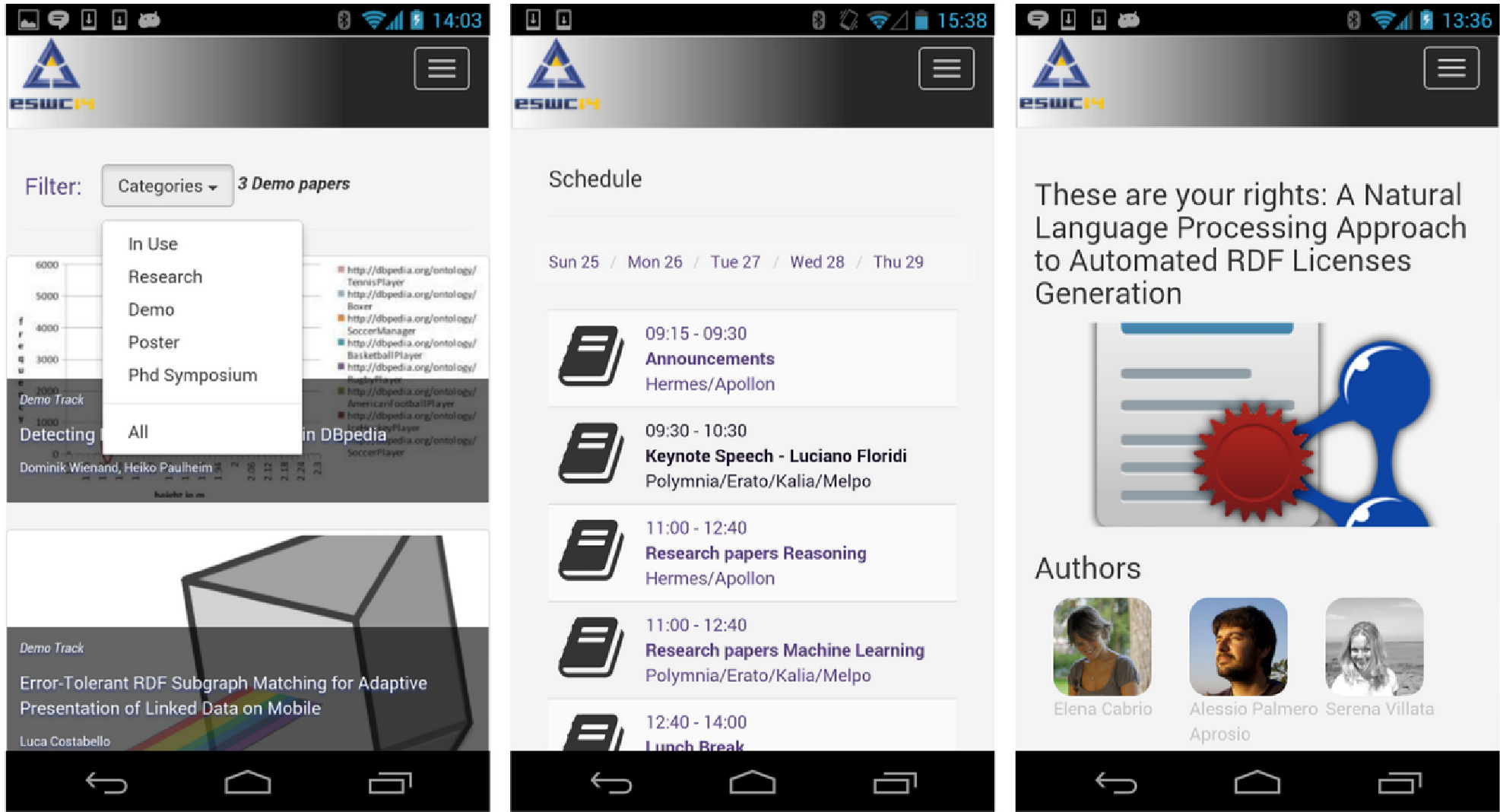 Figure 2: Screenshots showing the browsing and calendar view of the conference schedule.
Critical Analysis & Conclusion
Takeaway
Conference Live proves that semantic data is most valuable when it is actionable. By moving from a static "archive" of papers to a "live" interface for voting and social media, the authors increased the utility of the SWDF corpus.
Limitations
- Scalability: The Twitter API (V1.1) used at the time required manual creation of widgets for each paper, which is a bottleneck for larger conferences.
- Adoption: While successful, the 133 downloads suggest that advertising needs to begin much earlier in the conference cycle to ensure a statistically significant "crowd."
Future Outlook
The authors plan to incorporate more structured data providers and perhaps even venue mapping. As we head into an era of AI-driven conferences, the "validated terminology" collected here serves as an early precursor to fine-tuning LLMs for academic sentiment analysis.