
CA-EM: Why "Confidence" is the Secret Sauce for Truth Discovery in Social Media
Confidence-aware truth estimation in social sensing applications
The paper introduces a Confidence-Aware Maximum Likelihood Estimation (CA-EM) framework for truth estimation in social sensing. By explicitly modeling varying degrees of source confidence using an Expectation-Maximization (EM) algorithm, the method significantly improves the accuracy of identifying true claims and assessing source reliability in unvetted data environments like Twitter.
TL;DR
In the chaotic world of social sensing—where thousands of unvetted Twitter users act as "human sensors"—determining what is actually true is a nightmare. This paper introduces the CA-EM (Confidence-Aware Expectation Maximization) framework. Unlike previous models that treat every tweet from a user with the same weight, CA-EM listens to how a user reports information. By integrating source confidence into a rigorous mathematical model, it boosts truth estimation accuracy by up to 30% over traditional methods.
The Problem: The "Flat Reliability" Fallacy
Most truth discovery algorithms operate on a simple assumption: if Source A is 70% reliable, every claim they make is treated with 70% trust.
However, human sensors are nuanced. Consider two tweets:
- "I am standing right in front of the building; it is definitely on fire!"
- "I think I heard someone say there's a fire, but I'm not sure."
If we treat these as identical data points, we lose critical information. The "flat reliability" assumption is a bottleneck that leads to high false positives, especially in high-stakes scenarios like disaster response or manhunts.
Methodology: Modeling the "Shades of Certainty"
The authors propose a Confidence-Aware Maximum Likelihood Estimation approach. The core innovation lies in the transition from a simple Sensing Matrix to a dual-structure involving a Confidence Matrix ().
The Mathematical Intuition
The framework treats the "truth" of an event as a latent (hidden) variable (). Using the Expectation-Maximization (EM) algorithm, the model iteratively guesses:
- E-Step: Given the current reliability of sources, how likely is this specific claim to be true?
- M-Step: Given the estimated truth of the claims, how reliable is this source when they express a specific degree of confidence ?
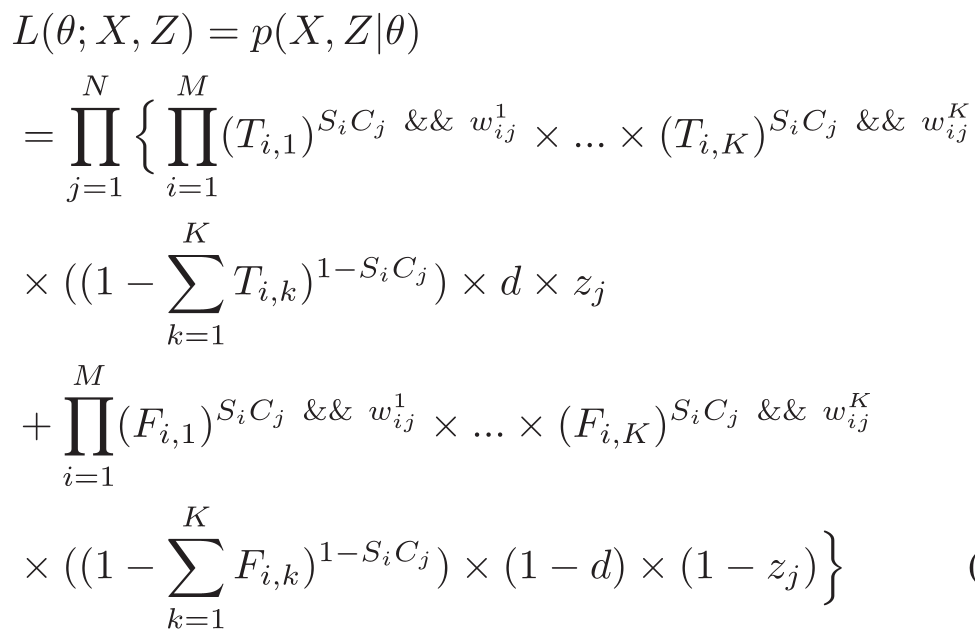 The Likelihood Function above shows how the model combines source reporting () with specific confidence levels () to calculate the overall probability.
Experiments: Real-World Battle Testing
The researchers didn't just stay in the lab. They tested CA-EM against three massive real-world datasets:
- Boston Marathon Bombing
- Hurricane Sandy
- Egypt Unrest
They used "heuristics" to define confidence in the real world. For example, an original tweet with a URL was marked as "High Confidence," while a retweet without a link was "Low Confidence."
SOTA Results
The results were striking. In the Egypt Unrest trace, CA-EM identified 30% more true claims than the previous state-of-the-art "Regular EM" model.
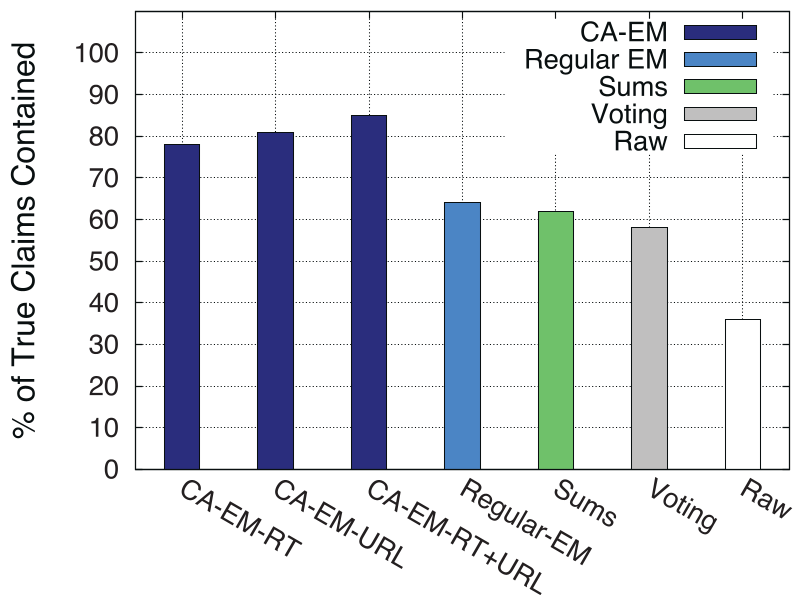 Figure 5 illustrates the CA-EM schemes (CA-RT, CA-URL, CA-Combo) consistently suppressing unconsolidated claims while surfacing true information.
Critical Insight: Beyond Binary Truth
The brilliance of this work is that it turns a subjective human trait—confidence—into a objective weight in a MLE framework.
Key Takeaways for the Future:
- Source Dependency: The authors admit that human sensors often "copy" each other (retweeting). Future versions of CA-EM will need to account for social network topology to avoid "echo chamber" effects.
- NLP Integration: While this paper used simple markers (URLs/RTs), the next frontier is using LLMs or sentiment analysis to extract confidence directly from the semantic tone of the text.
Conclusion
CA-EM proves that in the age of "alternative facts" and social media noise, the reliability of information isn't just about who is talking, but the certainty they project. By mathematically encoding this confidence, we can turn a chaotic stream of tweets into a high-precision sensor network.