
Trusting the Messenger: Why Your Friends Make You Trust Big Tech
The Confidence in Social Media Platforms and Private Messaging
This study investigates the sociological predictors of user confidence in social media platforms for private messaging, utilizing a representative sample of Finnish users (N=3,724). It identifies "social resources"—specifically network size and trust in social ties—as the primary drivers that alleviate privacy concerns and bolster platform confidence.
TL;DR
Why do we keep using platforms that leak our data? A study of 3,724 Finnish users reveals that our confidence in social media platforms isn't built on their security protocols—it's borrowed from the people we message. The larger your network and the more you trust your friends, the more likely you are to trust the platform, regardless of your technical privacy skills.
The "Parasite" in Your Pocket: The Motivation
In the wake of scandals like Cambridge Analytica, the logical response would be a mass exodus from social media. Yet, platforms like Facebook and WhatsApp remain dominant. The authors of "The Confidence in Social Media Platforms and Private Messaging" argue that we shouldn't view platforms as static containers, but as parasites that thrive on "social noise."
The core insight is that platforms aim for invisibility. When we use a private messaging service to share a secret, the social distance between us and our friend shrinks. In that moment of intimacy, the "channel" (the platform) becomes a transparent bridge. If the bridge works, we stop looking at its structural integrity.
Methodology: Measuring the Invisible
To quantify this phenomenon, the researchers analyzed data from a nationally representative survey of Finns aged 15–74. They focused on two "social resources":
- Network Size: The number of friends and acquaintances.
- Interpersonal Trust: How much the user trusts those specific connections.
They then tested these against behavioral variables like privacy skills (e.g., knowing how to use Incognito mode) and social media skills.

Core Findings: The Social Buffer
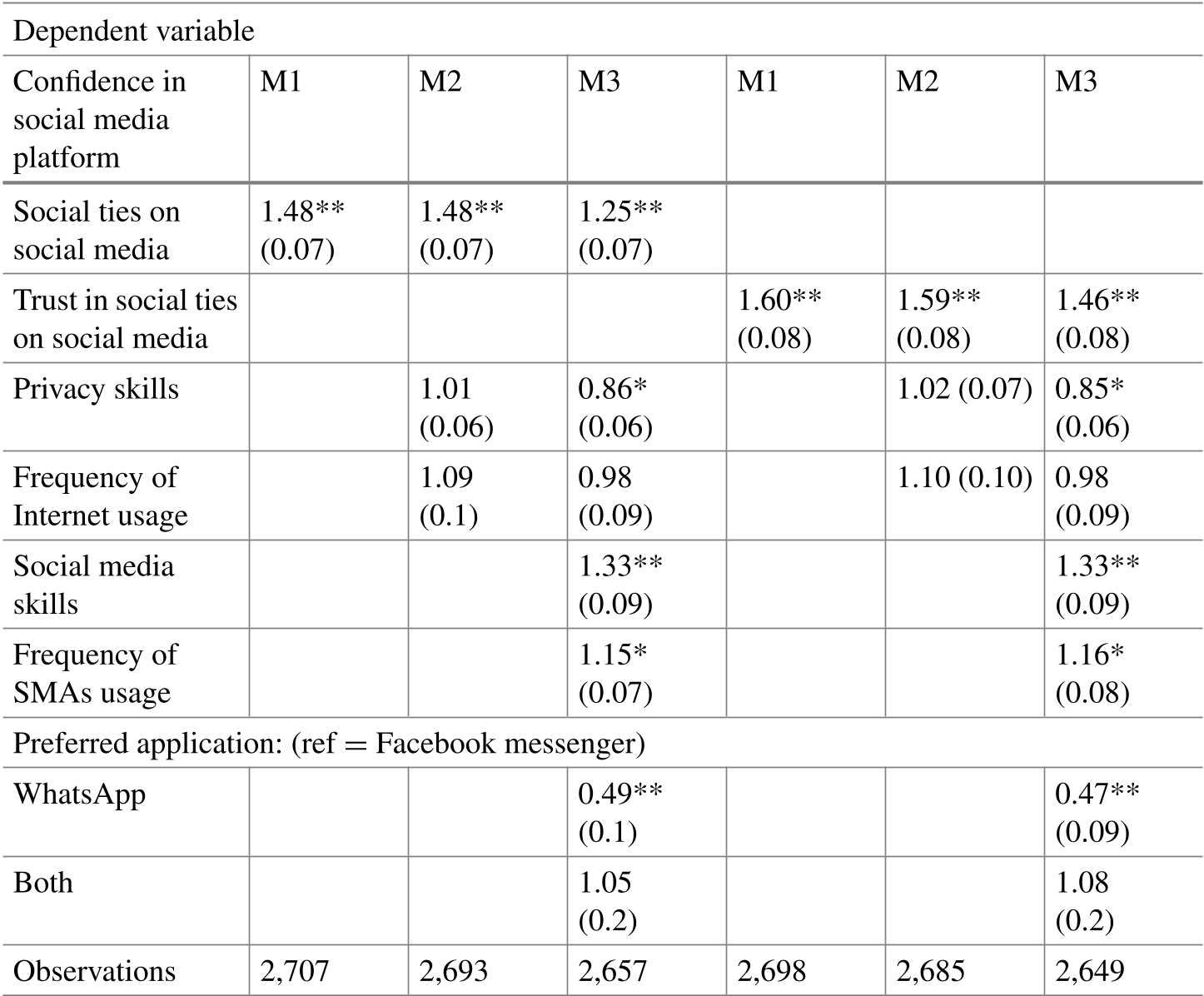
The study’s results (Table 2 & 3) present a fascinating look at the "socialization" of trust:
- Trust is Infectious: If you trust your social ties, your probability of trusting the platform to keep your messages private increases significantly (OR = 1.60).
- The Literacy Irony: Users with higher privacy skills actually demonstrated lower confidence in platforms. Knowing how the "parasite" works makes you more wary of it.
- WhatsApp vs. Messenger: Users who preferred WhatsApp over Facebook Messenger generally reported lower trust in the "platform ecosystem," likely due to WhatsApp's marketing focus on end-to-end encryption, which brings the "parasite's" existence (and its mitigation) to the forefront.
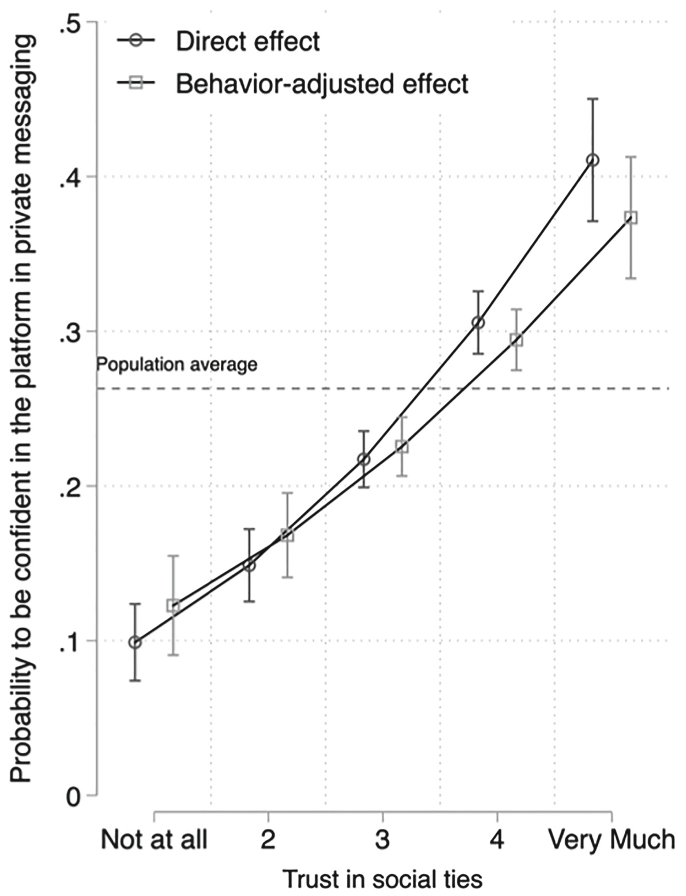 Fig 1: The probability of platform confidence scales linearly with the size of your social network and the trust you place in those ties.
Detailed Results (Quantitative Analysis)
The KHB mediation analysis proved that social factors aren't just secondary—they are primary drivers. Frequency of messaging application (SMA) usage confounded 13% of the effect of network size on trust. This suggests that the more we act out our friendships online, the more "mundane" and "safe" the platform feels.
Critical Insight: The "Hermes" Effect
The authors conclude that social media platforms function like the Greek god Hermes—the messenger who stands between two parties. As long as the flow of energy (messages, secrets, photos) remains uninterrupted, the user occupies the position of a "host" who doesn't mind the "parasite" draining their data.
The Takeaway for the Future: Platforms don't need to prove they are trustworthy; they only need to facilitate trustworthy social interactions. If the "noise" of your social life is loud enough, you won't hear the platform's privacy settings changing in the background.
Limitations
- Timeline: The data was collected just before the 2018 peak of Facebook's privacy controversies.
- Causality: As a cross-sectional study, it cannot definitively prove if high trust causes high usage or if high usage leads to a normalization of trust.
Conclusion
This research shifts the conversation from Institutional Trust (trusting Google/Meta) to Networked Trust (trusting your friends on Google/Meta). It reveals that the "Social" in Social Media is the ultimate defense mechanism for platform survival.