
Beyond the Linear Trade-off: A Configurational Look at the Privacy Calculus
Calculus interdependency, personality contingency, and causal asymmetry: Toward a configurational privacy calculus model of information disclosure
This study proposes a Configurational Privacy Calculus Model (CPCM) to explore information disclosure behavior on Social Networking Sites (SNS). Using Fuzzy-set Qualitative Comparative Analysis (fsQCA), it identifies multiple causal pathways (configurations) involving perceived benefits, privacy risks, and personality traits (BAS/BIS) that lead to high or low disclosure.
TL;DR
Why do people share private life details on SNS even when they know the risks? This paper argues that the traditional "Benefit minus Risk" formula is too simplistic. By introducing the Configurational Privacy Calculus Model (CPCM) and testing it with 529 WeChat users, the researchers prove that disclosure depends on the combination of specific benefits (social, self-expression, documentation) and personality traits (BAS/BIS). Crucially, they show that high and low disclosure follow completely different logical paths (causal asymmetry).
The "Privacy Paradox" and the Failure of Linear Models
For decades, the Privacy Calculus Model (PCM) has been the gold standard for understanding disclosure. It views humans as "rational accountants" who weigh benefits against risks. However, empirical results have been inconsistent.
The authors identify three major blind spots in traditional models:
- Calculus Interdependency: Benefits and costs don't work in isolation. A massive benefit can "neutralize" a high risk.
- Benefit Substitution: You don't need all benefits to share; for some, "social reward" is enough to ignore the lack of "life documentation."
- Personality Contingency: Some people are naturally wired to chase rewards (Behavioral Activation System - BAS), while others are wired to avoid punishment (Behavioral Inhibition System - BIS). This changes the "weights" they assign to the calculus.
Methodology: The Shift to fsQCA
Instead of using Structural Equation Modeling (SEM) to find the "average" effect of a variable, the authors used Fuzzy-set Qualitative Comparative Analysis (fsQCA). This allows them to identify "recipes" (configurations) of conditions that lead to the same outcome—a concept known as Equifinality.
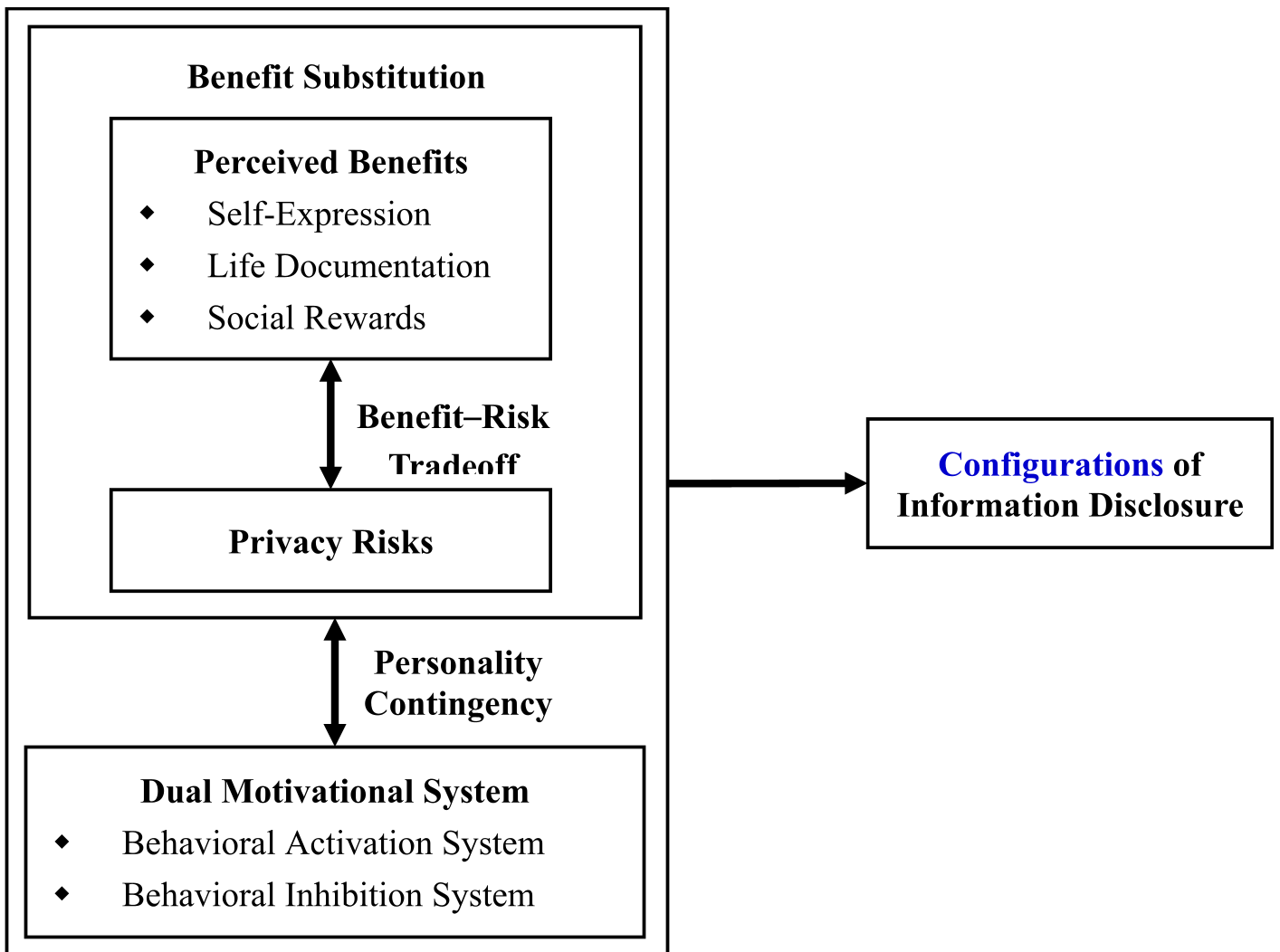
Key Findings: The "Recipes" for Disclosure
1. High Disclosure Paths
The study found six solutions (SH1-SH6) for high disclosure.
- The "Pure Gain" Path: When any benefit is present and privacy risk is absent.
- The "Risk-Taker" Path (BAS Dominant): Even if privacy risks are high, users with high BAS (activation-hungry) will still disclose if they perceive high social rewards. The internal drive to seek social approval "overpowers" the fear of data leaks.
2. Low Disclosure Paths
Low disclosure isn't just the opposite of high disclosure. It follows Causal Asymmetry:
- The "Boredom" Path: If none of the three benefits (social, expression, documentation) are present, users won't share, even if the privacy risk is zero.
- The "Cautious" Path (BIS Dominant): If a user is high in BIS (inhibition-oriented), high privacy risks will stop them even if they see potential benefits.
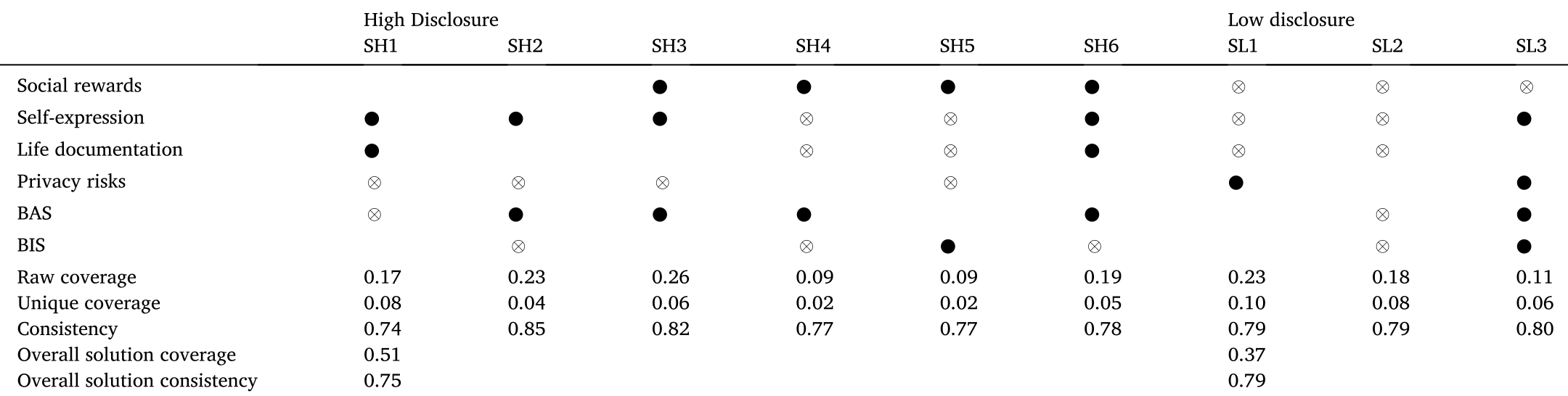
Quantitative Evidence
The measurement model showed high reliability (CR > 0.85). Interestingly, Social Rewards emerged as the most potent benefit—often able to compensate for risks on its own, whereas Life Documentation usually required the presence of other benefits to drive behavior.
Critical Insight & Industry Value
The paper’s biggest contribution is the Personality Contingency. It explains why "one-size-fits-all" privacy notices often fail.
- For Product Designers: Don't just reduce friction or risk; understand that for "Activation-oriented" users, highlighting social gains is more effective than mitigating fears. For "Inhibition-oriented" users, privacy guarantees are the literal "entry ticket" to engagement.
- Academic Impact: This moves PCM research from "Variance Thinking" (Factor A causes Outcome B) to "System Thinking" (Bundle A+B+C causes Outcome B).
Limitations
The study was conducted in China on WeChat Moments. Cultural context (collectivism vs. individualism) might influence the weighting of "Social Rewards." Furthermore, it measures intention rather than actual behavior, leaving room for the typical "intention-behavior gap" study in the future.
Summary
CPCM proves that the privacy calculus is a holistic, multi-path process. Whether success is defined as increasing disclosure or protecting users, we must look at the user's personality and the specific "benefit recipe" rather than just the privacy settings.