
The Conflict Spectrum: Mapping Geopolitics to the Cyber Battlefield
Conflict spectrum: An empirical study of geopolitical cyber threats from a social network perspective
This paper presents an empirical study investigating the correlation between geopolitical events and nation-state cyber threats using Social Network Analysis (SNA). By modeling state interactions as directed graphs and applying the Quadratic Assignment Procedure (QAP), the authors demonstrate that cyber activity patterns significantly mirror geopolitical dynamics.
TL;DR
Is cyber warfare just "politics by other means"? This paper explores this hypothesis by quantifying the link between physical geopolitical events and digital cyber threats. Using Social Network Analysis (SNA) and the GDELT dataset, the authors prove a high statistical correlation (0.73) between international friction and cyber attacks, suggesting that the digital domain is a direct mirror of physical world tensions.
Problem & Motivation: Beyond the Firewall
Most cybersecurity research is "low-level"—it examines code, protocols, and vulnerabilities. However, the motivation behind nation-state attacks remains a "black box" because such data is scattered across unstructured news reports and diplomatic cables.
The authors argue that we cannot understand cyber risk without looking at the geopolitical context. If State A and State B are in a trade war, will they also clash in cyberspace? This study moves away from technical signatures to focus on the strategic landscape, treating states as nodes in a global social network.
Methodology: Modeling Interdependent Systems
The core of this research involves converting millions of events into structural representations.
1. Network Construction
The researchers extracted over 4 million geopolitical events and 10,000 cyber events from the Global Data on Events, Location and Tone (GDELT) project. They constructed two directed, weighted graphs:
- Nodes: Sovereign States.
- Edges: Interactions (Cyber or Geopolitical).
- Weights: The frequency/redundancy of these interactions.
2. The QAP Advantage
Standard statistics (like OLS regression) fail on network data because nodes are interdependent—if you remove one state, the entire structure shifts. To solve this, the authors used the Quadratic Assignment Procedure (QAP). This non-parametric method randomizes the matrices multiple times to ensure the observed correlation isn't just a fluke of random noise.
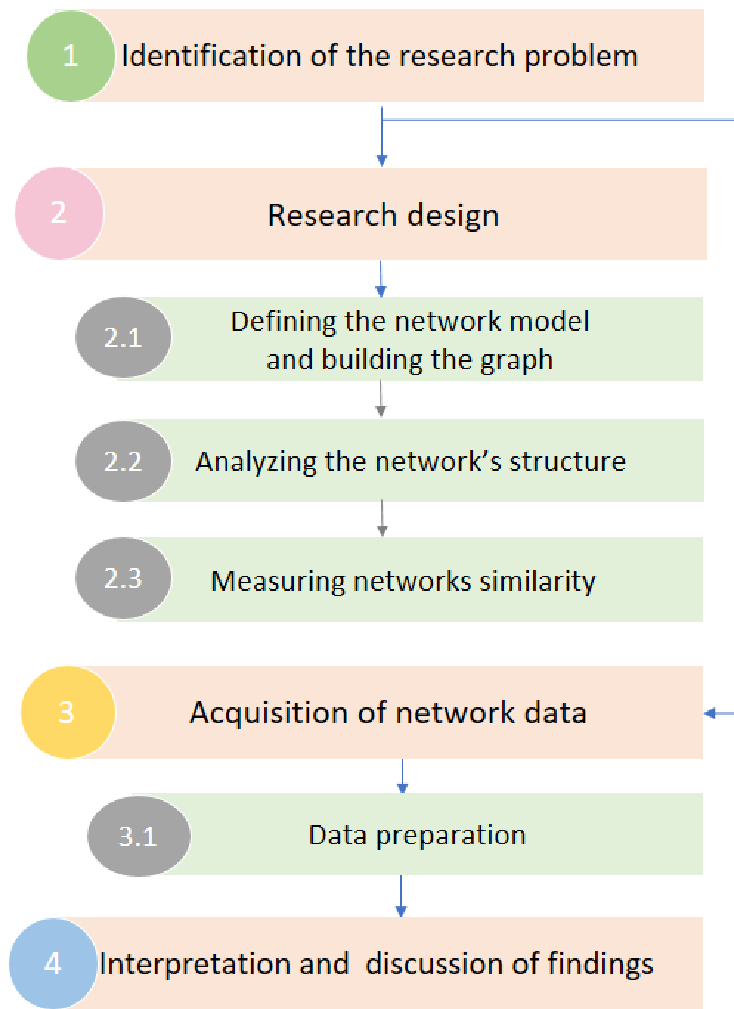 Figure 1: The research design involving model definition, structural analysis, and similarity measurement.
Experiments & Results: The Mirror Effect
By focusing on a central "State A," the authors analyzed its "ego network." The visualization shows clear overlaps: states that appear as major geopolitical neighbors also emerge as major cyber neighbors.
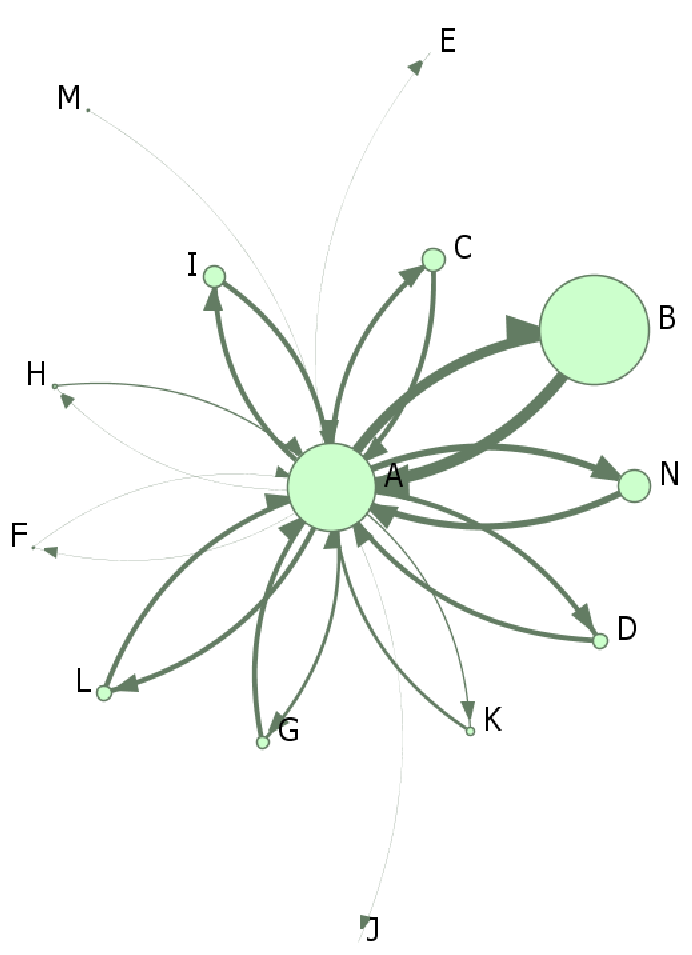 Figure 2: Representation of cyber connections showing actors like State B and C as high-activity nodes.
Key Findings:
- High Specificity: State B, the most significant geopolitical partner/rival of State A, was also the most significant cyber actor.
- Conflict Correlation: Most high-weight edges in the cyber graph corresponded to "Verbal Conflict" or "Material Conflict" tags in the CAMEO taxonomy (the coding system used by GDELT).
- Statistical Significance: A correlation of 0.73 with a significance of 0.03 confirms that the structure of the geopolitical graph is an excellent predictor of the cyber threat graph.
 Table 1: QAP Correlation results showing the 0.73 score.
Critical Analysis & Conclusion
Takeaway
The "Conflict Spectrum" is real. Cyber threats are not isolated technical incidents; they are part of a continuous spectrum of international relations. For practitioners, this means Threat Intelligence should include geopolitical monitoring—social science is now a cybersecurity discipline.
Limitations & Future Work
While the paper demonstrates correlation, it does not prove causality (e.g., does a cyber attack cause a diplomatic protest, or vice versa?). The authors aim to expand this to a "Macro-level" view in future work, covering thousands of nodes rather than just a focused ego-network of twelve states. They also suggest investigating the intensity of geopolitical events to see if there is a "threshold" at which diplomatic friction inevitably boils over into a cyber offensive.
By bridging the gap between social network science and cybersecurity, this work provides a framework for predicting digital storms by watching the physical horizon.