
Confluence: Visualizing Social Physics for Interactive Narrative
Confluence: visualizing social physics for interactive narrative
Confluence is an open-source, web-based development framework designed to integrate "social physics" engines (specifically the Ensemble Engine) with graphical game environments. It provides specialized tools for interactive social network visualization, automated strategy analysis, and real-time social rule authoring to facilitate emergent storytelling in games.
TL;DR
Confluence is a pioneering web-based framework that brings the rigor of physical simulations to the abstract world of human social interactions. By integrating the Ensemble Engine with real-time visualization tools, it allows developers to build games where narratives emerge organically from "social laws" rather than pre-written scripts.
Context: Beyond Scripted Dialogues
In the current landscape of game development, we have mastered Physical Physics—gravity, collisions, and fluid dynamics are handled by engines like Unreal or Unity. However, Social Physics—the complex web of relationships, cultural norms, and psychological traits—remains largely primitive, often trapped in rigid "dialogue trees."
The authors of Confluence argue that social reality should be modeled as explicitly as physical reality. The goal is to move from "special cases" to "general rules," enabling every playthrough to generate a unique, emergent story.
The Problem: The Invisibility of Social Data
The primary hurdle for social physics is two-fold:
- Integration: Existing engines like Ensemble are difficult to hook into modern graphical interfaces.
- Observability: Unlike a falling box, a breaking heart or a growing rivalry is invisible. Developers need a way to see the "social forces" at work to balance gameplay and debug AI logic.
Methodology: The Confluence Architecture
Confluence acts as a middleware that connects the social simulation layer with the graphical rendering layer. Its core innovation lies in its Social Analytics Suite:
- Interactive Graph Visualization: It maps characters as nodes and relationships as edges, allowing developers to see the "hidden order" of the game world in real-time.
- In-Game Authoring: Developers can modify social rules while the game is running, such as changing how a "personality trait" influences a character's reaction to an insult.
- Automated Strategy Searching: A tool that analyzes potential social moves to see if players can reach specific narrative goals, effectively "unit testing" the story logic.
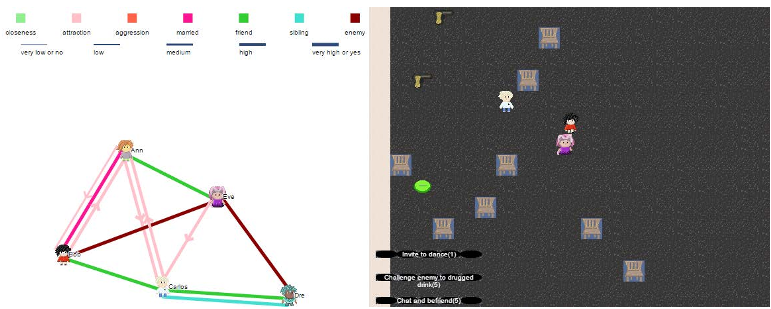 Figure 1: The dual-view interface showing the 3D game world alongside the underlying social network graph.
Experiments: "Party Time!"
To prove the framework's efficacy, the team developed "Party Time!". In this social puzzle game, the player doesn't use weapons; they use social engineering. By manipulating guests' relations and traits, the player must induce enough social discomfort to make guests leave.
The experiment demonstrated that when characters are governed by social norms (e.g., "you shouldn't be mean to friends") and personalities (e.g., "introverted guests get tired faster"), the game creates complex, unscripted scenarios that feel "alive."
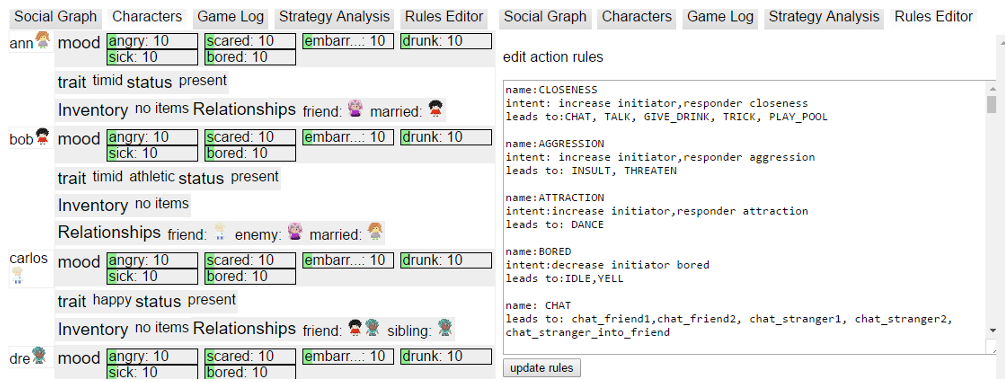 Figure 2: The developer interface for monitoring character states and editing social rules on the fly.
Critical Insight: The Future of Emergent Narrative
The significance of Confluence is not just in its game mechanics, but in its Visual Analytics. By making the invisible social web visible, it provides a "debugger for human nature."
Limitations
While powerful, the current framework is limited by the complexity of the social engine itself. As the number of social rules grows, the computational cost of the Ensemble Engine can become a bottleneck. Furthermore, translating these abstract social "states" into natural-sounding dialogue remains a secondary challenge not fully addressed here.
Conclusion
Confluence represents a vital step toward truly systemic games. It shifts the role of the game writer from a "scriptwriter" to a "legislator"—someone who defines the laws of a society and then lets the characters live within them. For researchers and indie devs, this web-based open-source tool lowers the barrier to entry for the next generation of interactive drama.