
Intelligent Congestion Control: Rethinking Social-Based Sensor Networks via MADM
Congestion control in social-based sensor networks: A social network perspective
The paper introduces a MADM-based congestion control approach for Social-based Sensor Networks (SSN). It leverages social ties and decision theory (Entropy method) to optimize message forwarding and buffer management, significantly outperforming traditional routing protocols like Epidemic and Prophet in high-load scenarios.
TL;DR
In Social-based Sensor Networks (SSN), conventional congestion control fails because you can't "throttle" a source you won't see for another three hours. This paper introduces a Multiple Attribute Decision Making (MADM) framework that uses Shannon Entropy to prioritize messages based on social ties, TTL, and size. The result? A massive jump in delivery ratios (+69%) and a dramatic slash in network overhead.
The "Store-Carry-and-Forward" Bottleneck
In SSNs, nodes (smartphones, wearables) move according to social patterns. High-frequency encounters create "social hubs" that are naturally prone to congestion. Traditional Congestion Control (CC) methods like CODA or ECODA rely on rapid feedback loops to slow down source nodes.
However, in SSNs:
- Feedback is broken: By the time a "buffer full" message reaches the source, the network topology has already changed.
- Social Blindness: Standard protocols treat all neighbors equally, ignoring that some nodes are "socially closer" to the destination and can clear their buffers faster.
Methodology: The MADM Perspective
The authors treat each encounter as a decision-making event: Which messages should I hand over to minimize future congestion?
1. Identifying Congestion Factors
The model identifies four pivotal attributes:
- Node Delay (): A social metric derived from inter-contact time. Shorter delay implies higher buffer turnover efficiency.
- Free Buffer Size: The immediate capacity of the recipient.
- Message Size & TTL: The internal constraints of the data itself.
2. The Entropy Weighting Mechanism
Since you cannot assume all factors are equally important in every context, the paper uses Shannon Entropy to calculate objective weights (). This avoids the bias of subjective "hard-coded" priorities.
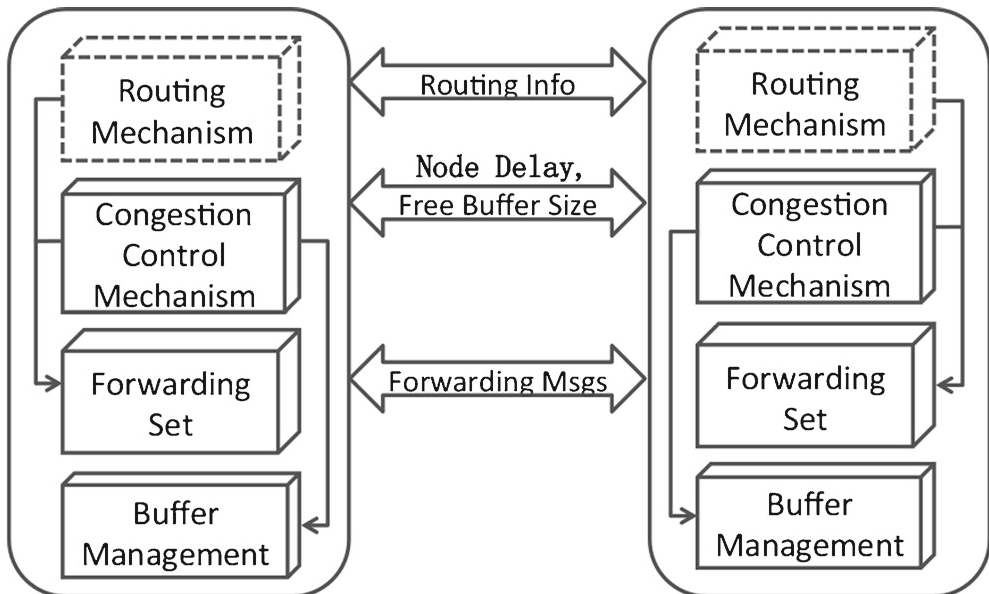 Figure 1: The architecture where routing and congestion control modules collaborate to determine the optimal forwarding set.
The utility of a message is calculated as: Nodes forward messages in descending order of utility, ensuring that even if a contact is brief, the most "valuable" (least congestion-inducing) data is moved first.
Experimental Validation
Using real-world mobility traces (Infocom2006, Sassy, Pmtr), the authors tested "Congestion-Aware" (-c) versions of Epidemic, Spray&Wait, and Prophet protocols.
Key Findings:
- Massive Delivery Gains: In the Infocom2006 trace (busy conference environment), Epidemic-c outperformed the vanilla version by 69% when buffers were tight (2MB).
- Efficiency Surge: The delivery overhead—often the death of flooding protocols—was slashed. For Epidemic, the overhead of the congestion-aware version was only a fraction (~3.4% to 5.5%) of the original.
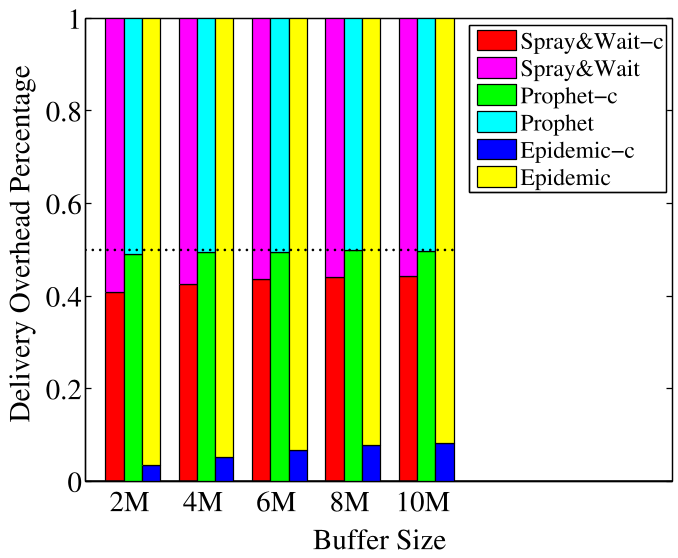 Figure 2: Delivery Ratio improvement as a function of buffer size. Note how the -c variants maintain high performance even as resources shrink.
Critical Analysis & Conclusion
Why it Works
The "magic" isn't just in the math—it's in the Inductive Bias. By acknowledging that nodes with stronger social ties to a destination will "hold" a message for less time, the system naturally routes data toward "high-velocity" paths, effectively increasing the "virtual" capacity of the entire network.
Limitations
- Selflessness Assumption: The paper assumes all nodes are "selfless." In real-world social networks, nodes are often "selfish" (conserving their own battery/storage).
- Computational Overhead: Calculating entropy and sorting message utilities on every encounter may be taxing for low-power IoT sensors, though negligible for modern smartphones.
Future Outlook
This work lays the groundwork for Context-Aware Networking. As we move toward 6G and ubiquitous sensing, the "social" layer of the network will become just as important as the physical layer in managing limited spectrum and storage resources.