
Connected Traveller: Leveraging the Social Web for Energy-Efficient Mobility
Connected Traveller, Social Web and Energy Efficiency in Mobility
The paper introduces the "Connected Traveller" (CT) concept, a service-oriented framework and mobile platform designed to improve energy efficiency in individual mobility. It leverages Fuzzy Logic and similarity clustering to form dynamic, virtual social communities of travellers with overlapping schedules, enabling proactive resource sharing such as vehicle pooling.
TL;DR
Individual travelling is inherently inefficient because it treats every trip as an isolated event. This paper presents the i-Travel framework, which virtualizes travel plans to create dynamic, "Connected Traveller" social networks. By using Fuzzy Logic to identify temporal overlaps in 4D space-time, the system enables travelers to share resources (like taxis or fuel) and transform individual waste into community efficiency.
Problem: The Solitary Traveller's Energy Tax
In current urban environments, mobility is driven by individual objective functions—maximizing personal convenience or speed while ignoring ecological impact. The pain point is twofold:
- Information Asymmetry: Two people might be at the same airport heading to the same downtown district at midnight, but they have no way of knowing it.
- Behavioral Fluctuations: Traditional engineering models for "load shaping" struggle with the random, subjective nature of human travel habits.
The authors argue that mobility needs to be viewed through an Energy Terms lens, where social status and lifestyle choices are data points that can be clustered to find optimization opportunities.
Methodology: Virtualizing the "Event Space"
The core of the i-Travel approach is the transformation of a physical journey into a Digital Travel object. This is a collection of spatial-temporal data points:
The 4D Maturation Model
Instead of just looking at where a person is now, the system models the "maturation of the event space." It predicts future "being there" and "being now" points every 30 minutes.
Fuzzy Reasoning for Social Cohesion
To bridge the gap between "hard" GPS data and "soft" human behavior, the authors employ Fuzzy Logic. For instance:
- Rule:
IF (travellers in the same airport) AND (arrival time is late evening) THEN (suggest taxi sharing).
This handles the ambiguity of real-world travel, allowing the system to act as a proactive agent that seeds social cohesion before the travellers even meet.
Experiments & Results: The Power of the Cluster
The study shifts the focus from the single node () to the cluster (), representing a Connected Traveller Unit.
Key findings include:
- Dynamic Aggregation: The system successfully creates virtual communities that "live shortly" but manifest a collective energy-saving identity.
- Optimization Thresholds: The authors found that social cooperation is most likely to succeed in small groups of 3-4 units. Larger groups face a breakdown in "voluntary" cooperation and logistical complexity.
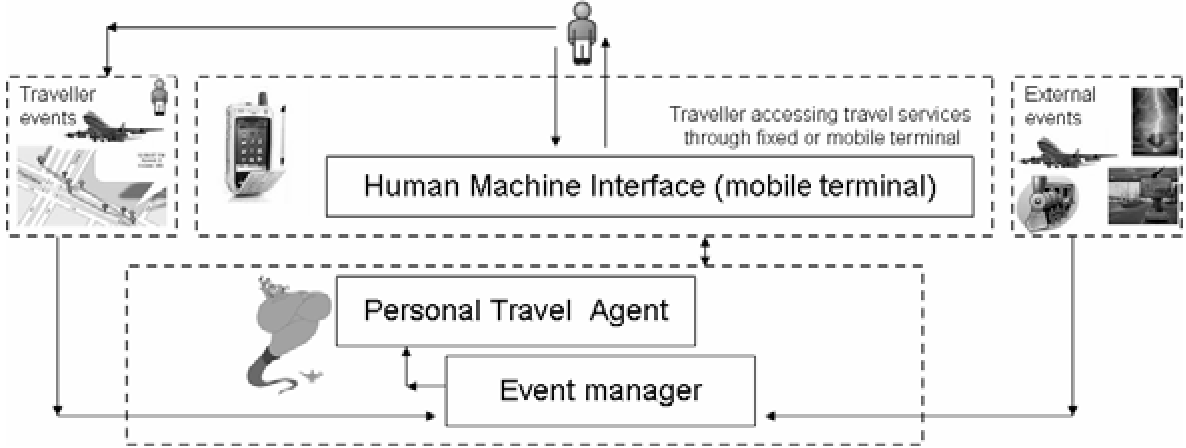
- Context Awareness: By leveraging smartphones with GPS and dedicated software, the platform can deliver proactive service offerings (the "e-Marketplace") that negotiate specialized local transit options in real-time.
Critical Analysis & Conclusion
The "Connected Traveller" concept effectively bridges the gap between Internet of Things (IoT) and Social Networking.
Takeaway
The genius of this approach doesn't lie in faster engines or better batteries, but in Information Logistics. By making latent social opportunities visible, the i-Travel framework creates a new market of connected services that align personal convenience with environmental sustainability.
Limitations
While the theory is sound, the paper acknowledges that Privacy Constraints (e.g., airlines not sharing passenger lists) and the "incomplete information" available to individual e-agents remain significant hurdles for a global rollout.
Future Outlook
The path forward involves maturing the e-Marketplace where these virtual communities can legally and safely negotiate their shared segments. As urban areas move toward Smart Cities, the CT model offers a blueprint for how "volatile" social networks can solve "permanent" ecological problems.