
Find & Connect: Converting Hallway Handshakes into Digital Ties
From offline to online: connecting people with a mobile social networking application at a conference
The paper introduces Find & Connect, a mobile web application designed to bridge the gap between offline interactions and online social networking at academic conferences. Using active RFID technology for indoor positioning, the system integrates proximity-based discovery with homophily-driven recommendations to foster new social connections.
TL;DR
At major conferences, we often meet dozens of people only to lose those connections once the flight home takes off. Find & Connect is a research prototype deployed at UbiComp 2011 that uses Active RFID badges to track physical proximity and automatically help attendees find and connect with people they’ve "encountered" in the real world. It proves that physical proximity is the leading driver for extending professional social networks.
The Problem: The "Ephemeral" Nature of Conference Networking
Academic conferences are breeding grounds for Ephemeral Social Networks (ESNs)—temporary communities that exist for a few days and then vanish. The authors identified a massive gap:
- Physical Friction: We forget names or affiliations of the person who asked that great question during a session.
- Missed Opportunities: You might be in the same room as a perfect collaborator but never know it because you aren't looking at their name tag.
- Context Gap: Standard apps like LinkedIn don't know how or where you met someone, losing the rich context of the encounter.
Methodology: The "Secret Sauce" of Invisible Tracking
Unlike modern apps that rely on power-hungry GPS or manual check-ins, Find & Connect utilized sub-meter-level tracking via Active RFID.
1. The Positioning Engine
The researchers deployed RFID readers in meeting rooms and provided attendees with active RFID tags. By using the LANDMARC algorithm, they could triangulate a user's position within a 5-meter error range, allowing the system to "know" who was standing near whom without the user ever opening their phone.
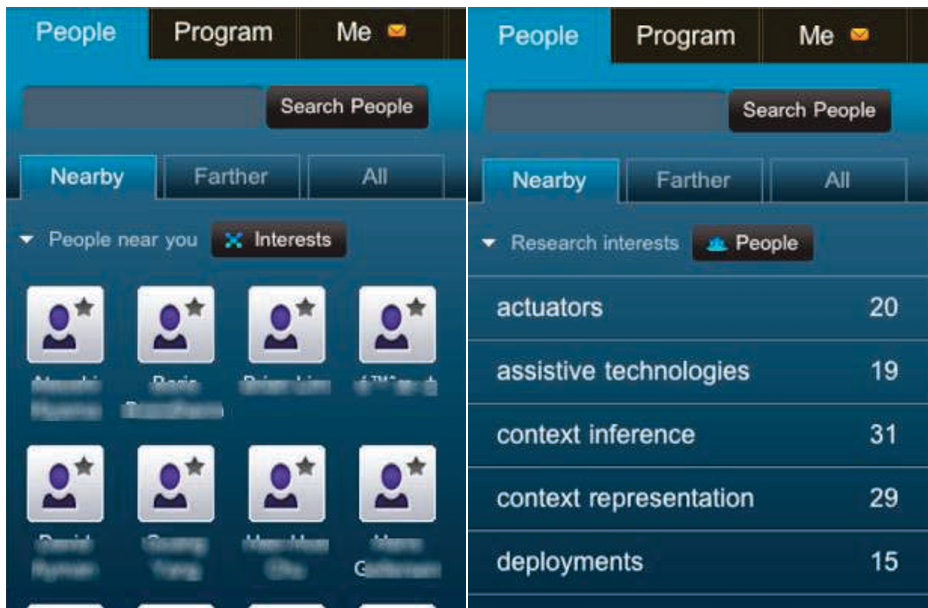 Figure: The mobile interface showing what two users have "In Common," including session history and physical encounters.
2. Defining an "Encounter"
The system didn't just log every person you walked past. It filtered for meaningful interactions using two thresholds:
- Distance: Less than 4 meters.
- Duration: At least 5 minutes.
- Speed Filter: If you were moving faster than 1.5 m/s, the system ignored the interaction as a "pass-by."
Experimental Results: Proximity is King
The logs from UbiComp 2011 provided a fascinating look at how social networks actually grow:
- Offline vs. Online Rhythm: Offline interactions (encounters) peaked during the day, specifically during keynotes and demo sessions. Online interactions (sending contact requests) actually continued late into the night, as attendees "processed" their day's meetings from their hotel rooms.
- The "Why" Behind the Add: When users added a contact, the top reasons were "Know each other in real life" (39%) and "Encountered before" (37%). This confirms that in a professional setting, physical presence is the most trusted validation for a digital connection.
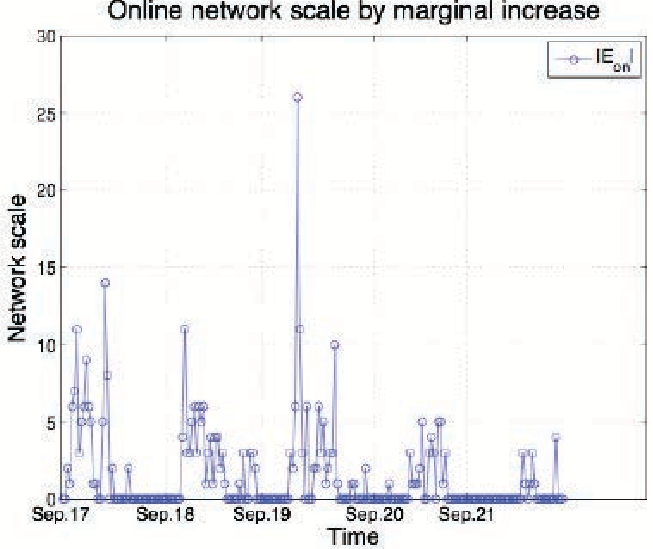 Figure: The marginal increase in online interactions, showing activity spikes during breaks and late-night sessions.
Critical Insight & The Future
The most striking takeaway is that even though the app provided "Homophily" recommendations (people you should know based on research interests), users were still more likely to connect with people they had physically stood near.
Limitations & Evolution
While pioneering, the system faced hurdles:
- Hardware Dependency: Carrying an extra RFID tag is a barrier to entry.
- Privacy vs. Utility: While users could opt-out, the "always-on" nature of tracking requires immense trust.
Looking Forward: Today, this functionality is being absorbed into "Nearby" features in apps like WeChat or specialized event platforms like Brella, but this 2014 study remains a seminal piece of evidence for the bi-directional influence of our offline and online worlds.