
Towards Consensus: Solving the "Co-Owned Data" Privacy Dilemma in Social Networks
Towards Consensus-Based Group Decision Making for Co-Owned Data Sharing in Online Social Networks
This paper proposes a consensus-based Group Decision Making (GDM) framework for co-owned data sharing in Online Social Networks (OSNs). By integrating Fuzzy Logic Systems with the Extended Induced Ordered Weighted Averaging (EIOWA) technique, the authors manage privacy conflicts through trust-aware aggregation of stakeholder opinions.
TL;DR
The sharing of photos or data involving multiple people (co-owned data) is a major privacy loophole in current social networks. This paper introduces a framework that forces a Consensus-Reached Group Decision Making (GDM) process before sharing. By combining Fuzzy Logic and Trust-weighted aggregation, it ensures that the "owner" of the data respects the privacy concerns of "co-owners."
The Problem: The "Post First, Ask Later" Flaw
Current Online Social Networks (OSNs) like Facebook follow a "share-then-remediate" model. If a friend posts a photo of you that you find sensitive, you can only untag yourself after the damage is done. This creates a "privacy loss" that is often irreversible.
The core challenge is: How do we aggregate the conflicting opinions of diverse stakeholders—some who want to share and some who don't—in a way that is fair and reflects the trust between them?
Methodology: The Dual-Fuzzy Engine
The researchers propose a framework built on two parallel fuzzy systems to handle the inherent "vagueness" of human privacy preferences.
1. The Fuzzy Decision System (Assessing Risk)
This system calculates Data Sensitivity () using five pillars of information security: CIAPP (Confidentiality, Integrity, Availability, Privacy, and Possession). It then factors in the "Confidence" in the target audience to output a linguistic decision: Yes, No, or Maybe.
2. The Fuzzy Alternative System (Reaching Agreement)
While the first system looks at risk, this system looks at Preferences. Each co-owner selects from alternatives (e.g., "Share with restrictions" or "Do not share").
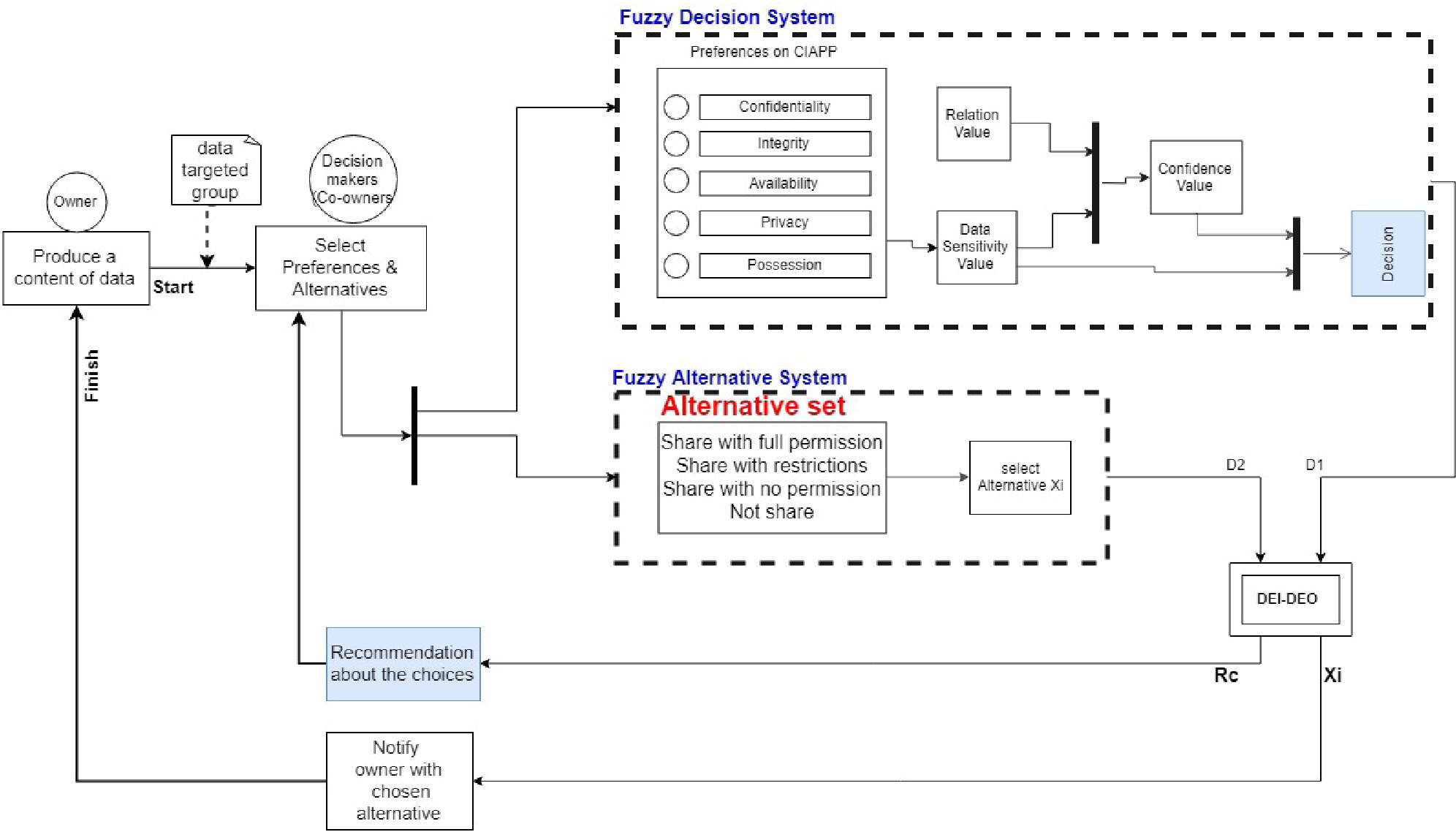 Figure: The main steps of the proposed consensus-reaching process.
The secret sauce here is the EIOWA (Extended Induced Ordered Weighted Averaging) technique. Unlike simple voting, it weights each person's opinion based on their Trust Value (). If the owner highly trusts a co-owner, that co-owner's "Do Not Share" vote carries significantly more weight.
Resolving Conflicts: The DEI-DEO Mechanism
The Decision In-Decision Out (DEI-DEO) module acts as a final filter. It compares the risk assessment (System 1) with the group's preference (System 2). If there is a "Conflict" (e.g., the risk is high but the group voted to share), the framework triggers a feedback mechanism, asking users to reconsider their choices to avoid privacy leaks.
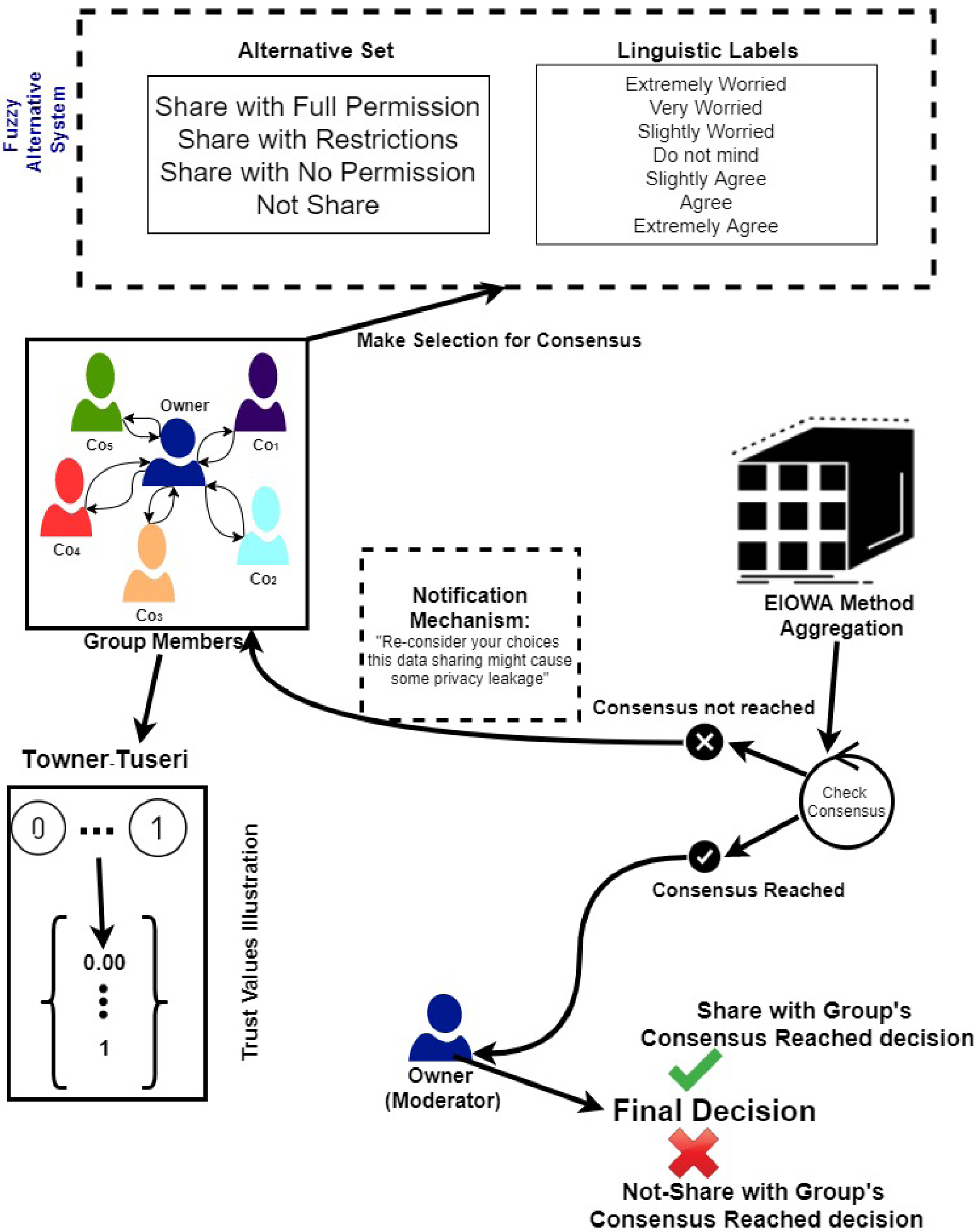 Figure: Integration of Trust values into the EIOWA technique.
Real-World Implementation: The "Trusty" Network
The authors didn't just stay in the realm of theory. They built Trusty, a functional OSN to test their model.
- Scale: 4,200 nodes and 1,000 edges.
- User Feedback: 50% of co-owners found the ability to provide input "Good" or "Very Good."
- Key Distinction: Unlike Facebook, Trusty allows trust to be dynamic. If an owner ignores the group's consensus and shares anyway, their trust rating among friends drops, effectively "punishing" bad privacy behavior.
Critical Insight & Future Outlook
This work highlights that privacy is not an individual setting, but a group contract. By quantifying "trust" and "sensitivity" through fuzzy logic, the authors provide a pathway to automate the awkward social negotiation of "Can I post this?"
Limitations: The model currently relies on manual input of CIAPP features, which might be too complex for the average user. Future iterations could benefit from AI-driven automated sensitivity detection to lower the friction of the consensus process.
Conclusion
The "Trusty" framework proves that technical mechanisms can bridge the gap between social intimacy and data protection. As we move toward more collaborative digital environments, consensus-based sharing will likely become the standard for responsible OSN design.