
Consensus-Based Service Selection: Using Crowdsourcing and Fuzzy Logic to Tame Diverse QoS Assessments
Consensus-Based Service Selection Using Crowdsourcing Under Fuzzy Preferences of Users
The paper proposes a multi-criteria service selection framework that combines trust-aware consensus theory with fuzzy logic. By utilizing crowdsourcing (human experts and software agents), it achieves a unified QoS assessment that converges to the most trustworthy evaluation through a dynamic interaction protocol.
TL;DR
The selection of Web Services is often hindered by conflicting QoS evaluations from different experts or monitoring tools. This paper introduces a framework that uses Consensus Theory to harmonize diverse opinions into a single "trustworthy" value and employs a Fuzzy Inference Engine to match these values with nuanced user preferences.
Academic Positioning: This work bridges the gap between Group Decision Making (GDM) and Service-Oriented Computing (SOC), moving beyond simple weighted averages to a more robust, interaction-based agreement model.
The Problem: The Noise in the Crowd
In the era of Cloud and SOC, we rely on QoS (Quality of Service) metrics—like Response Time (RT) and Success Rate (SR)—to pick the "best" service. However:
- Diversity of Perspective: Different evaluators (human experts vs. software agents) often report vastly different numbers for the same service.
- Dishonesty & Subjectivity: Some evaluators may be biased or provide inaccurate data.
- Complex Preferences: Users don't just want "fastest"—they want a trade-off (e.g., "reasonably fast AND highly reliable").
Prior works used fixed "discount factors" to handle old data or simple monitoring. They lacked a mechanism to reach an agreement when opinions vary wildly.
Methodology: Consensus + Fuzzy Logic
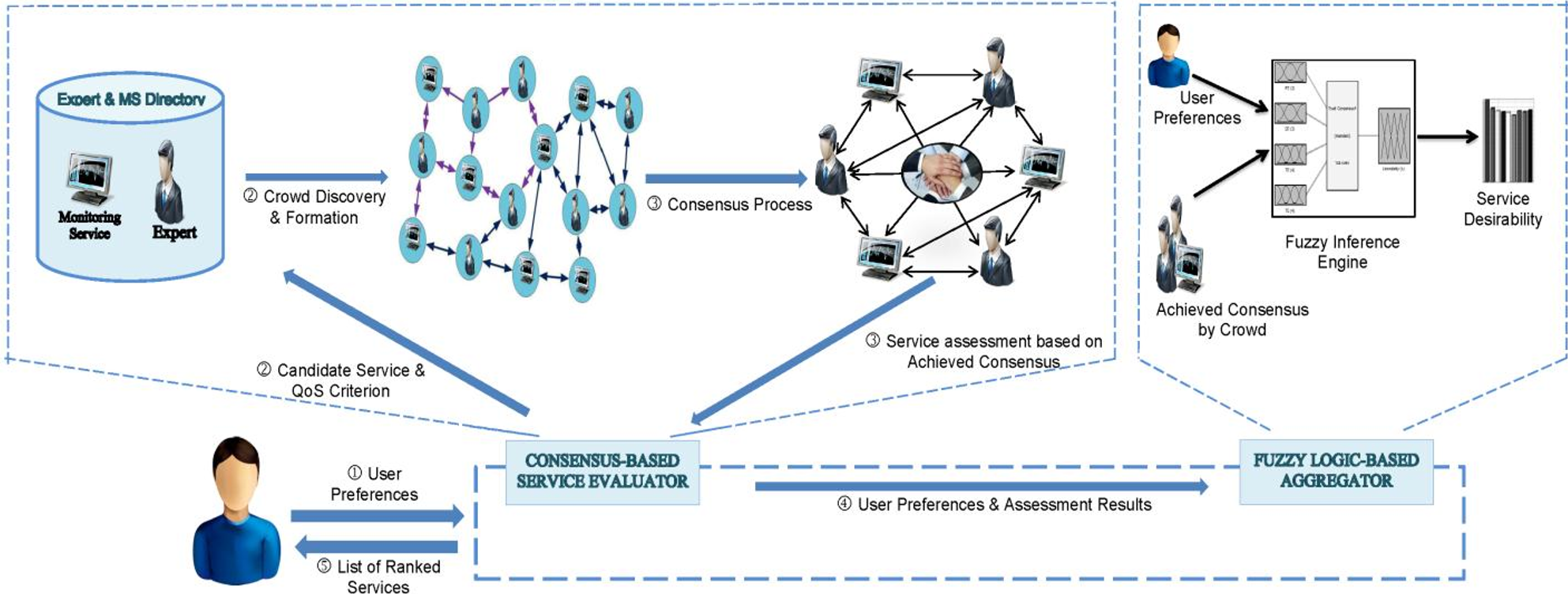
The authors propose a two-layered solution.
1. The Trust-Aware Consensus Layer
Instead of just averaging scores, the system models evaluators as nodes in a Social Trust Network.
- Interaction: Peers send signals to neighbors.
- Dynamic Trust: Trust () isn't static; it evolves. If Peer B's opinion consistently moves toward an agreement with Peer A, A's trust in B increases.
- Convergence: The algorithm ensures that all nodes eventually agree on a single QoS value (the consensus value), weighted by the most trustworthy members of the crowd.
2. The Fuzzy Aggregation Layer
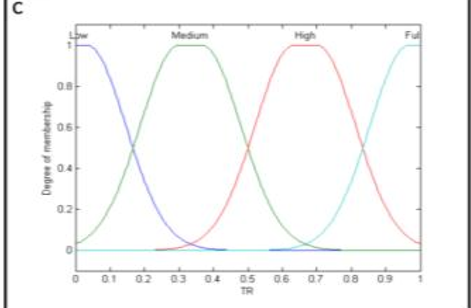
Once we have a "Consensus-achieved" RT or SR, how do we rank the services? The paper uses Fuzzy Logic to handle the "imprecision" of human desire. It defines linguistic variables like Low, Medium, and High for QoS and Desirable/Undesirable for the output.
Experimental Results
The authors tested the model with a 6-expert community across two scenarios.
Scenario A: Response Time (RT)
Initial evaluations ranged from 10s to 60s. Through the consensus protocol, the experts converged to approximately 45.48s. Interestingly, they converged toward the most trustworthy expert (Expert 5), who remained firm in their assessment.
Scenario B: Success Rate (SR)
Opinions ranged from 30% to 60%. Here, because Expert 5 was more connected and willing to interact, the network reached a consensus around 48.27%.
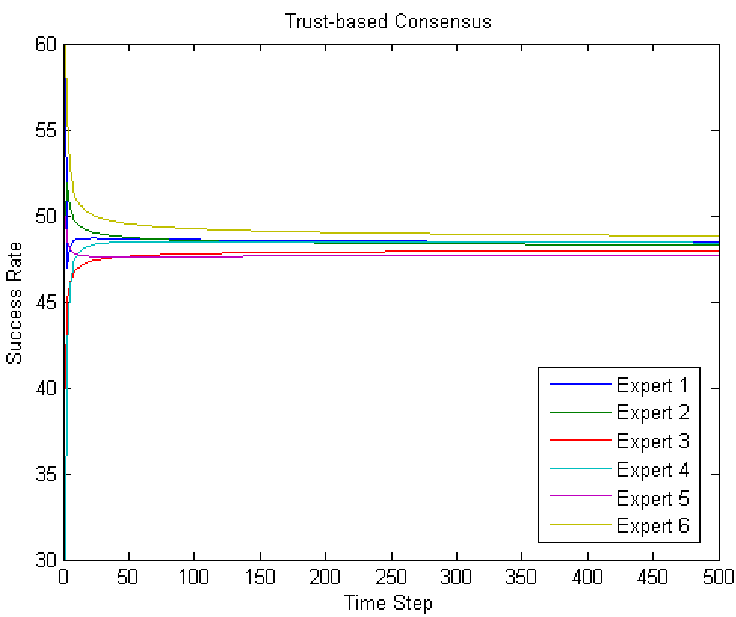
The chart above illustrates how individual opinions (jagged lines) eventually smooth out into a single horizontal line—representing the achieved consensus.
Critical Analysis & Conclusion
Takeaway
The true innovation here is the Self-Evaluated Crowd. Unlike traditional systems where a central authority must rank experts, this model allows the crowd to "rank each other" based on the quality of their contributions during the consensus process.
Limitations
- Network Density: The model assumes a "strongly connected" or "fully connected" network. In massive crowdsourcing, this might lead to high communication overhead ().
- Convergence Speed: While 500 iterations worked for 6 experts, the paper leaves the scalability to thousands of members as a future research direction.
Final Thoughts
As we move toward decentralized service architectures, mechanisms like this—that don't rely on a single source of truth but rather a negotiated, trust-weighted truth—will be essential for robust service selection.