
Turning Disagreement into Insight: A Consensus Approach to Overlapping Nodes
Consensus Clustering Approach for Discovering Overlapping Nodes in Social Networks
The paper introduces a Consensus Clustering approach to identify overlapping nodes in social networks by aggregating outputs from multiple disjoint community detection algorithms. It proposes two specific algorithms, Core-consensus and Periphery-consensus, with the latter achieving a high Recall of over 96% and an F-measure of 75% on benchmark LFR networks.
TL;DR
In social networks, individuals rarely belong to just one group. While most algorithms struggle to find these "bridge" individuals, this paper proposes Consensus Clustering. By aggregating the "opinions" of several simple disjoint algorithms, the authors' Periphery-consensus method identifies overlapping nodes with over 96% recall, proving that algorithmic disagreement is actually a powerful signal for community overlap.
The Problem: The "Disjoint" Fallacy
In the real world, a researcher might belong to both the "Machine Learning" and "Biology" communities. However, the vast majority of community detection algorithms—such as Edge Betweenness or Multilevel—are designed to force every node into exactly one bucket.
When you run five different algorithms on the same graph, they often provide five different answers. Usually, researchers view this inconsistency as a problem. This paper asks: What if this inconsistency is actually the solution?
Methodology: The Logic of Consensus
The authors propose that if multiple algorithms cannot agree on where a node belongs, or if they consistently place a node's neighbors in different clusters, that node is likely an overlapping node.
1. Core-consensus
This identifies "equivalence classes" where nodes and are only considered part of the same core if all underlying algorithms agree they belong together. While theoretically sound, it proved too strict for practical overlapping detection.
2. Periphery-consensus (The Winner)
This algorithm uses a two-step voting mechanism:
- Step 1: For a single algorithm, mark a node if of its neighbors are assigned to a different community.
- Step 2: If the majority of the ensemble of algorithms (e.g., Fast Greedy, Infomap, Walktrap) agree with Step 1, the node is officially labeled as "overlapping."
 Figure 1: The core conceptual framework for identifying community boundaries.
Experiments & Results
The authors tested their approach using LFR Benchmark networks, the industry standard for community detection. They used an ensemble of six base algorithms (EBC, FG, INF, ML, LEV, WT) provided in RStudio.
Performance Highlights:
- Recall: Consistently above 96%, meaning it almost never misses an overlapping node.
- F-Measure: Averaged 75% for dense networks.
- Scalability: Tested on networks up to nodes, showing stable precision and recall as the network size grows.
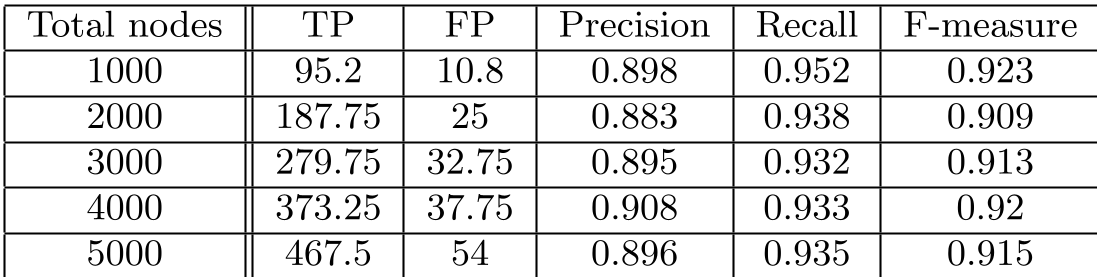 Table 1: Performance metrics across different network sizes (N=1000 to N=5000).
As shown in the comparative analysis, the Periphery-Consensus performance is "on par" with heavyweights like SLFA and significantly better than simpler link-based algorithms in dense scenarios.
Critical Insight & Conclusion
The brilliance of this approach lies in its Inductive Bias. Instead of building a complex new mathematical model for overlap (like Non-negative Matrix Factorization), it leverages the "errors" of simpler models.
Takeaway
If you are building a recommendation system or analyzing social structures, you don't necessarily need a PhD-level complex overlapping algorithm. By running a suite of fast, disjoint algorithms and looking for the "periphery" consensus, you can achieve SOTA-level results with much lower computational overhead.
Limitations
The paper notes that Core-consensus was largely unsuccessful, suggesting that absolute agreement in social networks is too rare to be useful. Future work should explore how to weight different "base" algorithms based on their individual reliability rather than treating every "opinion" as equal.