
Robust Consensus in the Wild: Navigating LSGDM in Social Networks
Consensus of large-scale group decision making in social network: the minimum cost model based on robust optimization
This paper proposes a novel Large-Scale Group Decision Making (LSGDM) consensus framework utilizing Robust Optimization. The core method integrates social network trust relationships with an ellipsoidal uncertainty set for unit adjustment costs, achieving faster consensus reaching compared to traditional SOTA methods like grey clustering or ranking-based clustering.
TL;DR
Reaching a consensus among 20+ experts with varying social ties and hidden "price tags" for changing their minds is notoriously difficult. This paper introduces a Robust Optimization framework for Large-Scale Group Decision Making (LSGDM). By factoring in trust relationships and the inherent uncertainty of negotiation costs, the model achieves consensus faster and cheaper than existing benchmarks.
Perspective: Why "Certainty" is the Flaw in Prior Research
Most previous models for consensus reaching assume the moderator knows exactly how much to "pay" an expert to move their opinion—the Unit Adjustment Cost. In reality, this cost is obscure and dynamic. Furthermore, experts aren't isolated islands; they exist in a social network where trust determines how likely they are to align with others.
The authors argue that ignoring these two factors—cost uncertainty and social harmony—leads to models that fail when applied to real-world crises, such as compensation negotiations during a pandemic.
Methodology: The Three Pillars of Robust Consensus
1. Social-Aware Expert Clustering
To handle 20+ participants, the system first clusters experts. Unlike standard K-means, this method uses a Comprehensive Evaluation (CE) matrix: where is trust and is relationship strength. This ensures that experts who already trust each other are grouped together, facilitating smoother negotiation.

2. Measuring "Harmony" instead of just "Similarity"
Consensus isn't just about numerical proximity; it's about social agreement. The paper defines a Harmony Degree, which weights opinion similarity by relationship strength. A high harmony index means the group is not just thinking alike, but doing so within a structure of mutual trust.
3. The Robust Counterpart Model
When the cost is uncertain (lying within an ellipsoidal set), the moderator faces a Min-Max problem: minimizing the total cost under the worst-case scenario. The paper transforms this into a solvable robust counterpart: This formula balances the nominal expected cost with a "protection term" against uncertainty ().
Experimental Validation: COVID-19 Case Study
The researchers applied this to a real-world scenario: negotiating compensation for tenants of the Huanan seafood market to close their stalls.
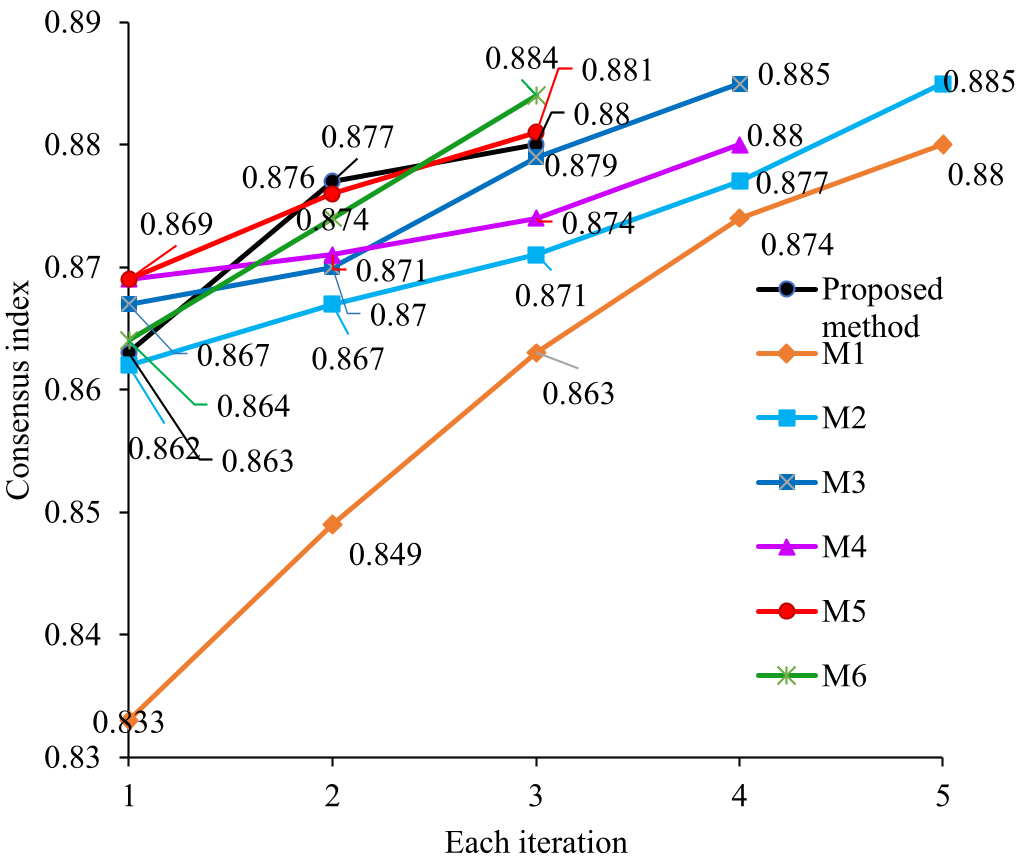
Faster Reach-to-Consensus
Compared to six other SOTA methods (M1-M6), the proposed robust method reached the consensus threshold (0.88) in just 3 iterations. Other methods required 5 or more, or failed to reach the threshold within the same cost budget.
Economic Superiority
As uncertainty () increases, the "Robust Optimization Case" consistently outperforms the "Worst Case" (where experts demand maximum compensation), saving significant resources for the moderator. For large values of uncertainty (), the Relative Improvement (RI) in cost-saving becomes a massive competitive advantage.
| Uncertainty () | Robust Cost () | Worst Case () | RI (%) |
|---|---|---|---|
| 10 | 167.94 | 174.20 | 3.59 |
| 20 | 179.73 | 199.20 | 9.77 |
Critical Insight: The "Social Network" Advantage
The core takeaway is that Social Networks are a feature, not a bug. While traditional GDM views social ties as potential biases, this paper shows that leveraging trust indices allows a moderator to target the "lowest-hanging fruit" in a network. By focusing adjustments on subgroups with the lowest local harmony, the global consensus rises more efficiently.
Future Outlook: Beyond Offline Negotiation
While the model is robust, it remains largely offline. The authors suggest that moving into Online LSGDM (where opinions change in real-time on social platforms) and accounting for strategic game-playing (experts lying about their costs to get more money) are the next frontiers for this research.
Conclusion
This work marks a significant pivot from purely mathematical consensus models toward sociologically-grounded robust algorithms. It provides a blueprint for moderators in government and industry to handle complex, large-scale negotiations where data is messy and social ties are deep.