
The Math of Conformity: Why Perfect Consensus Requires Infinite Peer Pressure
Consensus on Social Graphs under Increasing Peer Pressure
This paper introduces a generalized framework for modeling opinion dynamics on social graphs under time-varying peer pressure. By representing the evolution of agent strategies as a composition of contraction maps, the authors prove that agents reach a perfect consensus if and only if peer pressure increases without bound.
TL;DR
How do groups reach an agreement? This paper provides a rigorous mathematical answer: unless the pressure to conform grows infinitely large, individuals will always be pulled back by their private biases. By modeling social interaction as a series of contraction maps on a graph, the researchers define the exact conditions under which a "meaningful compromise" is possible.
Motivation: The Tug-of-War Between Self and Group
In any social network—from a board of directors to a Twitter thread—individuals face a constant tension. On one side is their private preference (what they truly believe); on the other is social stress (the discomfort of disagreeing with peers).
Previous models often treated this interaction as static. This paper, however, introduces a dynamic "peer pressure factor" . The researchers ask: Can we predict the final group opinion based on the initial network structure and the escalating intensity of social influence?
Methodology: Social Stress as an Optimization Problem
The authors model each agent as an optimizer trying to minimize a local objective function . This function is a weighted sum of two types of "stress":
- Internal Stress: The squared distance between the current opinion and the private preference .
- Social Stress: The squared distance between the current opinion and the previous opinions of neighbors, scaled by peer pressure .
The Governing Equation
The opinion update rule is derived as:
Where:
- = Matrix of individual susceptibility (stubbornness).
- = Degree matrix of the graph.
- = Adjacency matrix (who talks to whom).
- = The Graph Laplacian.
Note: The system treats the social network as a simple graph , where the Graph Laplacian dictates the flow of influence.
Convergence through Contraction Maps
The core technical insight is viewing each update as a Contraction Map (). Because each step "contracts" the space of possible opinions, the Banach Fixed Point Theorem guarantees that if we kept pressure constant, the system would reach a fixed point.
However, because peer pressure changes over time, the authors had to prove convergence for a composition of different maps ().
Key Results: Consensus vs. Dissonance
The paper establishes two distinct regimes for social evolution:
1. The Infinite Pressure Regime (Total Consensus)
If peer pressure approaches infinity as time goes to infinity, the identity of the group collapses into a single value. This value is the weighted average of initial preferences: In this state, the "Cost of Anarchy" is 1, meaning the local actions of agents perfectly align with the global social optimum.
2. The Bounded Pressure Regime (Persistent Diversity)
If peer pressure is limited (), the group never reaches consensus. Instead, they converge to a vector where opinions are shifted toward the average but remain distinct. Individual "stubbornness" prevents the graph from reaching a unified state.
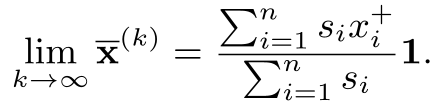 The mathematical proof that consensus is the limit of the opinion vector as pressure scales.
Critical Insight & Conclusion
This work transcends simple sociology; it provides a framework for understanding efficiency in decentralized systems.
Takeaway: If you are designing an AI swarm or a voting protocol, this paper suggests that consensus isn't just about connectivity—it's about the relative weight of the global objective versus local constraints.
Limitations: The model assumes a "simple graph" and linear quadratic stress. Real-world human behavior often involves "rebellion" or "negative influence," where high pressure causes individuals to move away from the group—a phenomenon not captured by this specific contraction map framework.
Future Work: Integrating non-convex stress functions or time-varying graph topologies (where edges break under too much pressure) would be the natural next step for this research.