
Consensus Software: Bridging Robustness and Social Good via Multiagent Systems
Consensus Software
This paper introduces the concept of "Consensus Software," a paradigm where software robustness and societal alignment are achieved through large-scale multiagent systems and decentralized participation. It proposes a framework where software behavior emerges from the consensus of its users rather than the centralized bias of a few developers.
Executive Summary
TL;DR: This paper explores "Consensus Software," a visionary framework where software robustness is intrinsically linked to democratic participation. By leveraging multiagent systems, redundant software components, and consensus ontologies, the author argues we can build infrastructure that is not only more resistant to technical errors but also more aligned with the sociopolitical interests of its users.
Positioning: This work serves as a foundational theoretical bridge between Software Engineering, Distributed Multiagent Systems (MAS), and Political Economy, moving beyond simple procedural code toward emergent, representative systems.
The Pain Point: Centralization and the "Representation Gap"
Modern society is increasingly governed by algorithms—from electricity allocation to reputation scoring on platforms like eBay. However, most of these systems suffer from two critical flaws:
- Fragility: A single bug in a centralized controller can crash an entire infrastructure.
- Bias: Software models (like Amazon’s recommendation engine or corporate HR databases) are "black boxes" constructed by developers with zero input from the individuals they supposedly represent.
The author observes that when users cannot correct or influence the models that control their lives, the systems become both less accurate and less accepted by society.
Methodology: The Pillars of Consensus Software
To solve these issues, the author proposes a transition from centralized programming to a consensus-driven methodology. This is supported by three technological "threads":
1. Multiagent Redundancy
Instead of a single "perfect" piece of code, the system uses a large-scale collective of computational agents. Each agent has its own objectives, but through communication, they can "cover" for each other’s mistakes. This creates a safety net where the failure of one component does not lead to a total system collapse.
2. Consensus Ontologies
One of the greatest challenges is interoperability: how do independently built components understand each other? The author proposes "Consensus Ontologies"—a way to relate fragmented, local ontologies through a "semantic bridge."
- Physical Intuition: Common parts of the data models reinforce one another, while unique, potentially erroneous parts are deemphasized by the collective.
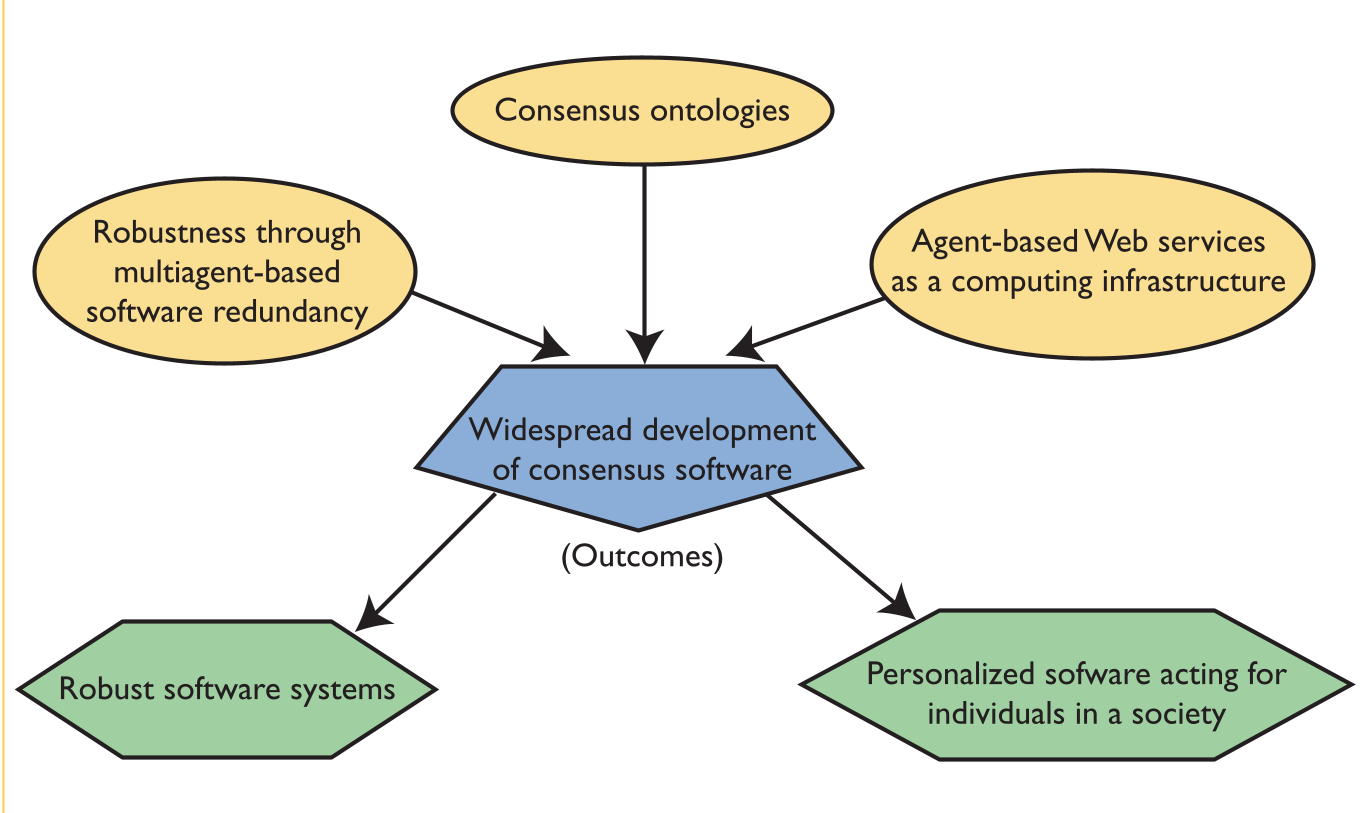 Figure 1: The synergy between consensus ontologies, agent-based services, and software redundancy.
3. Sociopolitical Models
The paper draws parallels between OOP (Object-Oriented Programming) and political institutions. Just as a democracy evolves through collective bargaining (as per economist John Commons), software should evolve through the aggregated preferences of its "stakeholders" (the users).
Experiments and Insights
The author highlights that in decentralized systems—like eBay’s reputation system—performance actually improves with more users. This is a counter-intuitive but powerful result: the "noise" of individual opinions eventually cancels out unfair ratings, leading to a more robust "truth."
Research by the author’s team confirmed that even without a "global" shared dictionary, small, independently developed ontologies can be automatically linked. This proves that top-down standardization is not a prerequisite for global cooperation.
 Figure 2: The critical research questions identifying the gap between current OOP models and true consensus programming.
Critical Analysis & Conclusion
The Takeaway
The true value of this work lies in the realization that robustness is a social property. If many people contribute to the components of a societal control system, it becomes harder to censor, harder to break, and easier to trust.
Limitations
- Latency: The paper acknowledges the difficulty of real-time decisions in consensus-based systems.
- Validation: Analyzing "emergent" behavior is far more difficult than traditional unit testing. How do we prove a consensus system is "correct" if its goals are constantly shifting?
Final Outlook
Writing in 2003, Huhns predicted the decentralization we are seeing today in technologies like Blockchain and the Semantic Web. As we move into an era of AI agents, the need for "Consensus Software" that prevents any single entity from monopolizing algorithmic control has never been more relevant.