
When Less is More: Why Negative Facebook Posts Can Actually Drive Customers to Your Brand
Consequences of customer engagement behavior: when negative Facebook posts have positive effects
This study investigates the impact of Customer Engagement Behavior (CEB) on Facebook, specifically analyzing how the valence of brand-related posts and the tie strength of the sender influence purchase intentions. Using two online experiments in a restaurant context, it identifies the "blemishing effect" where minor negative information from weak ties can unexpectedly boost visiting intentions for known brands.
TL;DR
Counter-intuitive as it may seem, a negative comment on social media isn't always a brand's death knell. A fascinating study by Bitter & Grabner-Kräuter reveals that if a customer already likes your brand, a "minor" negative post from a distant acquaintance can actually increase their intention to visit. This "blemishing effect" highlights the complex interplay between social tie strength and brand familiarity.
The "Blemishing" Paradox: Why Bad News is Sometimes Good
In the traditional marketing playbook, positive reviews are the holy grail. However, the researchers behind this study leaned into a psychological quirk: when we already have a positive attitude toward a brand, a small piece of negative information (a "blemish") can lead us to double down on our positive view.
The catch? It depends entirely on who says it and how well the audience knows the brand.
Methodology: Testing Ties and Valence
The researchers conducted two experiments centered on a restaurant brand to test how Valence (positive vs. negative info) and Tie Strength (close friends vs. distant acquaintances) interact.
- Study 1: Focused on users who knew the restaurant brand.
- Study 2: Focused on users who were unfamiliar with the brand.
The Conceptual Framework
The authors proposed that information from "Strong Ties" (close friends) is processed with more effort and is seen as highly "diagnostic" (useful). Conversely, "Weak Ties" (acquaintances) trigger lower processing effort, which is the perfect environment for the blemishing effect to take root.
 Above: The research model visualizing how valence and tie strength influence visiting intentions and diagnosticity.
Key Findings: The Blemishing Effect in Action
1. Familiarity Breeds... Reinforcement?
For users who already knew and liked the restaurant, a negative post from a weak tie resulted in the highest visiting intentions. Because the source was a distant acquaintance, the reader didn't scrutinize the negative claim heavily. Instead, it triggered a "bolstering" process where the reader reminded themselves of why they liked the brand in the first place.
2. The Power of the Best Friend
When a strong tie (a close friend) posted something negative, the effect was the opposite. Readers took this information seriously. Because we trust our close friends, their negative experiences are highly diagnostic and successfully lowered the intention to visit.
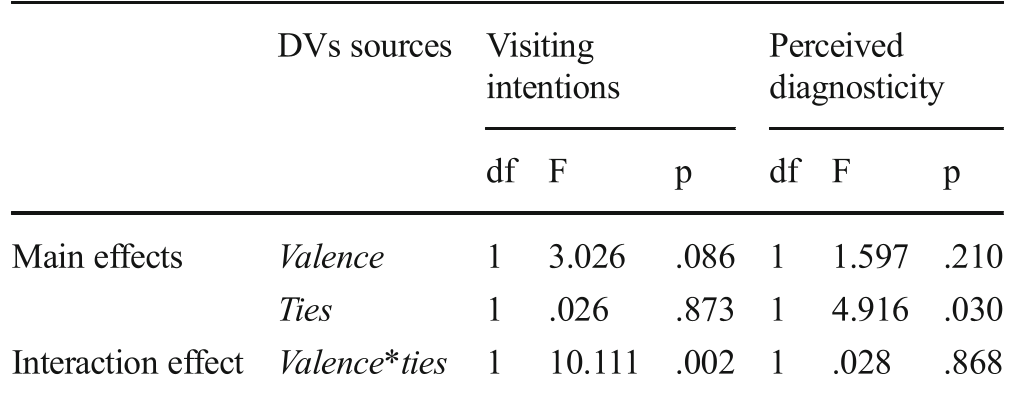 Above: Table showing significant interaction effects (p=0.002) for visiting intentions in Study 1.
3. The Unfamiliar Frontier
In Study 2, for an unknown brand, the blemishing effect disappeared. Without a prior positive attitude to "bolster," negative information was simply seen as negative. Here, positive posts from strong ties were the only effective driver for visiting intentions.
Deep Insight: Tie Strength as a Filter
The study proves that "Diagnosticity" is the invisible currency of social media.
- Strong Ties = High Diagnosticity. Their words are treated as hard evidence.
- Weak Ties = Variable Impact. Their negative words can act as a catalyst for a person's existing biases.
Critical Analysis & Managerial Implication
This research offers a sigh of relief for Community Managers. You don't necessarily need to delete every minor negative comment. If your brand has a loyal following, a stray complaint from a "weak tie" might actually do your PR a favor by making your brand seem more authentic and prompting fans to defend you.
Strategic Takeaways:
- For Established Brands: Don't fear the "minor blemish." Authenticity involves imperfection.
- For New Product Launches: Focus exclusively on "Strong Tie" endorsements. Since there is no prior brand attitude to bolster, you need the high-utility trust that only close friendships provide.
Limitations: The study used a relatively small sample and focused on a single industry (restaurants). Furthermore, it interpreted "Facebook posts" in a controlled environment; real-world browsing with high-speed scrolling might further reduce processing effort, potentially amplifying the blemishing effect.
Conclusion
The social graph is not just a pipe for information; it is a lens that changes the color of the information itself. By understanding that tie strength moderates how negative news is perceived, brands can navigate the volatile waters of social networking with greater strategic precision.