
PICTURE: Solving the "Missingness" Trap in Clinical Early Warning Systems
Demonstrating the consequences of learning missingness patterns in early warning systems for preventative health care: A novel simulation and solution
The paper introduces PICTURE (Predicting Intensive Care Transfers and other UnfoReseen Events), a tree-based early warning system for patient deterioration. It leverages a novel Variational Autoencoder (VAE) with a custom loss function to simulate EHR data and solve the "missingness pattern learning" bias, achieving SOTA performance (AUROC 0.83) in predicting ICU transfers and adverse events.
TL;DR
Early warning systems (EWS) are critical for preventing hospital deaths, but many modern AI models are brittle. This paper reveals that models often "cheat" by learning patterns of missing data (e.g., "The patient is sick because the doctor ordered a lactate test") rather than the patient's actual physiology. The authors introduce PICTURE, a gradient-boosted system that uses Bayesian imputation to ignore these shortcuts, outperforming standard clinical scores like NEWS and SOFA while maintaining high transparency through SHAP explanations.
The Hidden Bias: Why Models Fail Across Hospitals
In the world of Electronic Health Records (EHR), data isn't missing at random. A doctor orders a specific lab because they suspect deterioration. If a machine learning model sees that a test was ordered, it can predict the patient is sick without even looking at the test result.
While this "informative missingness" boosts accuracy within one hospital, it's a disaster for generalizability. If a different hospital has a policy of ordering that test for everyone, the model’s logic falls apart. The authors demonstrate this through a novel simulation using a Variational Autoencoder (VAE), showing that traditional tree-based models (like XGBoost or Random Forest) suffer massive performance drops when these missingness patterns shift.
Methodology: Simulating and Solving Bias
The researchers developed a VAE with a custom loss function specifically designed for high-missingness environments. This allowed them to generate "digital twin" patient data to test how different imputation strategies handle shifting data patterns.
The VAE Architecture
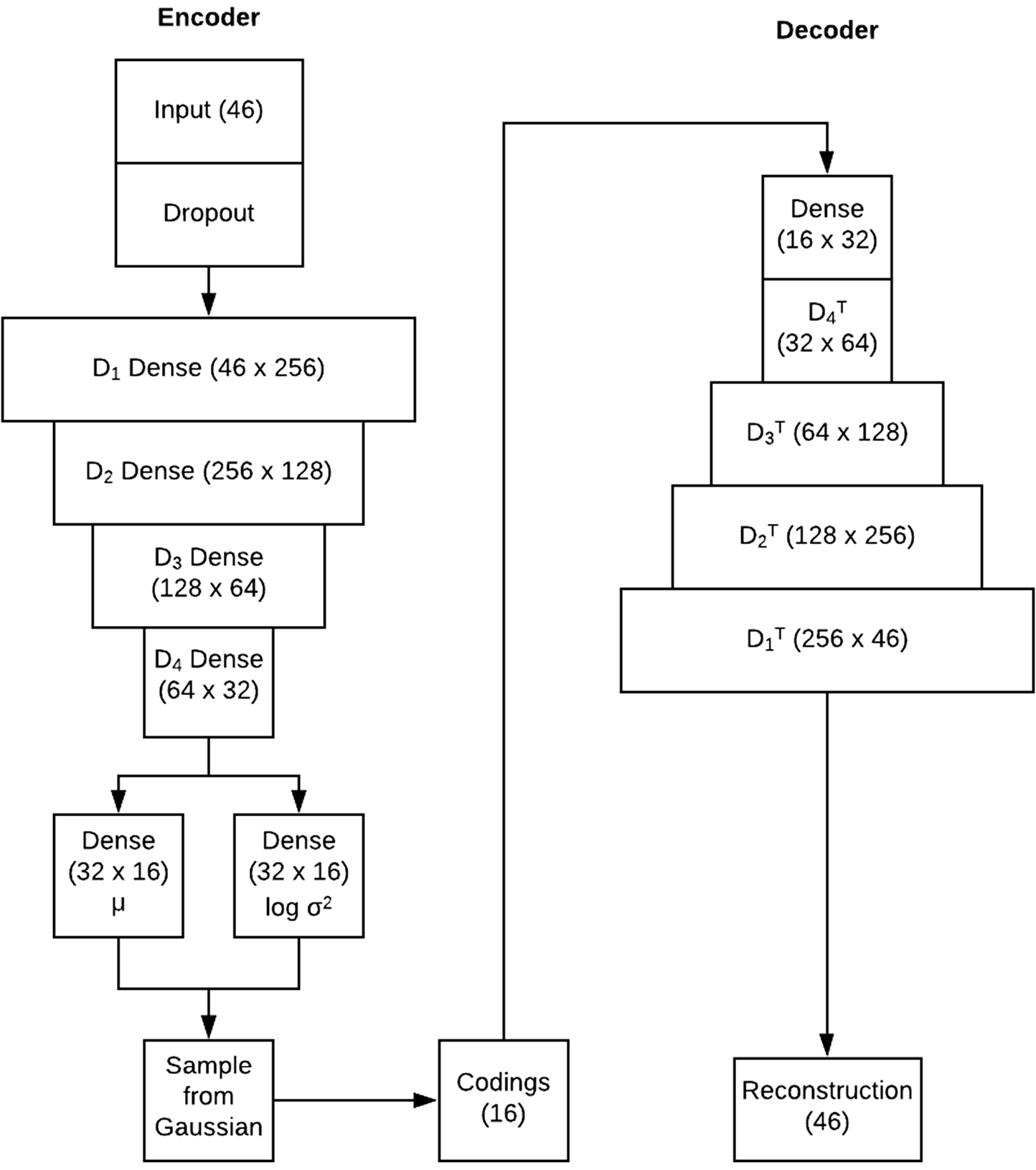
The breakthrough was identifying that Bayesian Regression Mean Imputation effectively "blinds" the model to the missingness pattern, forcing it to rely on the underlying biological signals.
The PICTURE System
- Core Engine: XGBoost (Gradient Boosting Trees).
- Input: Vitals, complete blood counts, metabolic panels, and calculated indices (Shock Index).
- Imputation: 20 rounds of iterative Bayesian refinement.
Experimental Results: SOTA Performance
PICTURE was tested against 42,987 hospital encounters from 2018. It didn't just beat simple scores; it outperformed optimized machine learning baselines.
Performance Comparison
| Method | AUROC | AUPR (Standardized) | WDR (Efficiency) |
|---|---|---|---|
| PICTURE | 0.83 | 0.27 | 3.9 |
| Logistic Regression | 0.80 | 0.22 | 5.3 |
| NEWS Score | 0.77 | 0.22 | 6.1 |
| SOFA Score | 0.63 | 0.10 | 11.3 |
The Workup-to-Detection Ratio (WDR) of 3.9 is particularly impressive—it means for every four alarms PICTURE triggers, one is a true deterioration event. This significantly reduces "alarm fatigue" compared to the NEWS score, which requires over six alarms to catch one event.
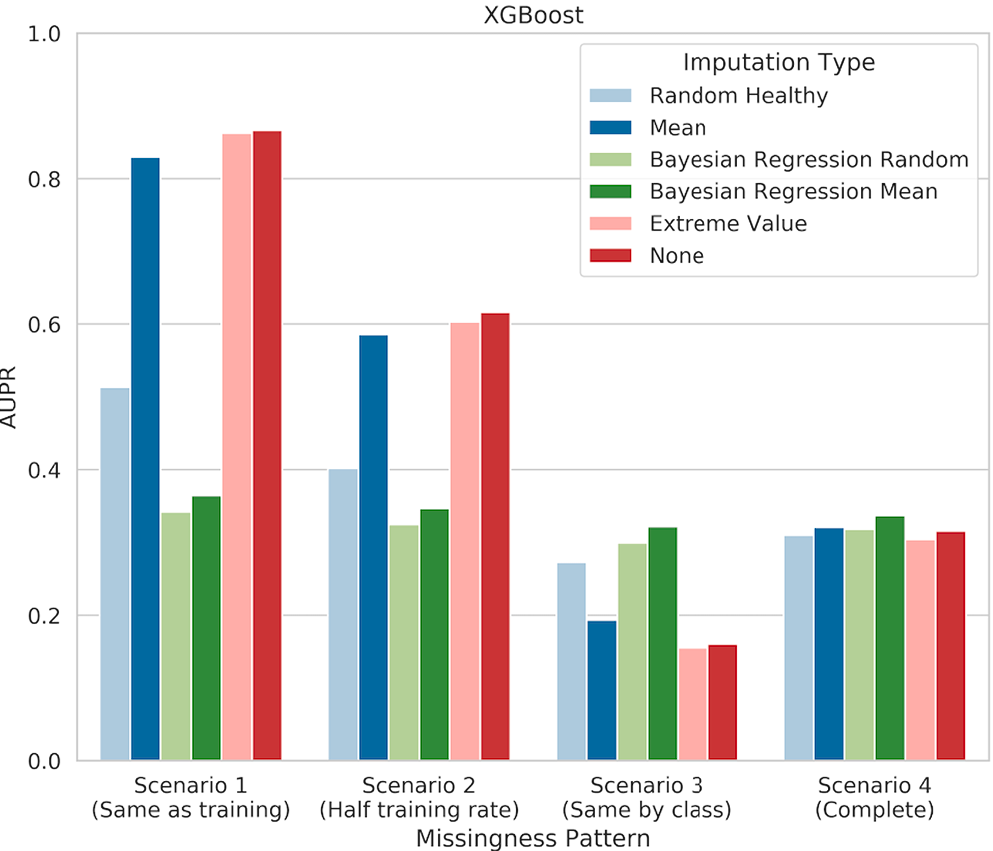 The simulation results (above) highlight how XGBoost's performance (None/Extreme imputation) collapses when missingness patterns change, while Bayesian methods remain stable.
Transparency: Opening the Black Box
One of the biggest hurdles for AI in medicine is trust. PICTURE utilizes SHAP (Shapley Additive Explanations) to provide a ranked list of "Why" for every alert. For instance, in cardiac arrest cases, the model consistently flagged Shock Index as the primary driver—a finding that has high "face validity" with clinical experts.
Critical Insight & Future Outlook
This work highlights a critical "Inductive Bias" in clinical ML: we want models to learn biology, not administrative behavior. By releasing their VAE code and weights, the authors have provided a roadmap for other researchers to validate their models against "realistic" synthetic data without violating patient privacy (HIPAA).
Limitations: While the Bayesian approach is robust, the study was conducted at a single academic center (Michigan Medicine). The next step for this technology is multi-center validation to prove that these de-biasing techniques hold up in diverse community hospital settings.
Conclusion: PICTURE proves that we don't have to choose between accuracy and generalizability. By identifying and neutralizing the "missingness trap," we can build AI that truly understands patient risk.