
Logic Over Semantics: Automating the Bridge Between Words and Numbers in Decision Making
Consistency-Driven Automatic Methodology to Set Interval Numerical Scales of 2-Tuple Linguistic Term Sets and Its Use in the Linguistic GDM With Preference Relation
This paper introduces a consistency-driven automatic methodology for defining interval numerical scales in 2-tuple linguistic representation models. By leveraging Linear Programming (LP), the method maps qualitative linguistic terms to quantitative interval values, achieving the first automated, semantics-free bridge between linguistic preference relations and interval numerical preference relations in Group Decision Making (GDM).
TL;DR
Researchers have developed a new way to automatically turn qualitative expert "talk" into precise mathematical intervals. By using Linear Programming to ensure that the logic of a decision stays consistent throughout the translation process, this methodology removes the need for tedious manual definitions of what words "mean" in a numerical sense.
Background: The "Computing with Words" Challenge
In high-stakes Group Decision Making (GDM), experts rarely provide raw numbers; they prefer linguistic labels like "Strongly Better" or "Fair." The 2-tuple linguistic model is the industry standard for processing these labels. However, the world isn't always symmetrical. "Very Good" might be much closer to "Excellent" than "Bad" is to "Terrible."
Defining these Unbalanced Linguistic Term Sets (ULTS) usually requires experts to manually map words to fuzzy sets—a process that is time-consuming and prone to human error.
The Core Insight: Consistency as a Driver
The authors, Dong and Herrera-Viedma, propose a brilliant shortcut: Consistency Preservation. Their logic is simple:
- If an expert is being logical (consistent) when they say is better than , and is better than , then MUST be better than .
- Therefore, a "good" numerical scale is one that keeps these logical relationships intact once the words are converted to numbers.
Methodology: The Linear Programming Approach
The paper formalizes this into an optimization problem. Instead of asking "What does 'Fair' mean?", the system asks "What interval for 'Fair' minimizes uncertainty while satisfying all transitivity rules?"
The Optimization Framework
The model seeks to:
- Minimize Uncertainty: Shrink the width of the intervals .
- Enforce Order: Ensure that "Better" is always numerically higher than "Fair."
- Guarantee Transitivity: For fuzzy relations, it follows .
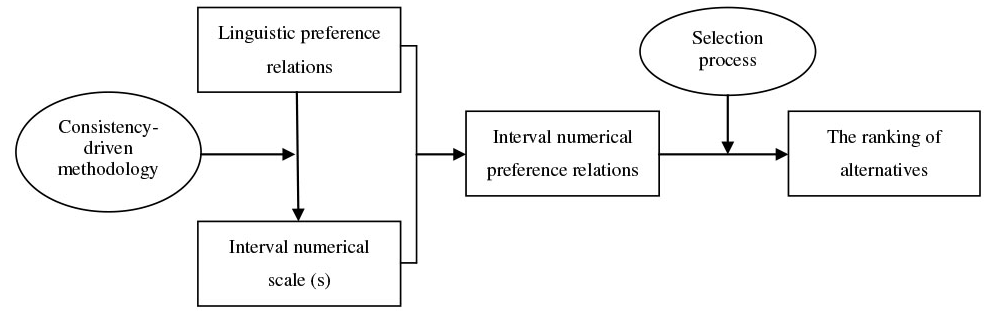 Figure 1: The framework for applying consistency-driven methodology in Group Decision Making.
Exporting to AHP: The Interval Multiplicative Scale
The researchers extended this to the Analytic Hierarchy Process (AHP). Traditionally, AHP uses a 1-9 scale. This paper allows for an Interval AHP Scale, where the system automatically constructs interval multiplicative preference relations based on the specific consistency of the expert’s input.
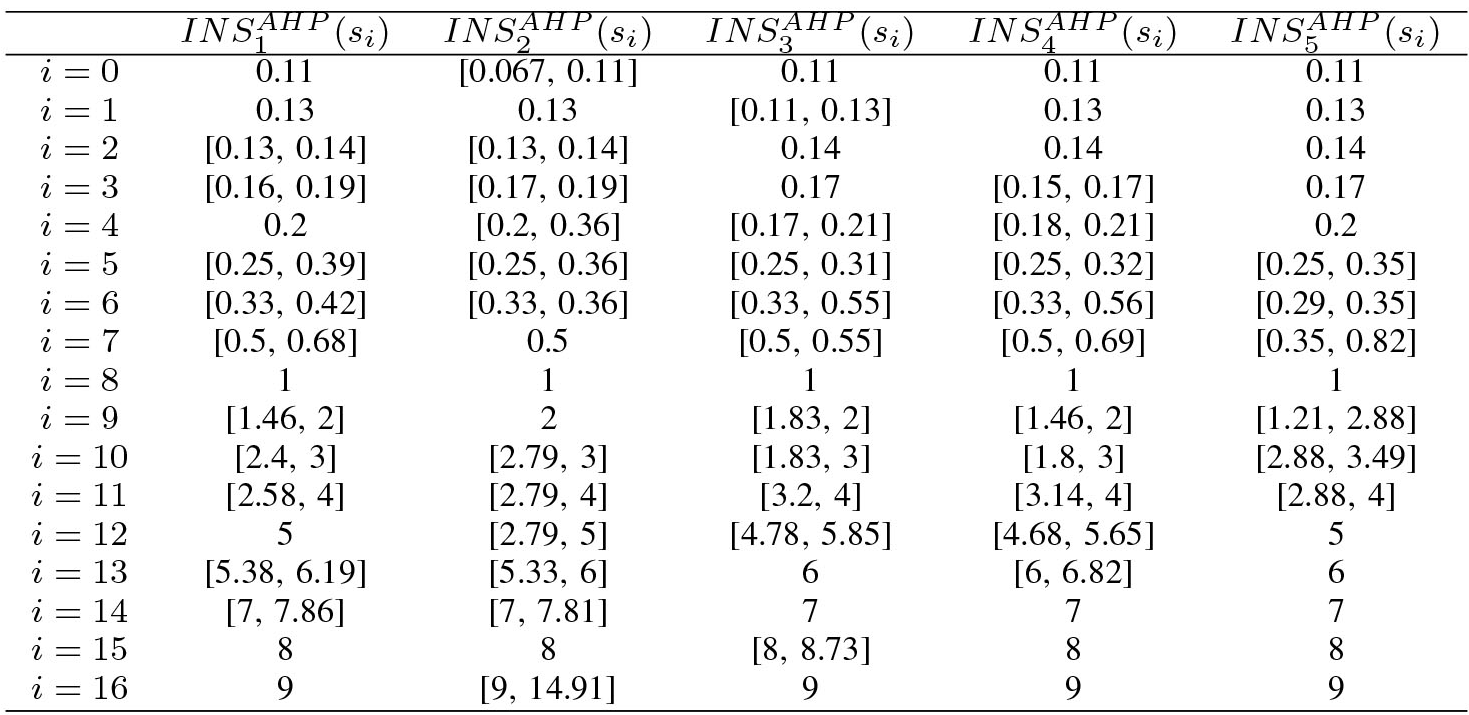 Table 1: Automatically generated Interval Numerical Scales (INS) for five different experts, highlighting how the system adapts to individual logic.
Experimental Results & Insights
The paper demonstrates the model through two major examples:
- Uniform Scaling: Where all experts share a scale calibrated by the group's collective logic.
- Individual Scaling: Recognizing that "words mean different things to different people," the system generates a custom scale for every expert.
The result? A ranking of alternatives (e.g., ) that is mathematically robust and captures the inherent uncertainty of linguistic labels without requiring a PhD in fuzzy logic from the end-user.
Critical Analysis
Advantages:
- Efficiency: Uses Linear Programming, which is computationally "cheap" and fast.
- Objectivity: Removes the "black box" of semantic definitions in Interval Type-2 Fuzzy Sets.
- Flexibility: Works for both additive (fuzzy) and multiplicative (AHP) contexts.
Limitations:
- Consistency Dependent: The model assumes the expert isn't being "random or illogical." If the input is pure noise, the optimization has no foundation.
- Preference Restricted: Currently only supports preference relations; it cannot yet handle simple vector-based linguistic evaluations.
Conclusion
This methodology represents a significant step toward Autonomous Decision Support. By letting the mathematical structure of the problem define the parameters of the language, we can build systems that understand "expert talk" with higher precision and less manual configuration.