
Beyond Friends and Enemies: Decoding Social Ties through Consistent Node Types
A model of consistent node types in signed directed social networks
This paper introduces a novel approach for edge sign prediction in signed directed social networks using a 16-type node classification model. By defining Bayesian node features that represent local link structures, the method achieves state-of-the-art performance on Wikipedia, Slashdot, and Epinions datasets.
TL;DR
Predicting whether a social link represents trust (+) or distrust (-) usually relies on "triads" (e.g., a friend of a friend). But what happens when two people have no mutual connections? This paper proposes a 16-type node model that looks at the inherent "behavioral type" of a node to predict edge signs, significantly outperforming traditional social status and balance theories, especially in sparse networks.
Background: The Limits of Social Balance
In the study of signed directed social networks (like Wikipedia's admin voting or Epinions' trust system), two theories have dominated for decades:
- Structural Balance Theory: "The enemy of my enemy is my friend."
- Social Status Theory: A positive link means the sender views the receiver as having higher status.
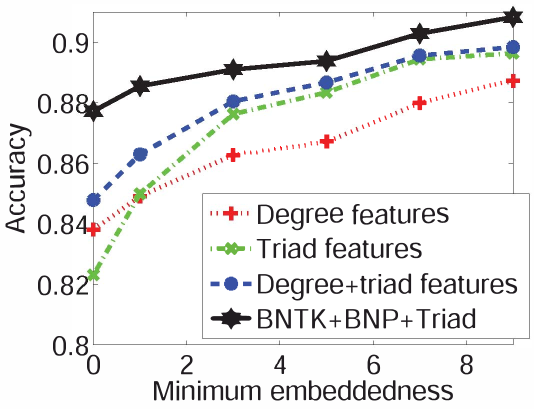
While elegant, these theories share a fatal flaw: Sparsity. They require "triads"—a common neighbor between nodes and . In the Slashdot dataset, nearly 48% of edges have zero embeddedness (no common neighbors). When there is no to provide context, triad-based models are essentially guessing.
The Methodology: The 16 Node Personalities
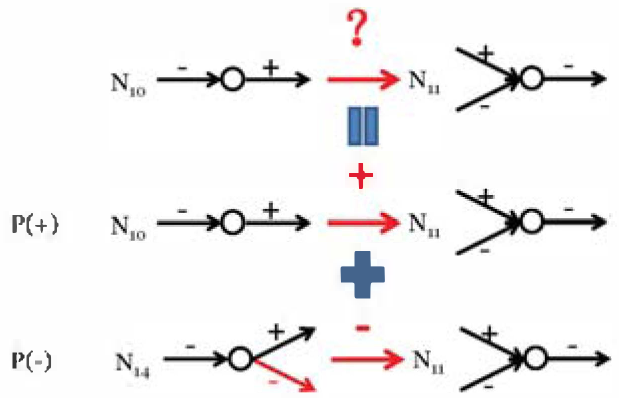
The authors argue that a node's local behavior (how it treats others and how it is treated) is a strong signal of the signs of its future edges. They define 16 Node Types based on:
- Connectivity: Does it have incoming edges, outgoing edges, or both?
- Sign Consistency: Are the edges all positive, all negative, or a mixture?
For example, a node that only receives negative edges (a "pariah") is fundamentally different from one that only sends positive edges (a "trusting" node).
Handling Uncertainty with Bayesian Features
In a real-world "partially observed" network, we don't know the signs of all edges. To solve this, the authors introduce Bayesian Node Features:
- Bayesian Node Type (BNT): Instead of a hard category, a node is represented as a probability distribution over the 16 types.
- Bayesian Node Properties (BNP): Calculated ratios of positive/negative edges combined with prior global probabilities.
- Kronecker Product (BNTK): To model how two nodes and interact, the authors use a Kronecker product of their type vectors, creating a 256-dimensional feature space that captures every possible "type-to-type" interaction.
Experiments and SOTA Comparison
The authors tested their model against traditional degree features, triad features, and low-rank matrix completion.
Key Result 1: Performance across Datasets
The Bayesian Node Type approach (combined with BNP and Triads) consistently outperformed all baselines.
| Method | Wikipedia | Slashdot | Epinions |
|---|---|---|---|
| Triad Features | 82.46% | 80.42% | 90.42% |
| Degree + Triad | 84.87% | 84.91% | 92.25% |
| BNTK + BNP + Triad (Ours) | 87.37% | 85.65% | 93.13% |
Key Result 2: The Sparsity Solution
As shown in the authors' analysis, the "Node Type" model provides a robust prediction even when the number of common neighbors is zero. This fills the critical gap where structural balance theory fails.
Critical Insight & Conclusion
This paper shifts the focus from relationships (the edge) to identities (the node). It effectively argues that in social systems, nodes have "roles" or "behavioral profiles" that remain consistent. A node that acts as a "source of negativity" will likely continue to send negative edges, regardless of whether a common friend exists to mediate the relationship.
Limitations: The model currently treats node types as static. In dynamic social networks, a "trusted" node can become a "foe" over time (e.g., social scandals). Future work integrating temporal dynamics into these 16 categories would be a significant leap forward.
Takeaway for Practitioners: When building recommendation or trust systems for sparse graphs, don't just look at who follows whom—look at the "nature" of the person participating in the link.