
Beyond the Source: Why Conspiracy Thinking and Framing Dictate Our Perception of Fake News
Effects of Conspiracy Thinking Style, Framing and Political Interest on Accuracy of Fake News Recognition by Social Media Users: Evidence from Russia, Kazakhstan and Ukraine
This study investigates how individual cognitive styles and news features influence the accuracy of fake news recognition among social media users in Russia, Kazakhstan, and Ukraine. Utilizing a large-scale online experiment (), the researchers identified that "conspiracy thinking" significantly impairs detection accuracy while news framing acts as a critical contextual moderator.
TL;DR
In an era of digital misinformation, what determines whether you can spot a lie? A massive study across Russia, Kazakhstan, and Ukraine reveals that it isn't just about who tells the story, but how it is framed and your own "conspiracy mentality." While dominant social frames help us recognize the truth, they also make us more vulnerable to well-packaged fakes.
The Core Conflict: Trust vs. Accuracy
Most people use "trust" and "accuracy" interchangeably, but this research draws a sharp line between them. News Credibility is a subjective inclination to believe, whereas Detection Accuracy is the objective ability to separate fact from fiction.
The researchers hypothesized that while we might trust our domestic sources more, that very trust might act as a "cognitive blindfold," making us less likely to scrutinize the information.
Methodology: A Trilateral Experiment
The study involved a robust sample of over 8,500 participants across Facebook and VKontakte. Participants evaluated news items that were systematically manipulated by:
- Truthfulness: Was the news actually true?
- Framing: Did it use "Dominant" (familiar/nationalistic) or "Alternative" (rare/unfamiliar) narratives?
- Source: Was it attributed to a domestic or foreign outlet?
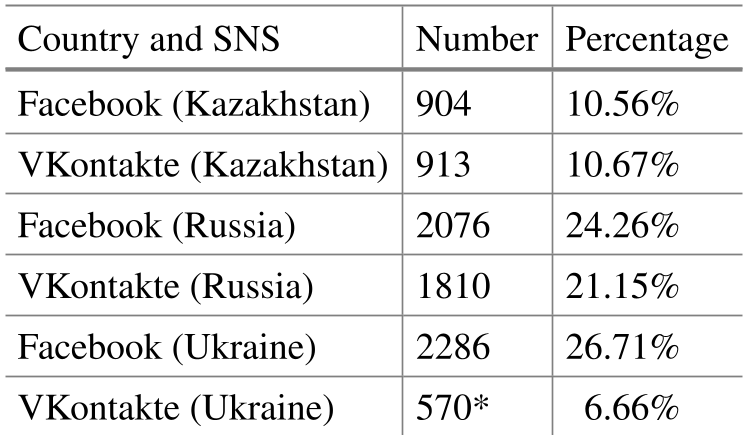 Table 1: Distribution of participants across countries and social networks.
Key Insights: Why We Fail to Spot Fakes
1. The "Conspiracy Mentality" Tax
The strongest individual predictor of failure was a "conspiracy thinking style." Users who believe that "official stories are rarely the truth" or that "covert organizations control events" were significantly less accurate at identifying fake news. This suggests that a generalized skepticism toward institutions doesn't make one a better "fact-checker"; instead, it creates a cognitive bias that welcomes alternative (and often false) narratives.
2. The Interaction of Framing and Truth
The most striking finding was the interaction effect between news frames and truthfulness.
- Dominant Frames act as a catalyst: they make true news easier to recognize as true, but they also make fake news much harder to debunk.
- If a fake news story is wrapped in a familiar nationalistic or social narrative that the user already accepts, its "believability" skyrockets, bypassing analytical filters.
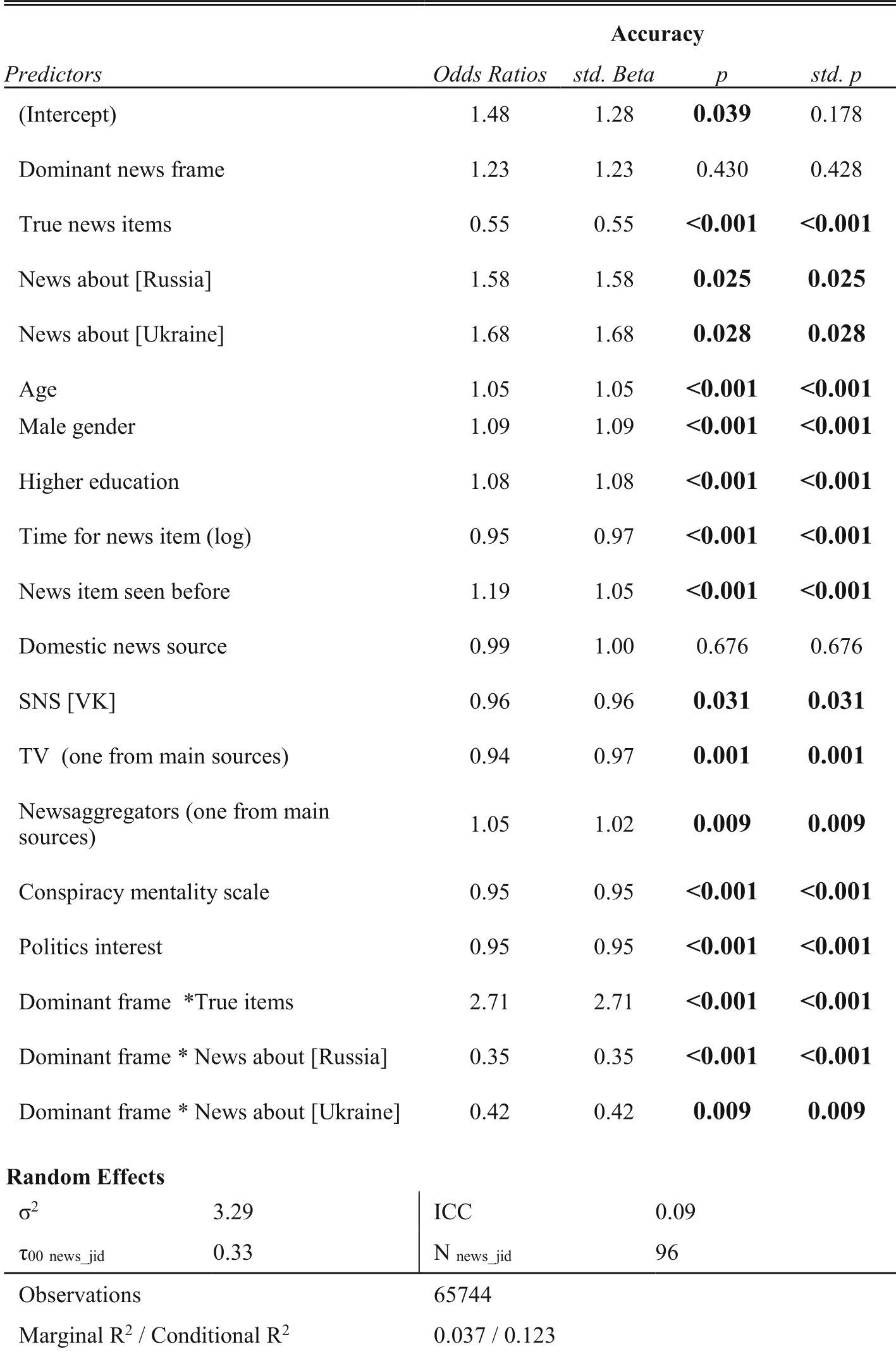 Table 3: GLM Mixed Regression results showing the significant impact of interaction effects.
3. The Source Paradox
Contrary to expectations, whether a news item came from a domestic or foreign source mattered very little for accuracy. In the modern social media ecosystem, the "Source Cue" is often overshadowed by the content's "Frame." Users seem to be reacting to the message and how it aligns with their worldview rather than the messenger.
Critical Analysis & Future Outlook
The study reveals a sobering reality: Political interest does not equal political literacy. In fact, participants with higher self-reported interest in politics were less accurate in recognizing fakes. This suggests that high interest might be linked to high polarization, where "motivated reasoning" leads users to accept fakes that support their tribe.
Limitations: The study relied on a survey model where participants knew they were being tested. In a "natural" social media scroll, accuracy might be even lower as users are less likely to employ "deliberation."
The Takeaway: To fight misinformation, we cannot simply rely on "flagging sources." We must address the underlying "Conspiracy Mentality" and understand that familiar frames are the most dangerous vehicles for deception. Future interventions should focus on "Pre-bunking"—teaching users to recognize the framing techniques used in misinformation rather than just debunking individual stories.