
Balancing Privacy: A Game-Theoretic Approach to Multi-Party Content Sharing
Constrained Social-Energy Minimization for Multi-Party Sharing in Online Social Networks
The paper introduces a game-theoretic framework for multi-party access control in online social networks (OSNs). It proposes a social-energy minimization model where stakeholders iteratively reach a consensus on privacy settings for shared content, achieving a balance between personal comfort and peer pressure.
TL;DR
When you are tagged in a photo on Facebook or Instagram, why does the uploader get the final say on who sees it? This paper addresses this "multi-party access control" (MPAC) flaw by proposing a game-theoretic framework. By modeling users as agents seeking to minimize "social energy," the researchers demonstrate how groups can—and do—reach a mathematical consensus that respects both individual privacy comfort and peer social pressure.
The "Uploader's Dilemma": Why Static Privacy Fails
Most Online Social Networks (OSNs) operate on a discretionary access control model. If Alice uploads a photo of Bob and Charlie, only Alice controls the visibility. If Bob is a private person and Alice is a public influencer, Bob’s privacy is compromised without his consent.
The authors identify two core problems with current systems:
- Inflexibility: Binary "Public/Private" choices don't capture the nuance of social circles.
- Lack of Collaboration: Stakeholders (those tagged or mentioned) have no formal mechanism to negotiate the visibility of content that affects their reputation.
Methodology: Social Energy Minimization
The researchers treat privacy selection as a Consensus-Building Game. Each user seeks to minimize their Social Energy , which is defined by two competing forces:
- Personal Comfort (): A quasi-convex function representing how far the current setting is from the user’s preferred privacy level ().
- Peer Pressure (): A social cost that increases over time as long as the group fails to agree. It pushes users to align their settings with their neighbors ().
The Model Logic
The "uploader" sets an initial upper bound (the most public the content can be). Subsequent stakeholders can then iterate, moving the setting toward a more "private" state.
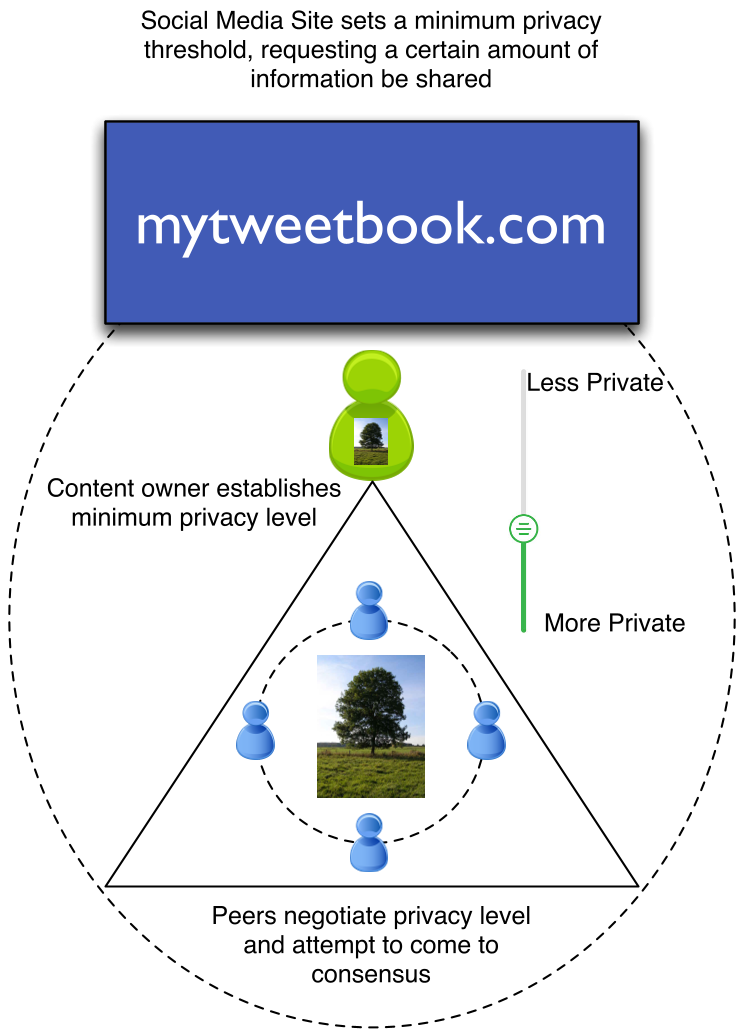 Figure 1: The Multi-Party Access Control (MPAC) workflow showing how individual utility functions converge into a collaborative decision.
Dealing with Human "Internal Noise" (Bounded Rationality)
Unlike perfect algorithms, humans don't always pick the mathematically optimal choice. To solve this, the authors use the Quantal Response model. This introduces a rationality parameter :
- As , users are perfectly rational.
- As , users act randomly. This allows the model to simulate real-world "noise" where users might make sub-optimal privacy choices due to haste or lack of information.
Experimental Insights: From Theory to Reality
The authors validated their model with a study of 95 individuals in a mock social network. They found that when users were allowed to revise their settings after seeing their friends' choices, they naturally converged.
Key Results:
- Convergence to the Mean: Rational play leads the final setting to the mathematical average of the group's initial preferences.
- The Lambda Effect: In simulations, higher rationality (higher ) ironically requires more rounds of negotiation to reach consensus, as users are more "stubborn" about their optimal choice.
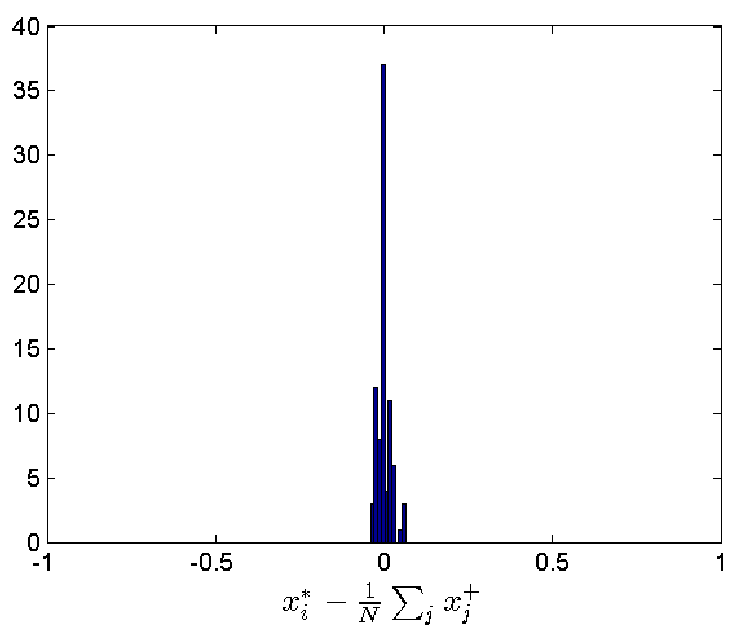 Figure 2: Histogram showing that real human consensus (x) centers almost perfectly on the mean comfort levels of the group, validating the mathematical prediction.*
Critical Analysis & Conclusion
This paper is a significant shift from "hard" security (encryption/firewalls) to "soft" behavioral security. It treats privacy as a social contract rather than just a database permission.
Takeaways for the Industry:
- UI/UX Implications: OSNs should implement "pre-publication" negotiation windows for multi-party content.
- Predictive Privacy: Platforms could use these energy functions to predict a consensus setting before a conflict even arises, reducing social friction.
Limitations: The current model assumes a "complete graph" (everyone in the group is connected). In large-scale releases, asymmetrical peer pressure (e.g., a celebrity vs. a normal user) would likely distort the "mean-convergence" result, representing a fertile ground for future research.