
Constrained Swap Dynamics: Is Your Target Item Reachable in a Social Network?
Constrained Swap Dynamics over a Social Network in Distributed Resource Reallocation
This paper investigates the distributed resource reallocation problem (Housing Market) over social networks where agents perform rational pairwise swaps. It introduces the Reachable Object (RO) and Guaranteed Level of Satisfaction (GLS) problems, analyzing their complexity under budget constraints like the number of swaps and total process duration. The authors establish that while these problems are generally NP-hard, they become Fixed-Parameter Tractable (FPT) in bounded-degree networks when constrained by the sequence length.
TL;DR
In a distributed "Housing Market," agents swap items with neighbors to improve their own utility. This paper explores whether a specific agent can eventually obtain a target item (Reachable Object) or be guaranteed a minimum utility (Guaranteed Level of Satisfaction). While these problems are generally hard, the authors prove they are solvable in "Fixed-Parameter Tractable" (FPT) time for typical social networks (bounded degree) when the trade sequence is not excessively long.
Problem & Motivation
Imagine an online swap meet or a task reassignment system. You have an item, but you want something else. You can only trade with people you "trust" or can "reach" (your neighbors in a social graph). Every trade must be rational—both parties must end up better off.
Previous research showed that even if the network is a simple tree, figuring out if you can ever get your dream item is NP-complete. This is discouraging. However, the authors of this paper noticed that in the real world:
- Agents aren't willing to perform 1,000 swaps to get one item.
- Social networks usually have a limited number of connections per person (bounded degree).
- We want more than just "hope" (Reachability); we want "guarantees" (Satisfaction).
Methodology: The Logic of Swaps
The authors define the Swap Dynamics Model where an instance consists of agents, objects, preference lists, an initial allocation, and a social graph .
To analyze complexity, they move beyond simple NP-hardness and use Parameterized Complexity. They focus on two types of budgets:
- Max-Swaps (): No agent performs more than exchanges.
- Makespan/Sum (): The total length of the sequence or the "time" (allowing parallel swaps) is limited.
They utilize a sophisticated link to First-Order (FO) Logic Model Checking. By translating the swap process into FO formulas, they leverage established theorems to place these problems into parameterized classes like and .
 Figure 1: The model of swap dynamics where agents A, B, C, and D exchange items based on neighbor connectivity and ranked preferences.
Experiments & Results
The paper is theoretical, providing proofs rather than bench experiments. The key findings are:
1. The Bad News: Max-Swaps per Agent
Even if you tell every agent they only have to swap twice (), the problem of reaching an object remains NP-complete. The authors proved this via a reduction from (3, B2)-SAT. This suggests that merely limiting individual effort doesn't make the global problem easier.
2. The Good News: Sequence Length and Bounded Degrees
When we limit the total time (makespan) or total exchanges:
- The problem is in , making it "not so hard" in the hierarchy of parameterized complexity.
- On Bounded Degree Graphs, the problem becomes FPT. This is the "Eureka" moment: if your social network doesn't have "super-nodes" with infinite connections, and you're looking for an item within a reasonable number of steps, we can solve it efficiently!
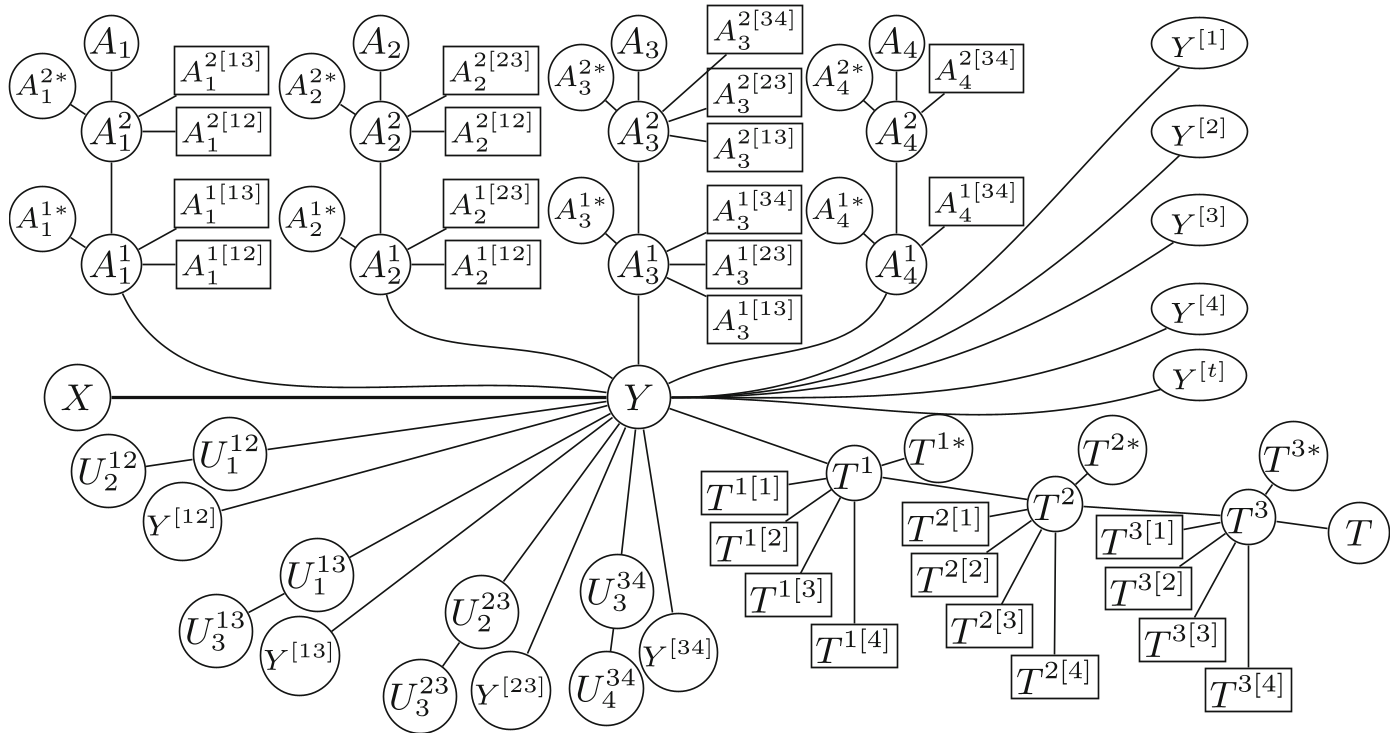 Figure 2: A sketch of the reduction from the Clique problem to RO-sum on trees, helping establish -hardness.
Critical Analysis & Conclusion
Takeaway
The most significant contribution is the duality between RO (optimistic search) and GLS (pessimistic guarantee). By proving that GLS is effectively the "dual" of RO, the authors provide a framework for systems that offer users firm guarantees rather than just potential outcomes.
Limitations
- Full Knowledge: The model assumes everyone knows everyone else’s preferences and the whole network structure. In a truly distributed system, agents only have local information.
- Strict Preferences: The model doesn't account for ties (indifference), which are common in real life.
Future Work
The authors suggest looking into Single-Peaked Domains (where preferences follow a specific logical order) and exploring "Incomplete Information" scenarios where agents must trade without knowing the full graph. This work paves the way for more robust, algorithmically sound peer-to-peer exchange platforms.