
UBS: Bridging Declarative Linguistics and Computational Efficiency via CLP
Constraint logic programming for computational linguistics
The paper introduces a framework and a prototype system called UBS (Unifikations Basierte Sprache) that applies Constraint Logic Programming (CLP) to computational linguistics. It integrates typed feature structures, finite sets, and negation into a declarative first-order logic environment, primarily targeting the implementation of Head-Driven Phrase Structure Grammar (HPSG).
TL;DR
This paper presents UBS, a prototype system that leverages Constraint Logic Programming (CLP) to solve the long-standing tension between the expressive needs of linguists and the performance requirements of computers. By treating linguistic phenomena—like feature structures and word order—as active constraints rather than passive data, the authors provide a pathway to implement complex grammars like HPSG without the typical performance "tax" of meta-programming.
The Core Conflict: Expressivity vs. Tractability
In computational linguistics, we want to describe language declaratively—telling the computer "what" a grammar is, rather than "how" to parse it. Logic programming (Prolog) is a natural fit, but it fails when faced with:
- Typed Feature Structures: Standard unification is too slow for complex sort hierarchies.
- Sets: Used for unbounded dependencies, set unification is notoriously NP-hard.
- Negation: Essential for defining "any form except 3rd person singular," yet difficult to implement safely in logic.
The authors argue that the answer isn't "less logic," but better logic—specifically, CLP.
Methodology: The CLP Secret Sauce
The authors move beyond simple syntactic term unification. They redefine the problem as a Constraint System .
1. Compiled Sort Hierarchies
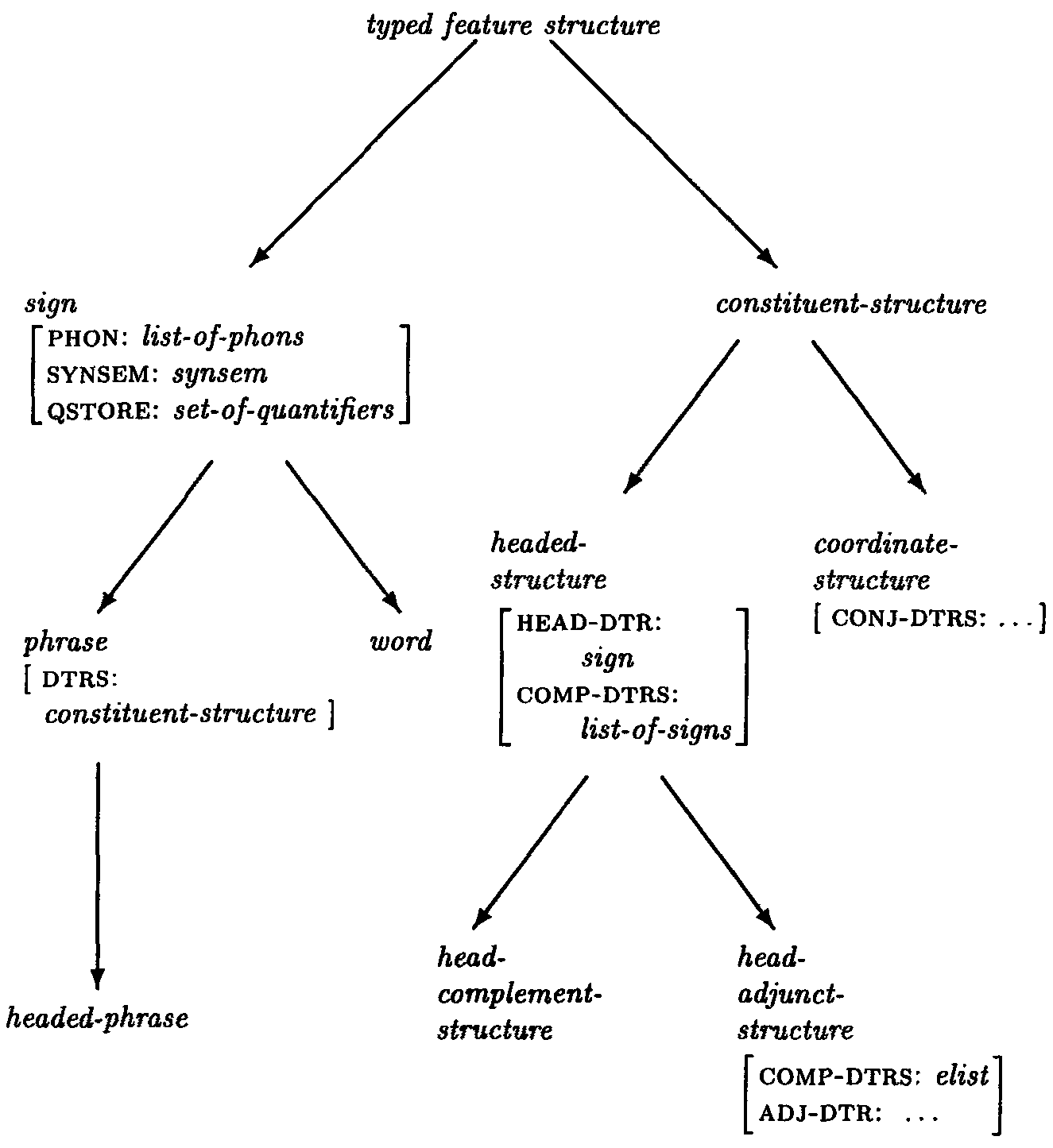
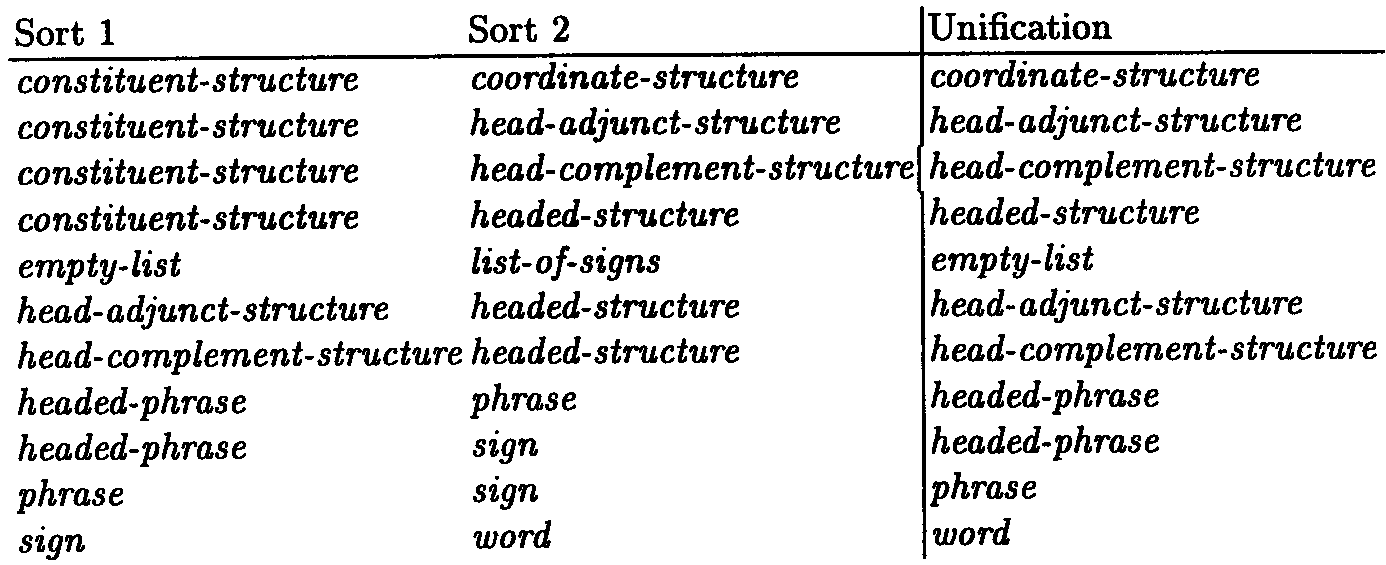
Instead of traversing a tree for every unification, UBS compiles the HPSG sort hierarchy into a pre-computed unification table. This turns inheritance checks into quasi-constant time lookups.
2. Set Unification via Simplification
Set unification often leads to "constraint multiplication" and explosive branching. UBS uses Constraint Handling Rules (CHRs) to delay non-deterministic choices. By treating as a delayed disjunction and applying the "first-fail principle," they prune the search tree far earlier than traditional methods.
3. Active Constraints for Word Order
One of the most elegant contributions is the treatment of Linear Precedence (LP). Instead of generating all permutations and then filtering them (Generate-and-Test), UBS sets up LP rules as Active Constraints. Using ECLiPSe's delay mechanism, a goal like order_consts is suspended until enough variables are instantiated to make a definitive judgment, effectively turning the parser into a "Constrain-and-Generate" engine.
Experiments: German Relative Clauses
The system was tested on German relative clauses (e.g., "Der Junge, der die Frau sieht, lacht"). German is notoriously difficult due to its flexible word order.
Key Result: Word Order Domains (WODs)
In tasks involving domain union (shuffling word clusters), a naive approach might generate permutations. By applying LP rules as negative constraints—where if unifies with , must not unify with —the search space is collapsed dramatically.
Critical Insight & Analysis
The real value of this work is the realization that linguistic constraints are "active" agents. In most systems, a constraint is a filter applied at the end. In UBS, a constraint is a process that survives throughout the computation, "waking up" only when relevant data arrives. This "coroutining" is what allows the system to remain declarative while behaving like a highly optimized procedural parser.
Limitations: While UBS is more efficient than pure Prolog, the authors admit that for "real-life applications," it still faces speed hurdles. The complexity of set unification remains a theoretical bottleneck, even if CLP provides better heuristics.
Future Outlook
This paper serves as a precursor to modern "Constrained Decoding" in LLMs, though the latter uses probabilistic constraints. As we move back toward neuro-symbolic AI, the techniques pioneered in UBS—especially the efficient handling of sort hierarchies and sets—may find new life in guiding the output of large-scale neural models.
Takeaway: If your logic program is slow, don't stop using logic—start using constraints.