
CLP: Bridging the Gap Between AI Heuristics and OR Optimization
Constraint logic programming for qualitative and quantitative constraint satisfaction problems
This paper introduces Constraint Logic Programming (CLP) as a unified framework to solve Qualitative/Quantitative Constraint Satisfaction Problems (QQCSP). By integrating the symbolic representation of AI with the computational efficiency of Operations Research (OR), the proposed CLP(R) approach achieves comparable performance to Mixed Integer Programming (MIP) while offering superior flexibility.
TL;DR
Real-world decision-making is rarely purely numerical or purely logical. This paper proposes Constraint Logic Programming (CLP) as a hybrid architecture to solve Qualitative/Quantitative Constraint Satisfaction Problems (QQCSP). By replacing the rigid 0-1 variable mapping of Mixed Integer Programming (MIP) with flexible predicate logic, CLP achieves massive representational economies (reducing thousands of constraints to a handful of rules) and enables partial solutions and easier model revisions without sacrificing computational speed.
The "Rigidity" Trap: Why MIP Struggles with Heuristics
In traditional Operations Research (OR), symbolic rules (e.g., "Assign highly skilled workers to high-priority products") must be forced into the Procrustean bed of Mixed Integer Programming (MIP). This process, known as propositional mapping, creates several pains:
- Matrix Explosion: Every logical condition requires new 0-1 variables, leading to massive, sparse matrices that are difficult to debug.
- Inflexible Revisions: If a business rule changes (e.g., new product priority), the entire MIP matrix often needs to be rebuilt from scratch.
- Binary Outcomes: MIP is "all-or-nothing"—it gives an optimal solution or an "Infeasible" error, providing no insight if data is missing.
Methodology: The CLP(R) Architecture
The authors propose a dual-level approach that mimics human decision-making:
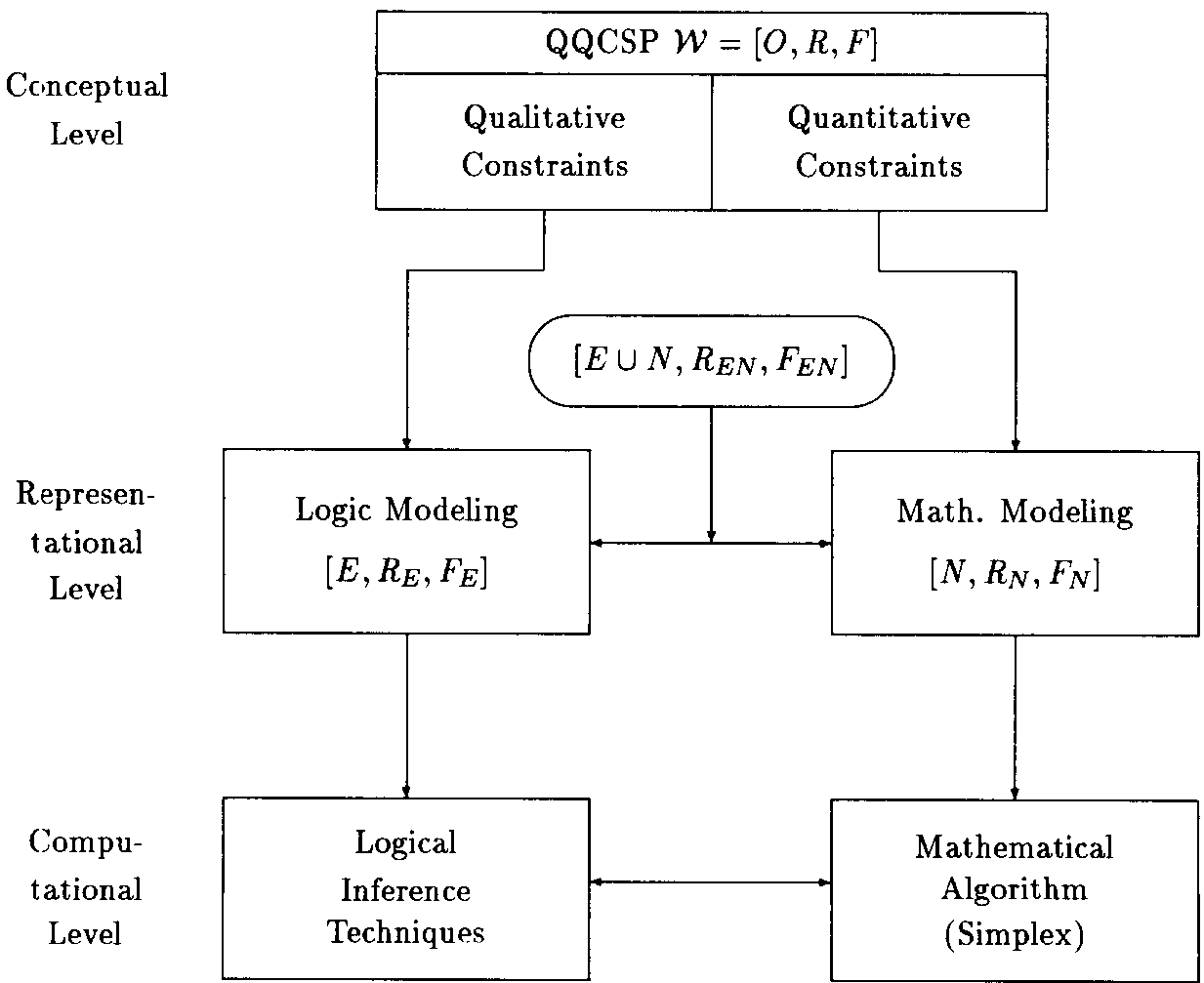
1. Representational Level
Unlike MIP, which maps everything to numbers, CLP maintains a Logical Model (Predicate Logic) for symbolic objects and a Mathematical Model (Numeric Relations) for quantities. They are linked through a shared relational system .
2. Computational Level: The Generate-and-Solve Loop
The CLP(R) interpreter contains an Inference Engine and a Constraint Solver.
- Inference: Uses deduction to find a feasible qualitative assignment.
- Solver: Uses a modified Simplex method to optimize the quantitative "Product Mix."
- Backtracking: If the solver finds the numerical constraints infeasible under the current symbolic assignment, the engine backtracks to find a new qualitative candidate.
Case Study: Production Planning
The paper demonstrates a manufacturing scenario involving labor assignment (Qualitative) and product mix profit maximization (Quantitative).
Representational Economies
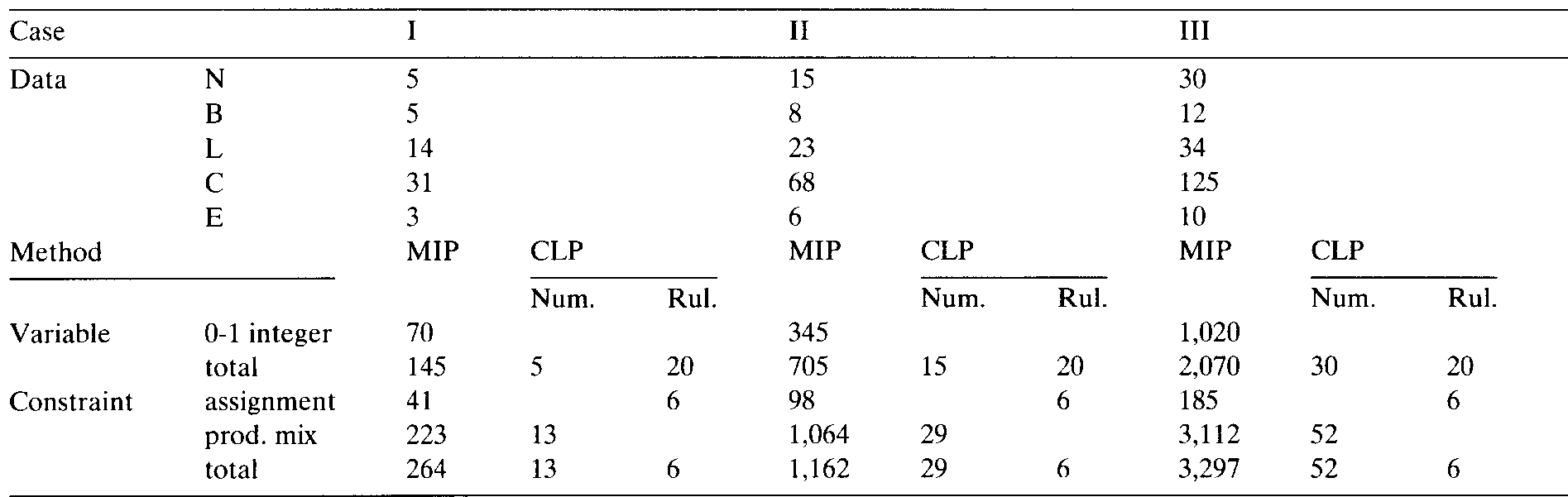
The difference in scale is staggering. In Case III (30 products, 12 labor groups), the MIP approach requires a matrix of 3,297 constraints and 2,070 variables. CLP replaces this with 6 predicate rules and 20 symbolic variables.
The Power of Partial Solutions
A unique advantage of CLP is its ability to handle incomplete information. If a manager doesn't know the exact profit target but wants to know the required man-hours for a range, CLP returns a partial solution (e.g., ) rather than failing. This allows for interactive "what-if" analysis that is impossible with standard MIP solvers.
Critical Insight: Why Does This Work?
The core "Why" behind CLP’s effectiveness is its Inductive Bias. By using Predicate Logic, CLP recognizes patterns (e.g., "All Men are Mortal") rather than treating every instance (Socrates, Plato) as a unique binary variable. This allows the model to stay "compact" as the problem size grows, whereas MIP’s matrix size grows exponentially.
Conclusion & Strategic Takeaways
The paper successfully argues that we don't need to choose between AI's representational power and OR's computational speed.
- For Researchers: This work paves the way for "Modeling Languages" that allow users to express complex constraints naturally without being OR experts.
- For Practitioners: CLP is a superior choice for environments with frequent rule changes or incomplete data, providing a more robust decision-support framework than pure optimization or pure expert systems.
While the paper shows CLP's efficiency is "comparable" to MIP, the true value lies in the cognitive economy—the ease with which a human can understand, revise, and interact with the model.