
Toward Evidence-Based Legal Reasoning: Marrying Logic Trees with DeepQA
Toward constructing evidence-based legal arguments using legal decision documents and machine learning
This paper presents a framework for automating the extraction and construction of evidence-based legal arguments using the Vaccine/Injury Project (V/IP) Corpus. It integrates a Default-Logic Framework (DLF) for modeling legal reasoning with the IBM Watson DeepQA architecture to transform legal decision documents into structured, computable argumentation models.
TL;DR
This research tackles the challenge of transforming unstructured legal decisions into structured, evidence-based arguments. By combining the Default-Logic Framework (DLF) with IBM's DeepQA (the engine behind Watson), the authors demonstrate how to move beyond simple keyword searches toward a system that understands the "why" and "how" of legal reasoning in vaccine injury cases.
Academic Positioning: This work is a seminal bridge between formal legal logic and high-performance Natural Language Processing (NLP), significantly advancing the field of Argumentation Mining.
Problem & Motivation: The Fog of "Open-Textured" Law
In law, terms like "proximate cause" or "entitled to compensation" are notoriously "open-textured"—their meaning evolves with every new court decision. Finding relevant precedents manually is time-consuming and expensive.
Current search tools are too shallow; they identify what a case is about but fail to capture:
- Horizontal Relevance: Which specific legal sub-issue does this evidence support?
- Vertical Relevance: How deep is the evidentiary chain (foundations vs. conclusions)?
- Presuppositions: The implicit common-sense links (e.g., "vaccination leads to symptoms") that make an argument persuasive.
Methodology: The Three-Layered Intelligence
The authors propose a sophisticated layering of information to "teach" a machine how to argue:
1. The Default-Logic Framework (DLF)
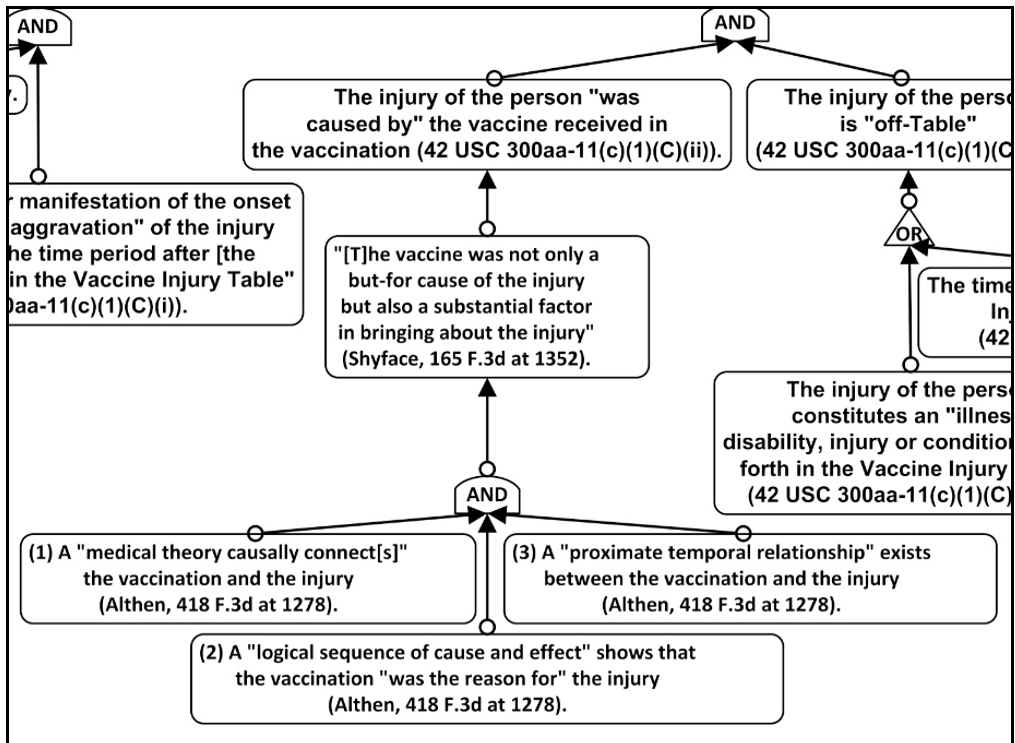
Instead of flat text, the law is viewed as an Inverted Rule Tree. In the Vaccine/Injury Project (V/IP) Corpus, the "Althen test" for causation is broken down into three prongs.
2. DeepQA Integration
The researchers adapt the DeepQA pipeline (famous for winning Jeopardy!).
- ESG Parser: Breaks down the sentence structure.
- PAS Builder: Simplifies the syntax so that different sentences with the same meaning are recognized as identical logical assertions.
- Relation Extraction: Identifies domain-specific links, such as
[Vaccine] -> [CauseVerb] -> [Injury].
3. Presuppositional & Pragmatic Layering
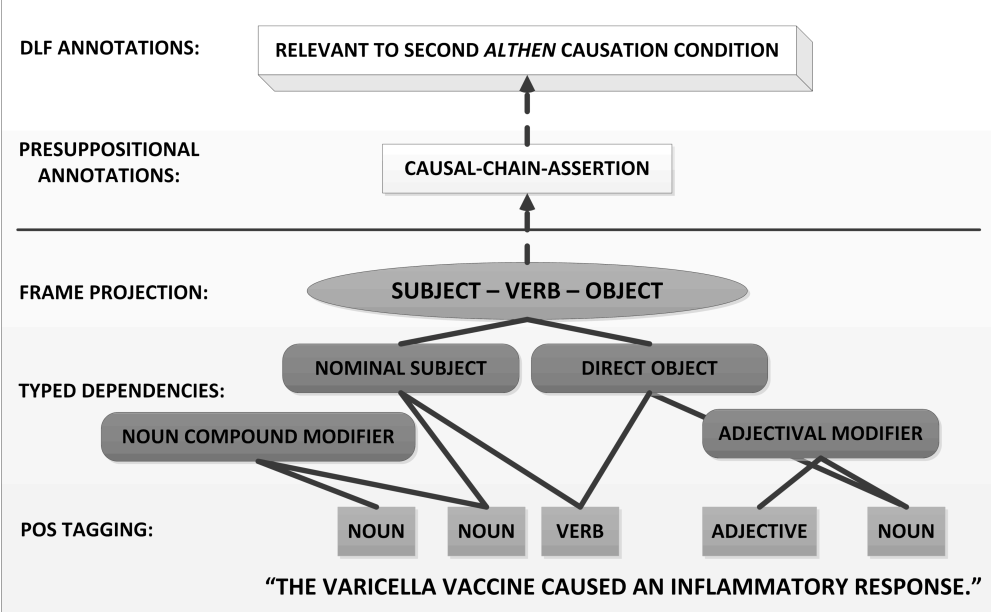
This final layer (shown below) wraps the linguistic analysis inside a legal context. It determines if a sentence is a "finding of fact" by a judge or merely a witness's testimony, assigning plausibility scores using a 7-valued ordinal scale.
Experiments & Results: Mapping the Casey Case
The framework was applied to the Casey v. Secretary of Health and Human Services case. The system successfully extracted 1,000+ assertion nodes across 35 decisions.
Key findings:
- Granularity Matters: By decomposing high-level concepts into leaf-node assertions (e.g., "symptom onset within 4 weeks"), the retrieval task became significantly more tractable.
- Confidence Scoring: Using Watson's scoring techniques, the system could identify which pieces of evidence were "Highly Plausible" based on the Special Master's findings.

Critical Analysis & Conclusion
The "Takeaway": This paper proves that legal argumentation is not just about words; it’s about inferential topology. By modeling the rule tree, we provide a "ground truth" that allows machine learning to navigate complex legal logic.
Limitations:
- Manual Effort: At the time of writing, much of the DLF annotation required human experts.
- Data Scale: The corpus (35 cases) is small, though dense.
Future Outlook: With today's LLMs (like GPT-4), the "Manual" part of this framework could potentially be automated. This paper provides the architectural blueprint for how a truly "Legal" AI should think—not just by predicting the next word, but by navigating the logical trees of evidence and authority.