
Precise Peer Influence Marketing: Building Friendships via Consensus Link Prediction
Constructing friendship in social networks for precise peer influence marketing by consensus link prediction algorithm
This paper introduces a user friendship construction system for precise Peer Influence Marketing (PIM), centered on a novel Consensus Link Prediction Algorithm (CLPA). By adaptively combining 12 different similarity indices (SIs) and integrating them with a Hill Climbing Algorithm (HCA), the model successfully builds friendships between dissimilar influencers and target users in scale-free social networks.
TL;DR
Peer Influence Marketing (PIM) is limited by the influencer's existing circle. This paper presents a framework to force-expand these circles by using a two-stage approach: a Consensus Link Prediction Algorithm (CLPA) to accurately find potential bonds in complex networks, and a Hill Climbing Algorithm (HCA) to strategically recommend "bridge friends" that bring influencers and target customers together.
The Problem: The "Dissimilarity" Barrier
In social networks, most algorithms are great at predicting links between people who are already similar (e.g., have 10 common friends). However, for a brand to grow, it must connect influencers with dissimilar users.
Current SIs (Similarity Indices) like Common Neighbors or Katz struggle with "scale-free" networks—where a few "super-nodes" have thousands of connections while most have few. A single index cannot capture the nuances of these varied structures.
Methodology: The CLPA-HCA Framework
1. Consensus Link Prediction Algorithm (CLPA)
Instead of betting on one mathematical model, the authors use 12 different indices categorized into:
- Direct-friend based: Salton, AA, RA, etc.
- Indirect-friend based: Local Path, Katz index.
- Quasi-friend based: Average Commute Time, SimRank.
To make these work together, they use Taboo Search (TSA) to optimize the weights of these indices based on their "consistency" (TMRCU). This creates a Composite SI that is far more robust than any single metric.
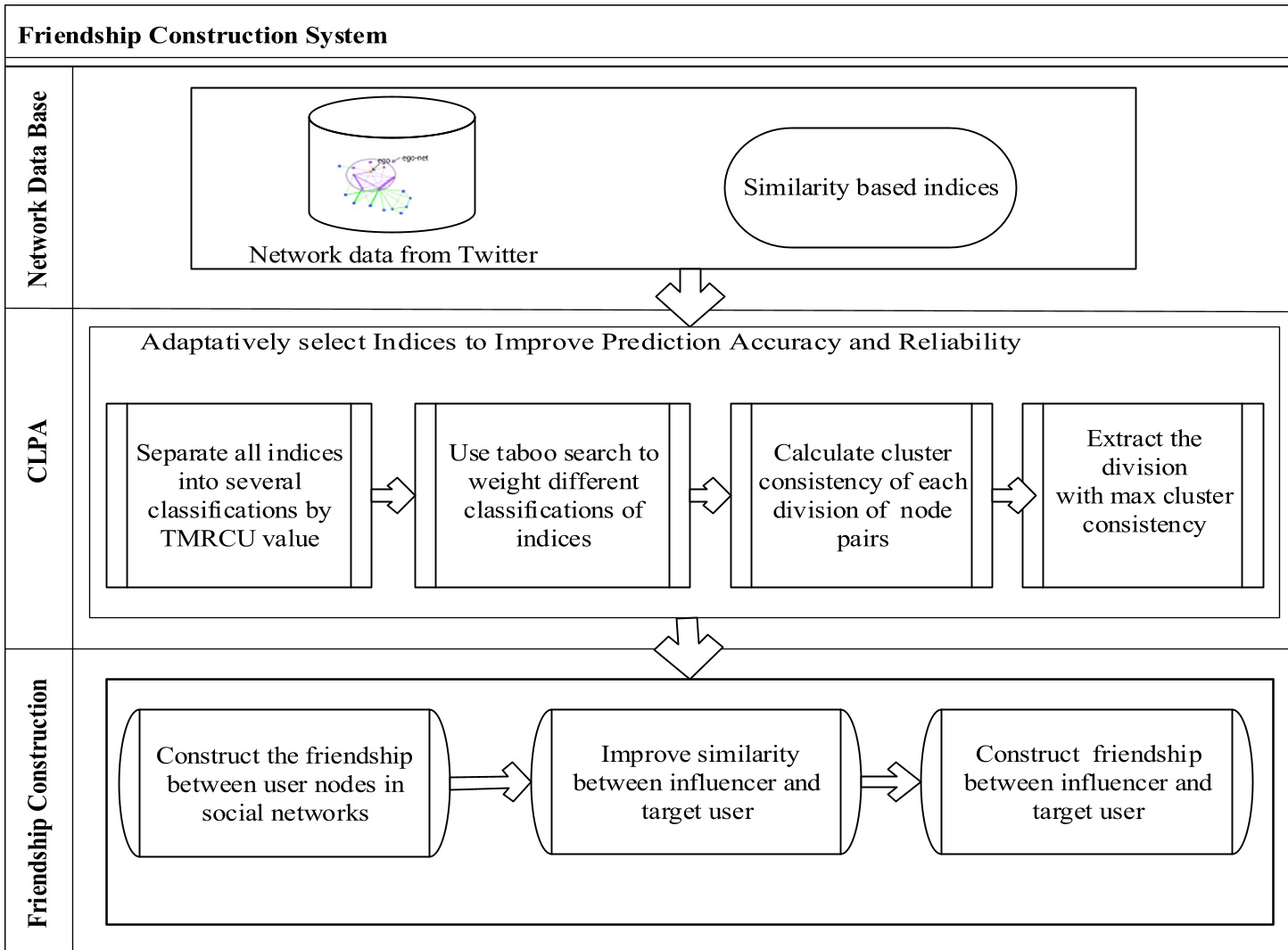
2. Hill Climbing (HCA) for Friendship Engineering
Once we have a way to measure the potential for friendship (CLPA), how do we actually create it? The HCA acts as a tactical advisor. It recommends a sequence of friend-introductions. Every new connection is designed to "climb the hill" of similarity, bringing the target user and influencer closer until the CLPA indicates they are ready to become direct friends.
Experiments & Results
The researchers tested this on 1,000 Twitter ego-networks. The results were decisive:
- Accuracy: CLPA achieved an AUC of 0.80, compared to single indices which hovered between 0.58 and 0.70.
- Robustness: The algorithm performed exceptionally well even in "low degree" networks—meaning it can predict friendships even when data is sparse.
- Efficiency: Using HCA reduced the "iterations" needed to establish a connection significantly compared to letting the network evolve naturally.
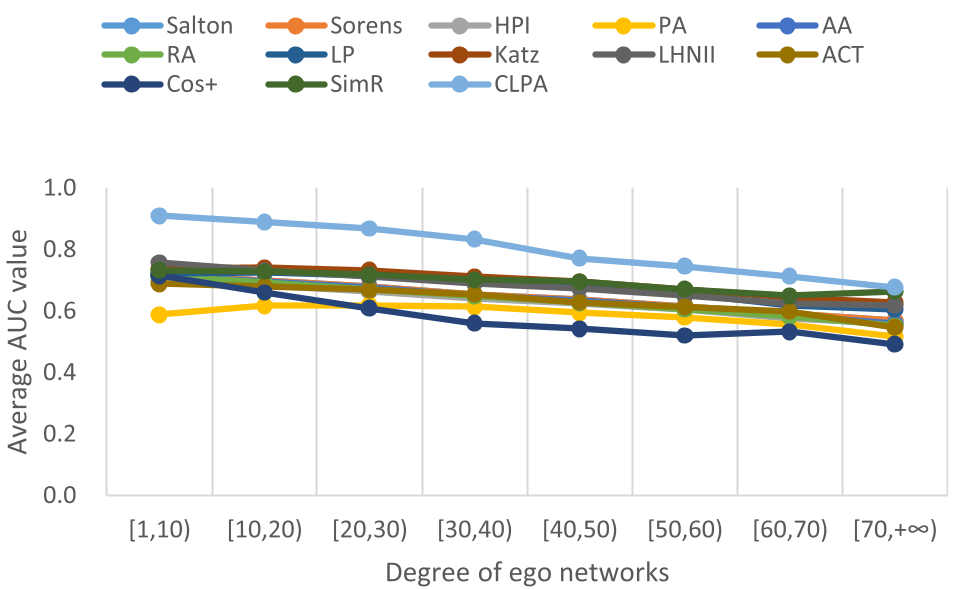
Table 4 (simplified): AUC Comparison in Different Degree Intervals
| Method | [1,10) Degree | [70,+∞) Degree | Mean AUC |
|---|---|---|---|
| CLPA (Ours) | 0.91 | 0.68 | 0.80 |
| Katz Index | 0.74 | 0.63 | 0.70 |
| Random Forest | 0.49 | 0.49 | 0.52 |
Critical Insight: Why it Works
The "magic" lies in Cluster Consistency. By looking for consensus among multiple algorithms, CLPA filters out the "noise" created by super-nodes (hubs) in scale-free networks. It identifies "true" similarity rather than just accidental proximity.
Conclusion & Future Outlook
This paper shifts PIM from a passive "wait-and-see" approach to an active "construct-and-influence" strategy. While the computational complexity is currently high for massive networks (like the full Facebook graph), the principle of consensus-based construction provides a blueprint for the next generation of social recommendation engines.
Future Directions:
- Applying this to weighted networks (considering the strength of friendship).
- Optimizing for Directed networks (where influence is one-way).