
Bridging Formal Concept Analysis and Ontology: A New Paradigm for Information Management
Constructing the Information Management System Based on Ontology and Concept Lattices
This paper proposes a hybrid Information Management System (IMS) that integrates Formal Concept Analysis (FCA) with Ontology modeling. By utilizing Concept Lattices as the core data structure, the system automates the extraction of connotative concepts and their hierarchical relationships, demonstrating superior computational efficiency compared to standalone ontology construction in management knowledge domains.
TL;DR
This research addresses the inefficiency and subjectivity of traditional knowledge modeling by merging Formal Concept Analysis (FCA) with Ontology. By leveraging Concept Lattices, the authors present a system that automatically extracts hierarchical knowledge from raw data, significantly reducing CPU processing time and improving semantic accuracy compared to manual ontology construction.
The Bottleneck of Subjective Knowledge Modeling
In the era of the Semantic Web (OWL/OWL-S), ontologies are essential for making data "computer-interpretable." However, a recurring pain point is the disunity of construction. Because different domain experts hold different viewpoints, building a shared understanding is often an inconsistent, manual process.
Current systems often suffer from "information garbage"—users spend more time filtering irrelevant data than retrieving useful insights. The author's insight is that knowledge management requires a more rigorous, mathematical foundation to define the "intent" (attributes) and "extent" (objects) of a concept without relying solely on human intuition.
Methodology: Integrating FCA and Lattices
The core of the proposed system is the Formal Context, defined as a triple . This structure allows the system to map a set of objects () to their corresponding attributes () via an incidence relation ().
1. Conceptual Formalization
The system extracts connotative concepts by analyzing the binary relationships within the data. It focuses on:
- The Extent: The set of objects belonging to a concept.
- The Intent: The set of all attributes shared by those objects.
2. The Model Architecture
The architecture transitions from an unstructured data source to a structured Concept Lattice. This lattice acts as an inheritance hierarchy where more general concepts sit at the top and more specific ones reside at the bottom.
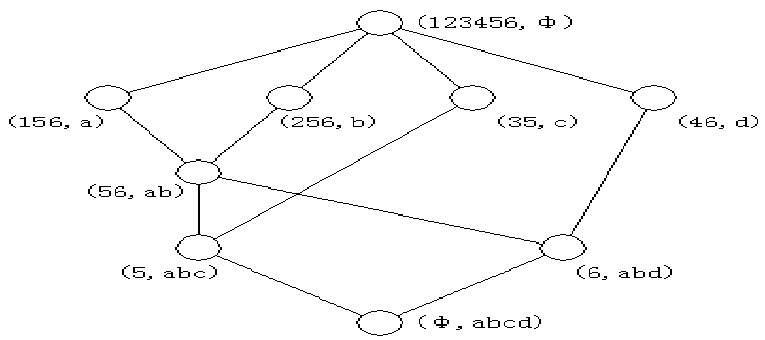 Fig 1: The generated concept lattice showing the hierarchical relationship between objects and attributes.
Experimental Performance
The system was tested on a Windows-based environment (Pentium 4, 1GB RAM) using Java. The primary metric was the CPU Time required to process varying numbers of attributes.
| Object | Attribute A | Attribute B | Attribute C | Attribute D |
|---|---|---|---|---|
| 1 | 1 | 0 | 0 | 0 |
| 2 | 0 | 1 | 0 | 0 |
| 5 | 1 | 1 | 1 | 0 |
| (Simplified Context Table from the Paper) |
Key Findings:
- Efficiency: FCA-based construction outperformed traditional ontology methods as the attribute count increased.
- Reliability: The system automatically identified "indispensable attributes," helping to reduce formal contexts without losing semantic meaning.
- Application: The model was effectively applied to an e-commerce recommendation scenario, matching travel routes to tourist requirements with high accuracy.
 The mathematical representation used for identifying attribute adjunctions.
Critical Analysis & Conclusion
The integration of FCA into Information Management Systems (IMS) provides an objective "machine-view" of a domain. By replacing manual classification with mathematical lattices, we solve the problem of subjective "disunity" in ontology.
Limitations: While FCA is efficient for binary relations, the paper's transition to "Fuzzy Set Theory" (briefly mentioned) suggests that a purely binary approach might struggle with the nuances of real-world "soft" classifications.
Future Outlook: The next logical step is applying this methodology to Multi-modal Information Retrieval, where the "attributes" include not just text, but visual and auditory features, requiring even more complex lattice structures.
Takeaway: If you are building a knowledge engine, don't just ask experts for rules; use FCA to discover the inherent hierarchy already living in your data.