
Beyond IRT: Revolutionary Item Selection with GMDH Abductive Networks
Constructing optimal educational tests using GMDH-based item ranking and selection
This paper introduces a novel approach for constructing optimal educational tests using GMDH-based abductive networks for item ranking and selection. By leveraging self-organizing polynomial models, the authors achieve high-accuracy pass/fail classification (91.2%) using only one-third of the original test items, rivaling traditional Item Response Theory (IRT) methods.
TL;DR
In the world of educational measurement, bigger isn't always better. This paper demonstrates a machine-learning-driven shortcut to "Shortened Tests." By using GMDH (Group Method of Data Handling), the researchers reduced a 45-item test to just 15 items while maintaining a 91.2% classification accuracy. This method matches the precision of industry-standard IRT but operates at lightning speeds and requires zero prior parameter estimation.
The "Curse" of Traditional Test Design
For decades, Item Response Theory (IRT) has been the gold standard. To pick the best questions (items), you calculate the Item Information Function (IIF)—essentially a measure of how much a question tells you about a student's ability.
The catch? IRT is high-maintenance. It assumes you already know the difficulty (), discrimination (), and guessing factor () of every question. As item banks grow into the thousands, calculating these becomes a computational nightmare. Modern machine learning "wrappers" (like Genetic Algorithms) can help, but they are notoriously slow—sometimes taking days to find an optimal subset.
The Solution: Abductive Machine Learning
The authors propose a "Self-Organizing" approach called Abductive Networks. Unlike standard Neural Networks (which are "Black Boxes") or IRT (which is mathematically rigid), Abductive Networks build themselves.
How it Works: The GMDH Logic
The core engine is the GMDH-based AIM (Abductory Inductive Mechanism). It works like biological evolution:
- Iterative Regression: It starts with simple relationships and adds layers of polynomial functional elements.
- Self-Pruning: It uses the Predicted Squared Error (PSE) criterion. This adds a "complexity penalty" to every new connection. If a new question doesn't significantly help predict the student's pass/fail status, the model simply kills that branch.
- Automatic Ranking: By repeatedly training models and removing the "winners," the authors created a definitive ranking of item quality based purely on data, not theory.
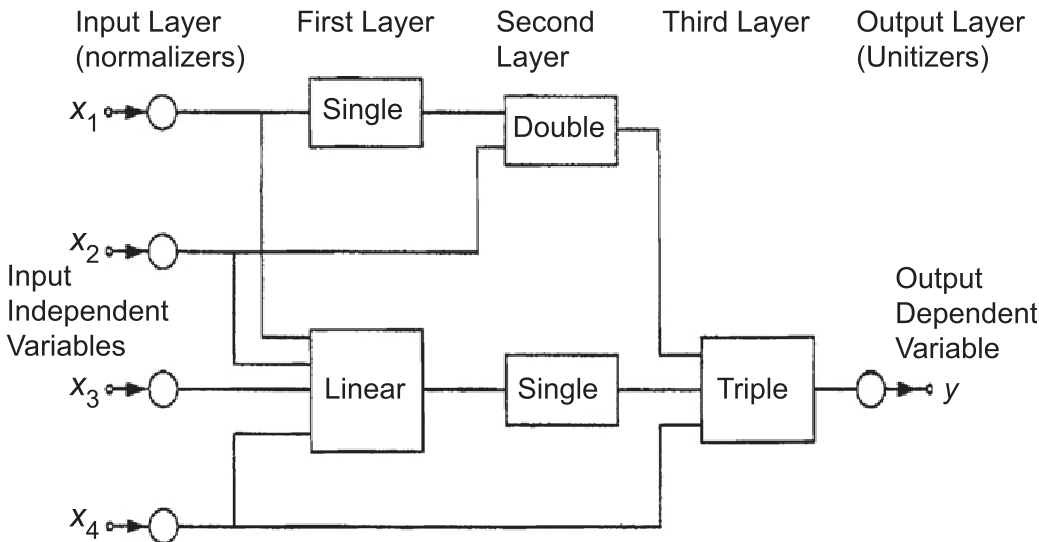 Figure 1: Typical layered feed-forward abductive network structure.
Methodology: The Ranking Experiment
The researchers tested this on a dataset of 2,000 examinees. Their goal was simple: predict if a student would Pass or Fail using the minimum number of items.
They forced the AIM algorithm to pick only the 3 best predictors at a time. Once those were picked, they were "disabled," and the algorithm had to find the next best 3. This continued until all 45 items were ranked into 12 groups.
Results: Efficiency Meets Accuracy
The results were striking. The team identified an optimum subset of 15 items.
- Accuracy: 91.2% (vs. 86.8% for random subsets).
- Speed: Training took roughly 4 seconds.
- Comparison: When compared to a Genetic Algorithm approach (which took 67 hours!), the GMDH method provided identical accuracy in a fraction of the time.
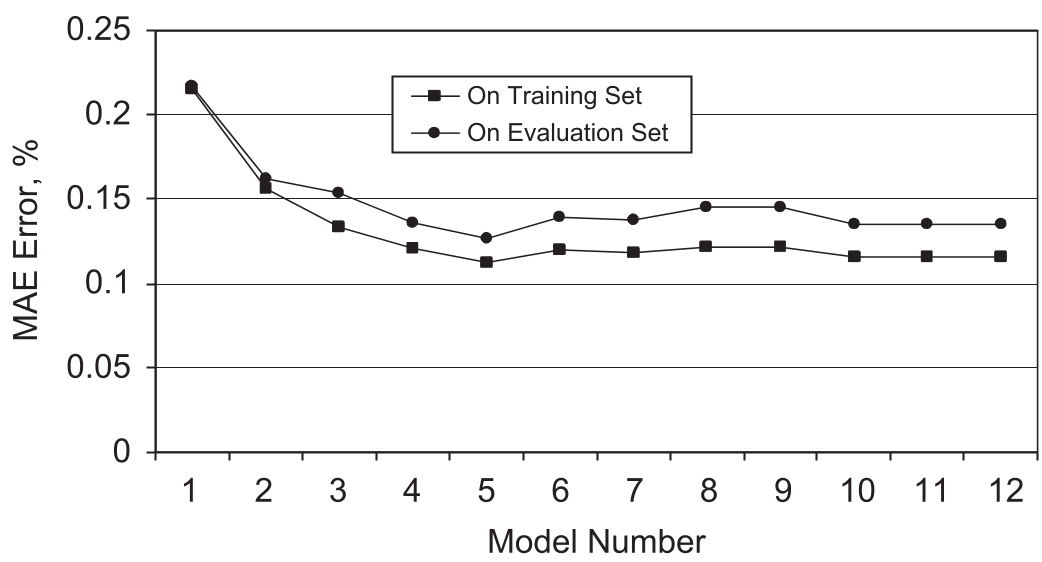 Figure 2: Classification error vs. number of items. Note how the error bottoms out at roughly 15 items, proving that adding more questions eventually leads to overfitting.
Deep Insight: Why Does This Matter?
The real breakthrough here isn't just the 91.2% accuracy—it's the Model Interpretability. Because the output is a polynomial expression (e.g., ), educators can actually see how questions interact. This "Transparent Box" approach is vital in high-stakes testing where we must explain why a certain question is more valuable than another.
Limitations & Future Work
The study focused on a binary Pass/Fail threshold. Future research could expand this to multi-level grading or Computerized Adaptive Testing (CAT), where the GMDH model could choose the next question in real-time as the student types.
Conclusion
This paper serves as a bridge between Psychometrics and Machine Learning. It proves that we don't need complex, parameter-heavy theories to build better tests; sometimes, a self-organizing polynomial is all you need to find the truth behind the data.