
Decoding Virtual Ties: Identifying Social Networks in the Noise of Second Life
Constructing Social Networks from Unstructured Group Dialog in Virtual Worlds
The paper introduces methods to construct social networks from unstructured public chat data in the virtual world of Second Life. It proposes the Shallow Semantic Temporal Overlap (SSTO) algorithm, which utilizes rule-based linguistic cues and temporal windows, and demonstrates that network modularity optimization can significantly reduce noise in links generated by temporal-only models.
TL;DR
Researchers at the University of Central Florida have developed a way to map "who is talking to whom" in the chaotic public chats of Second Life. By combining shallow semantic rules (SSTO) with a noise-reduction technique based on network modularity, they can reconstruct social communities even when the data is riddled with slang, emoticons, and overlapping conversations.
Background: The Wild West of Virtual Communication
Virtual worlds like Second Life (SL) are goldmines for social scientists, yet they present a "data nightmare" for NLP engineers. Unlike structured emails or moderated forums, SL public chat is a stream-of-consciousness mess. Multiple conversations happen in the same radius, users use erratic shorthand ("Yayyy", emoticons), and the "target" of a message is rarely explicitly tagged.
The core challenge is ambiguity: How do we tell if two players chatting at the same time are in a group together or just two strangers standing near each other?
The SSTO Algorithm: Shallow Semantics to the Rescue
The authors recognize that deep linguistic parsing is futile in this environment. Instead, they propose SSTO (Shallow Semantic Temporal Overlap). This rule-based approach looks for high-signal triggers:
- Salutations & Questions: If User A says "Hi" or "How do I...?", and User B responds within a short window, a directed link is drawn.
- Username Recognition: Detecting fragments of usernames within the text to identify targets.
- Pronominal Cues: Using "you" or "your" to link back to the immediately preceding speaker.
- Temporal Windows: If the chat persists for 8-12 utterances between users, a connection is reinforced.
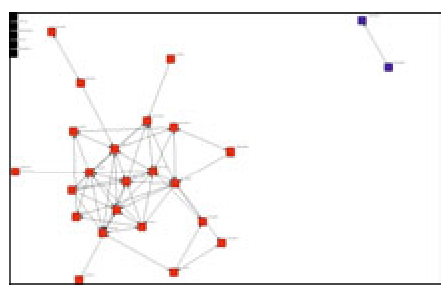 Figure 1: A visualization of a network reconstructed via the SSTO algorithm, showing clearer social clusters compared to raw temporal data.
Pruning the Noise with Modularity
For scenarios where semantic data is too thin, the authors use a Temporal Overlap (TO) approach. However, TO is "noisy"—it assumes everyone speaking within 20 minutes is connected, leading to a massive number of false-positive links.
To fix this, the authors turn to Network Modularity. They treat the noisy TO graph as a community detection problem using the formula:
By maximizing modularity (), they identify clusters of users who interact more with each other than by random chance. They then sever the links between communities. The logic is intuitive: if the math says User A and User B belong to different functional groups, that "link" created by their temporal overlap was likely just a coincidence.
Results: Semantics vs. Math
The authors tested their methods against a "Gold Standard" of hand-annotated data from eight different SL regions.
- SSTO is the Winner: Semantic-aware rules consistently yielded the lowest error (Frobenius norm) and the best F-score.
- Community Detection is a Powerful Filter: For the TO algorithm, adding daily or hourly community partitioning reduced the total error from 610.78 down to 507.21.
- The "Loose" vs. "Strict" Trade-off: Interestingly, "loose" incorporation of community data into SSTO (only using it when semantic cues failed) performed better than forcing strict community membership, suggesting that language remains the strongest signal.
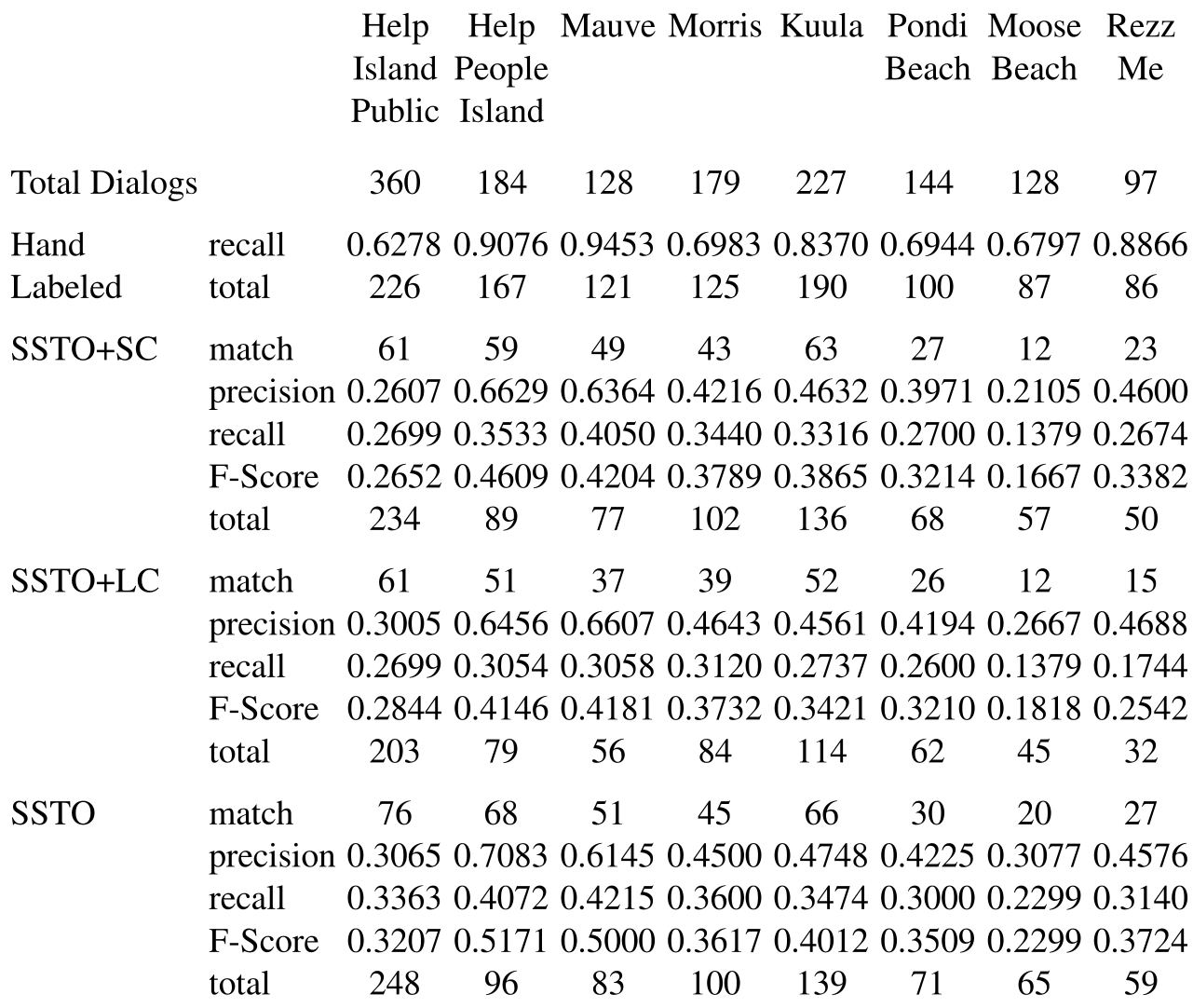 Table 1: Detailed Precision/Recall/F-Score comparison across different regions. Note the overall low scores, highlighting the difficulty of the task.
Critical Insight: The "Social" Inductive Bias
The true value of this paper lies in its realization that network structure is a form of metadata. When our primary data (text) is too dirty to use, the inherent "clumpiness" of human social behavior (modularity) can act as a natural filter.
Limitations & Future Work
The precision and recall remain relatively low (often below 0.5), which the authors attribute to the fact that even humans can't always tell who is talking in these virtual crowds. Future improvements likely lie in integrating 3D spatial data (avatar distance and orientation) to provide a "physical" context to the digital conversation.
Conclusion
This work provides a foundational framework for analyzing group formation in virtual worlds. It moves beyond simple keyword matching, proving that by looking at when people speak and how they cluster, we can map the invisible social fabric of the Metaverse.