
ETB: Scaling the Multilingual Foundation of Computational Linguistics
Construction of Multilingual Terminology Bank of Computational Linguistics
This paper presents the development of the Expanded Term Bank (ETB), a multilingual computational linguistics terminology resource covering seven languages (English, Chinese, Japanese, German, Russian, French, and Korean). Building upon a 1990s foundation of 5,415 terms, the ETB scales the collection to over 13,000 English terms and introduces a robust database management system for standardized academic communication.
TL;DR
Researchers from Beijing City University and Peking University have revitalized a classic 1990s linguistic resource, expanding it into the Expanded Term Bank (ETB). Covering seven major languages and over 13,000 terms, this project addresses the linguistic "vocabulary gap" created by three decades of rapid AI development, providing a standardized framework for global academic exchange.
Problem & Motivation: The Terminology Decay
In the high-speed world of AI and Computational Linguistics (CL), terminology is the "kernel knowledge." However, most standardized dictionaries used in the early 2000s were based on research from the 1980s.
The authors identified two critical gaps:
- Temporal Gap: Terms like "Information Retrieval" and modern "Natural Language Understanding" concepts were underrepresented.
- Structural Gap: Previous lexicons lacked the technical infrastructure to handle the complex, multi-to-multi mapping of terms (e.g., how the Chinese "语法" maps to both "grammar" and "syntax" in English).
Methodology: Building a Seven-Language Web
The ETB isn't just a list; it is a sophisticated relational database. The researchers pivoted from a simple 4-language comparison to a 7-language system (English, Chinese, Japanese, German, Russian, French, and Korean), cutting across five distinct language families.
The Core Architecture
The system relies on a hierarchical table structure:
- Main Multilingual File: Uses English as the primary key (anchor) to link all seven languages.
- Monolingual Indexing: Specialized tables for each language (except English) to allow fast searching from any language.
- Basic Information Tables: Going beyond mere translation to include definitions, synonyms, and hyponyms (hierarchical relationships).
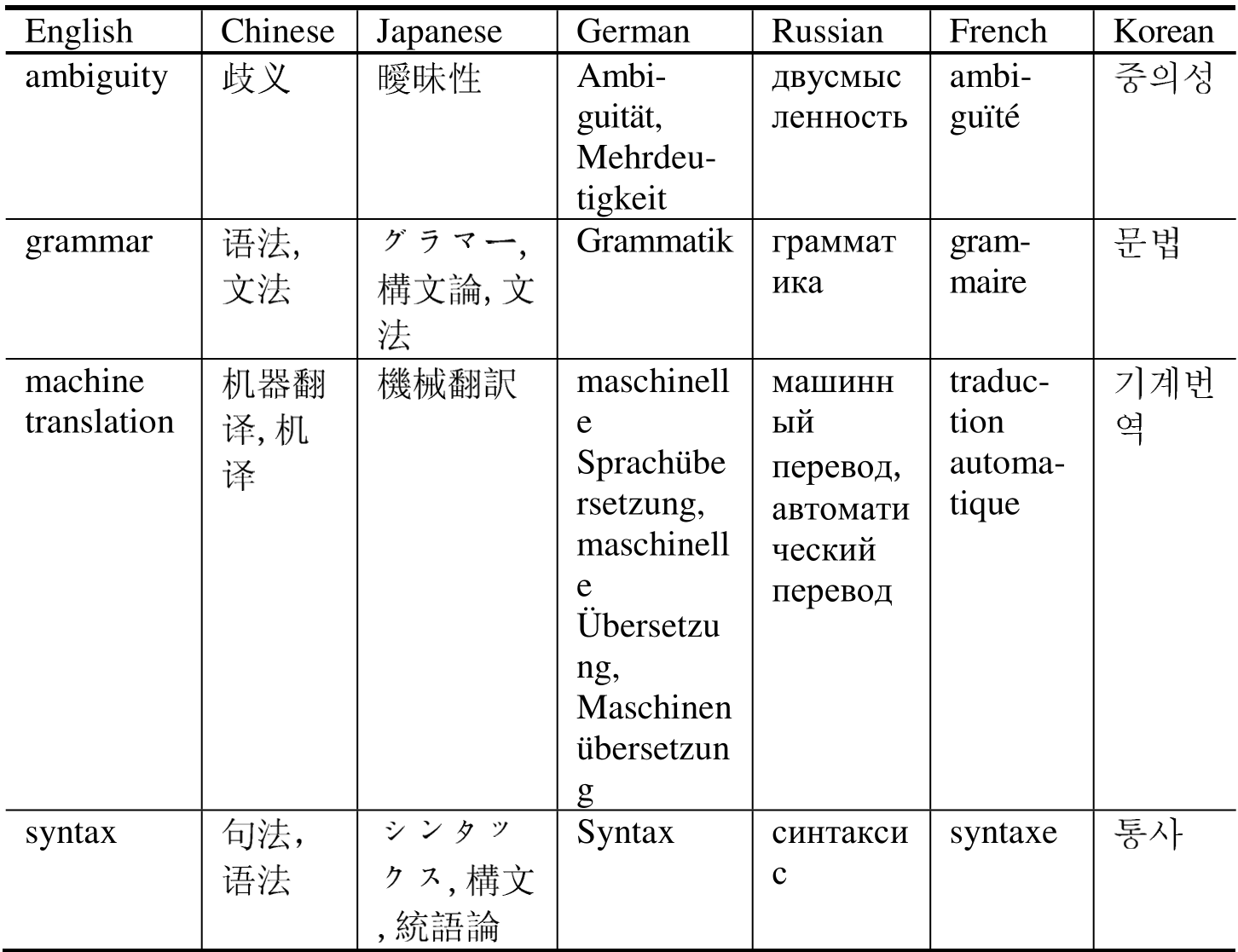 Table 1: Example of how core concepts like "Ambiguity" and "Machine Translation" are mapped across seven languages.
Experiments & Results: Quantitative Expansion
The project successfully transitioned from a static book-based lexicon to a dynamic digital bank. The expansion is significant:
- Scale: From 5,415 to over 13,000 English terms.
- Coverage: The "Core Term Bank" (CTB) was extracted using intersection computation to identify the most frequently used and authoritative concepts.
- System Functions: The management system (built on C# and SQL Server) supports automatic indexing of Pinyin for Chinese and Hiragana/Katakana transformations for Japanese.
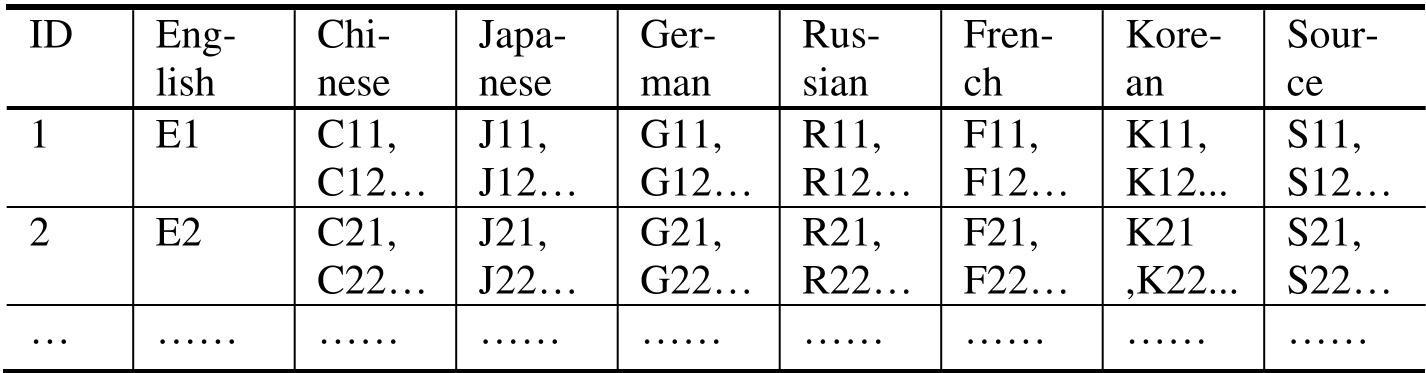 Table 2: The structural design of the main multilingual comparison file.
Critical Insight: More Than Just Translation
The genius of this work lies in its handling of cultural and linguistic nuances. For instance, the authors note that while Japanese "言語" and Chinese "语言" look similar and mean "language," the Chinese term "言语" corresponds to "speech," which in Japanese is "音声". By documenting these subtle differences, the ETB prevents "false friend" errors in academic translation.
Conclusion & Future Outlook
The ETB is a monumental effort in scientific standardization. While the English and Chinese segments are nearly complete, the authors acknowledge that filling in the full definitions and hierarchical relationships (synonyms/hyponyms) for all seven languages is a monumental task still in progress.
Takeaway: In an era of black-box LLMs, structured symbolic resources like the ETB remain vital for maintaining "ground truth" in scholarly communication and ensuring that machine translation preserves technical precision.