
Beyond Linear Logic: How Consumer Confusion Shapes Hotel Brand Loyalty
The effects of consumer confusion on hotel brand loyalty: an application of linguistic nonlinear regression model in the hospitality sector
This study develops a linguistic nonlinear regression model to analyze how consumer confusion dimensions—similarity, overload, and ambiguity—impact hotel brand loyalty. By integrating Fuzzy Likert Scales (FLS) with nonlinear multiple regression, the researchers achieved a high-predictive model (R² = 0.860) that captures complex interaction and quadratic effects in the hospitality sector.
TL;DR
In an era of information explosion, travelers are often paralyzed by too many choices and ambiguous hotel descriptions. This research moves beyond simple linear correlations to prove that consumer confusion impacts brand loyalty through complex, nonlinear pathways. By using Fuzzy Set Theory, the authors quantify the "blurriness" of human decision-making, revealing that while confusion generally hurts loyalty, extreme ambiguity can paradoxically "trap" consumers into staying loyal to a brand just to avoid the stress of further searching.
The Hidden Complexity of the "Confused" Traveler
Prior research in marketing often treats consumer confusion as a simple negative factor: "More confusion equals less loyalty." However, the reality of the hospitality sector is more nuanced. Choosing a hotel involves high financial and emotional risk. When faced with 500 similar-looking options on a booking site (Similarity Confusion) or vague descriptions of amenities (Ambiguity Confusion), consumers don't just act linearly—they hit breaking points.
The authors identify three critical pain points:
- Similarity Confusion: When brands look so alike that consumers can't tell them apart.
- Overload Confusion: When the sheer volume of choices exceeds the brain's processing capacity.
- Ambiguity Confusion: When information is unclear or contradictory.
Methodology: Fuzzifying the Human Mind
One of the most innovative aspects of this paper is the replacement of the rigid 1-to-5 Likert scale with Fuzzy Likert Scales (FLS).
Why Fuzzy Logic?
Standard scales assume that the "distance" between "Neutral" and "Agree" is a crisp, identical value for everyone. Fuzzy logic acknowledges that "Agree" is a linguistic region with overlap. By using Triangular Fuzzy Numbers, the researchers converted subjective feelings into a continuous mathematical landscape that better preserves the "semantic meaning" of the participants' answers.
 Figure 1: The conceptual framework illustrating the interaction and quadratic relationship between confusion dimensions and loyalty.
The "Aha!" Moment in the Results
After analyzing 406 participants, the researchers applied a Nonlinear Multiple Regression Analysis. The results were striking:
- The Loyalty Trap: The study found a positive quadratic effect for ambiguity. This means that as ambiguity increases, brand loyalty initially drops. However, once a "threshold of confusion" is reached, consumers actually become more likely to stick to their current brand. Why? Because the effort to find a "better" alternative in a foggy market becomes too exhausted—sticking with the "devil you know" becomes a survival heuristic.
- The Interaction Effect: Brand loyalty increases when consumers perceive both overload and similarity confusion simultaneously. In this state of "total paralysis," consumers use brand loyalty as a simplifying strategy to get rid of the intensive problem-solving process.
- Model Performance: The inclusion of nonlinear terms allowed the model to reach an R-squared of 0.860, explaining 86% of the variance in loyalty—a significantly higher performance than traditional linear models.
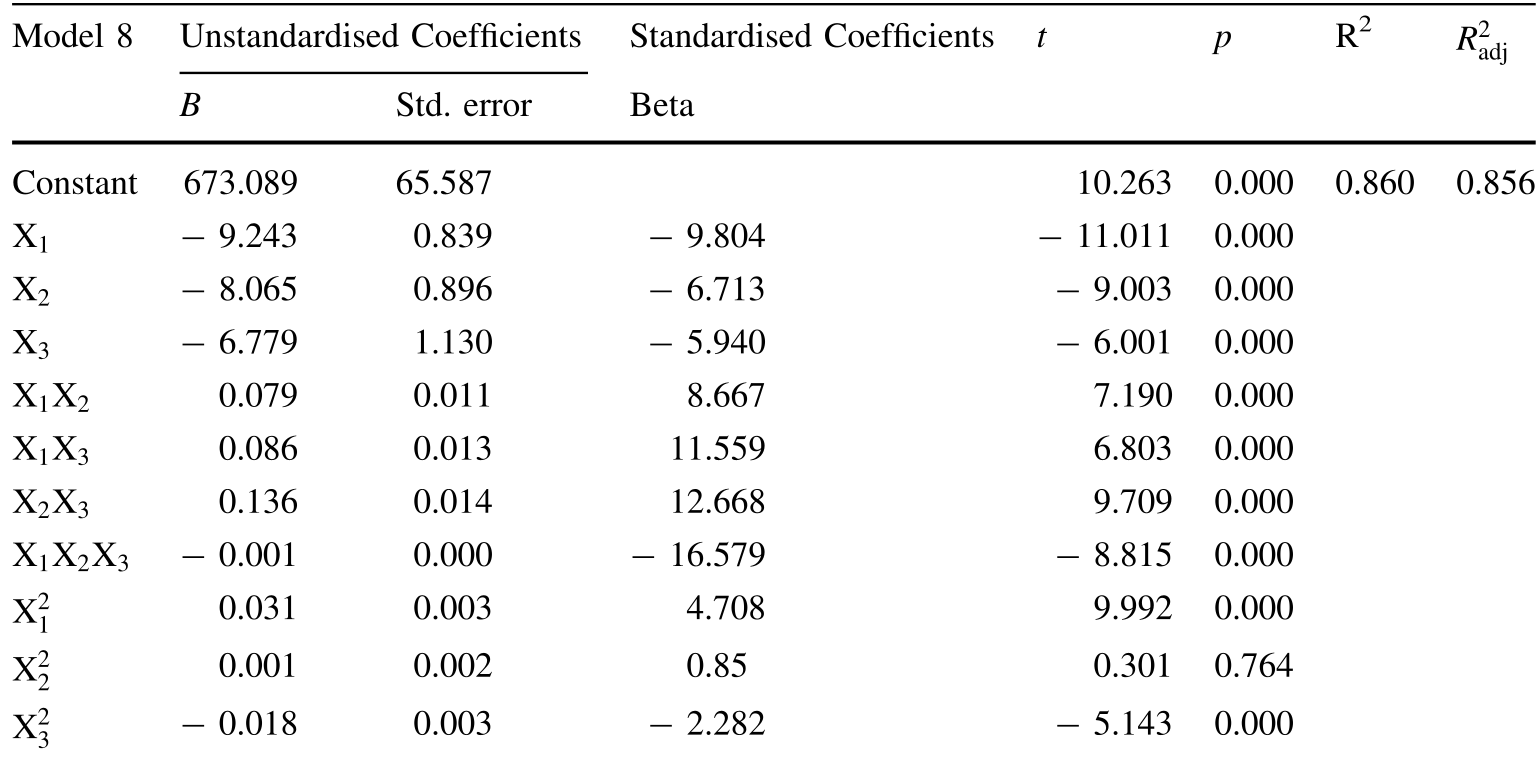 Table 2: Regression results showing the significant coefficients for interaction (X1X2, X2X3) and quadratic terms (X1^2).
Strategic Insights for the Hospitality Industry
- Clarity over Volume: Providing more photos and text isn't always better. If it adds to "overload," it might drive consumers away or make their loyalty feel like a burden rather than a choice.
- Differentiation is the Antidote: To combat "Similarity Confusion," hotels must use discriminative positioning. If your hotel looks exactly like the competitor, the consumer loses the motivation to be "loyal."
- Managing the "Breaking Point": Understanding that highly confused consumers might stay loyal out of fatigue rather than satisfaction is a dangerous trap. This "spurious loyalty" is fragile and disappears the moment a clearer, more distinctive alternative appears.
Conclusion
This study serves as a masterclass in applying advanced mathematical tools—Fuzzy Sets and Nonlinear Regression—to the "messy" world of human psychology. It reminds us that in the hospitality sector, the way we present information is just as important as the service we provide. To win a customer's heart, you must first clear their mind.
Limitations & Future Work: The authors note that the sample's familiarity with hotel brands was relatively low (purchasing once a year). Future research could investigate whether "frequent travelers" have higher confusion thresholds or different heuristic patterns.