
Beyond the Like Button: Decoding Competitor Strategies on Social Media
Insights from consumer interactions on a social networking site: Findings from six apparel retail brands
This study investigates the informational value of consumer social interactions on Facebook across six major apparel brands (C&A, Ernsting's family, Esprit, H&M, Primark, and Zara). It proposes a social interaction strategy framework to categorize brand behaviors and demonstrates how metrics like fan counts and engagement levels correlate with market performance and brand crises.
TL;DR
Is your social media presence actually reflecting your market value? This study analyzes over 2.5 million Facebook interactions across six apparel giants to prove that social metrics aren't just "vanity" numbers—they are windows into competitor sales, expansion strategies, and crisis vulnerability.
Background Positioning
In the landscape of digital marketing research, this work stands as a bridge between Relationship Marketing Theory and Quantitative Social Media Analytics. While many studies focus on "how to get more likes," this paper provides a diagnostic tool for benchmarking brand positioning within a competitive ecosystem.
Problem & Motivation: The "Silo" Trap
Most brands monitor their own social performance in a vacuum. However, the author argues that without a comparative framework, brands cannot understand their Inductive Bias toward certain communication styles. The difficulty lies in the fact that raw engagement data is noisy; a brand might have millions of fans but be "socially dead" in terms of actual dialogue, leaving them exposed to reputational risks.
Methodology: The Social Interaction Framework
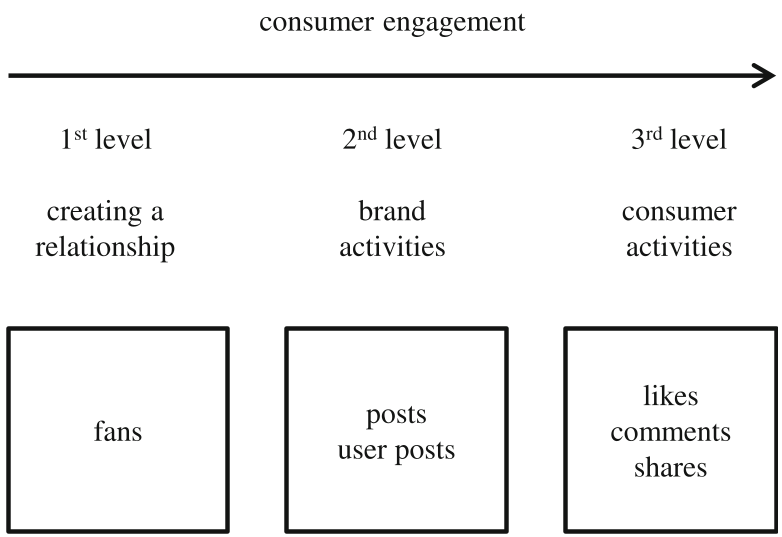
The core of the paper is a three-level analysis of Customer Engagement (CE):
- Creating a Relationship: Measured by Fan counts.
- Consuming Content: Measured by Brand Posting and Response Behavior.
- Contributing Content: Measured by User-initiated likes, comments, and shares.
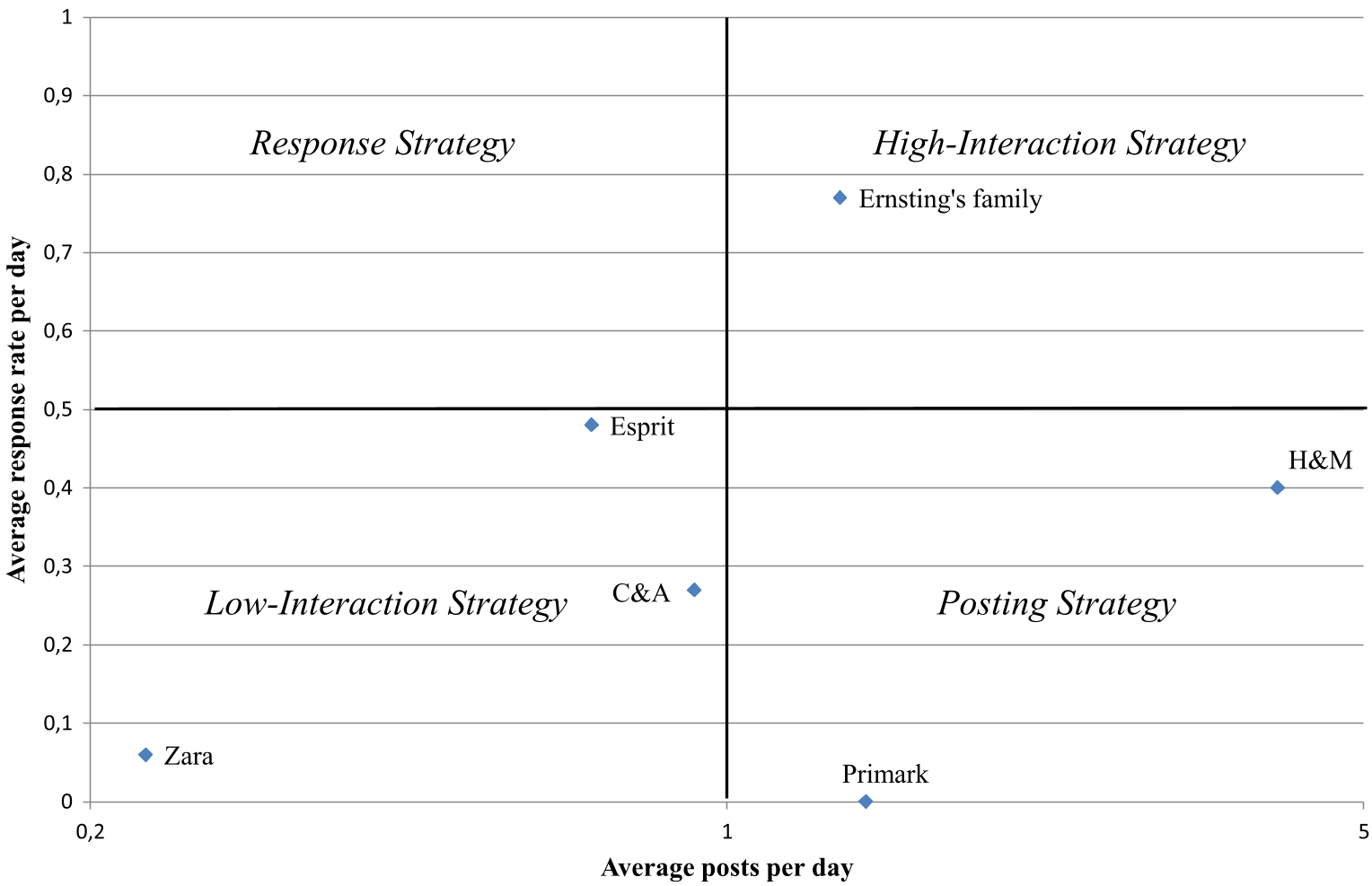
The author's most significant contribution is the Social Interaction Strategy Matrix, which plots brands based on their activity levels.
The Four Strategies:
- Low-Interaction: Low posts, low response (e.g., Zara during the study period).
- Posting Strategy: High volume of content, but little engagement with users (e.g., Primark).
- Response Strategy: Fewer posts, but high attention to user comments.
- High-Interaction: High volume of both posts and responses (e.g., H&M).
Experiments & Results: Sales Correlations and Crisis Signals
The study found a striking Pearson correlation of 0.893 between the number of fans and retail sales revenue. While correlation is not causation, it suggests that fan growth is a reliable indicator of market expansion—notably seen in Primark's rapid percentage growth during its European expansion.
The Zara Case Study: The Danger of Silence
On April 22nd, Zara experienced a massive spike in user posts (from 15 to 56) regarding a trademark dispute. Because Zara typically followed a Low-Interaction Strategy, it was ill-prepared for this "online firestorm." The study shows that even globally dominant brands see no "fan count" protection during a crisis; negative sentiment spreads through the network regardless of the total fan size.
Critical Analysis & Conclusion
Takeaway
Social media is no longer just a megaphone; it is a sensor. The fan count acts as a multiplier of reach, meaning high-reach brands (like H&M and Zara) face exponentially higher stakes when user sentiment turns negative.
Limitations
The study focuses exclusively on Facebook. In today's multi-platform world, a brand might adopt a "Low-Interaction" strategy on Facebook while being "High-Interaction" on Instagram or TikTok. Furthermore, the arbitrary thresholds for the strategy matrix (1 post/day, 0.5 response rate) may need adjusting for modern high-frequency social environments.
Future Outlook
Future research should integrate Natural Language Processing (NLP) to automate the sentiment analysis of these interactions. As retailers move toward "Social Commerce," the line between a "Comment" and a "Conversion" will continue to blur, making these comparative frameworks essential for any brand's survival.