
Beyond Star Ratings: Engineering Trust in Social Commerce via Text Mining and PageRank
Consumer Trust Recommendation in Online Social Commerce
2019-10-01
Summary
Problem
Method
Results
Takeaways
Abstract
This paper presents a social commerce recommendation framework that calculates consumer trust using text mining and network analysis. By combining an Improved TF-IDF method for comment weight analysis with an Improved PageRank algorithm for trust propagation, the system can quantify trust in environments where direct ratings are absent.
## TL;DR
In the world of social commerce, trust is the primary currency. This paper proposes a hybrid recommendation framework that eliminates the need for direct ratings. By applying an **Improved TF-IDF** to user comments and an **Improved PageRank** to the social graph, the authors create a mechanism to quantify "indirect trust" through friend-of-friend links.
## The Motivation: The "Empty Rating" Problem
Most e-commerce trust models assume users provide binary or scalar ratings. However, in Social Networks (OSNs), users mainly interact through texts, shares, and comments. Looking at a product image isn't enough; consumers fear inaccurate portrayals and lack of institutional faith. The authors recognized that the **latent trust** embedded in textual conversations is a goldmine that standard algorithms ignore.
## Methodology: Converting Text to Trust
### 1. Improved TF-IDF for Textual Weighting
Standard TF-IDF measures word importance, but for trust, we need to handle specific sentiment-bearing terms. The authors added a smoothing factor (0.01) to avoid zero-division and used a logarithmic scaling factor $\log(10 + n_i/K)$ to normalize the weight of terms across different comment documents.
### 2. Trust Propagation via Improved PageRank
Once weights are assigned to documents (comments), the system needs to determine how much a specific "Friend" should be trusted.
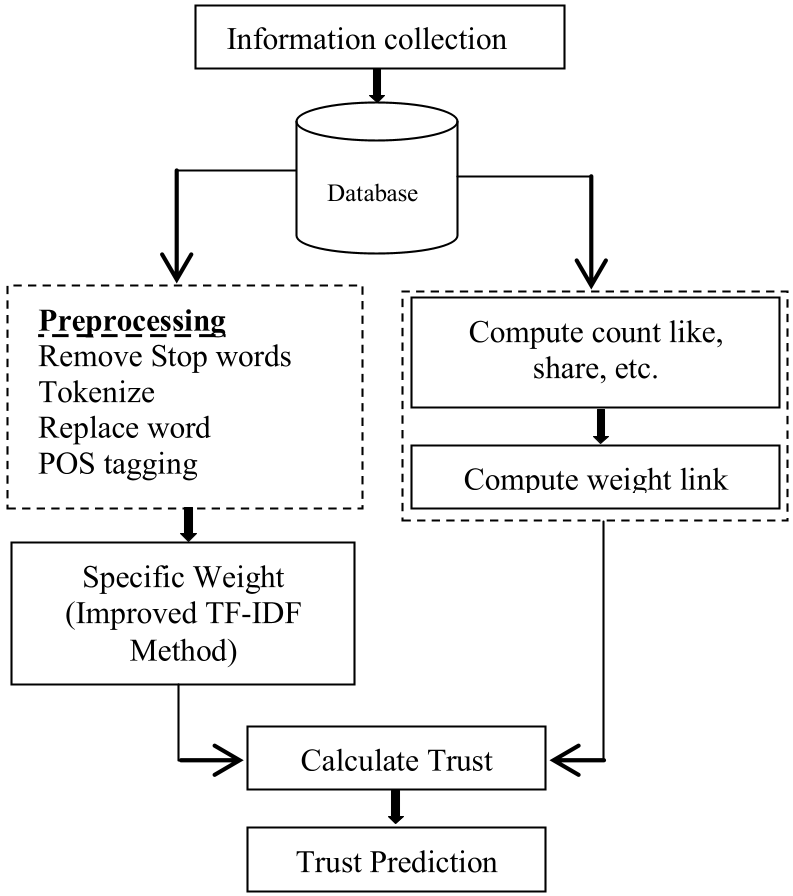
The PageRank formula was modified to treat users as nodes and social interactions as links:
$$PR_i = (1 - d) + d \left[ \sum_{j \in Li} \frac{PR_j}{O_j} \right]$$
This allows trust to flow from a known trusted source through the network to "friend-of-friends," effectively solving the data sparsity problem.
## Experimental Insights
The authors tested their approach using data from Facebook social commerce shares. By iterating the PageRank algorithm, they observed how trust values converged over time.
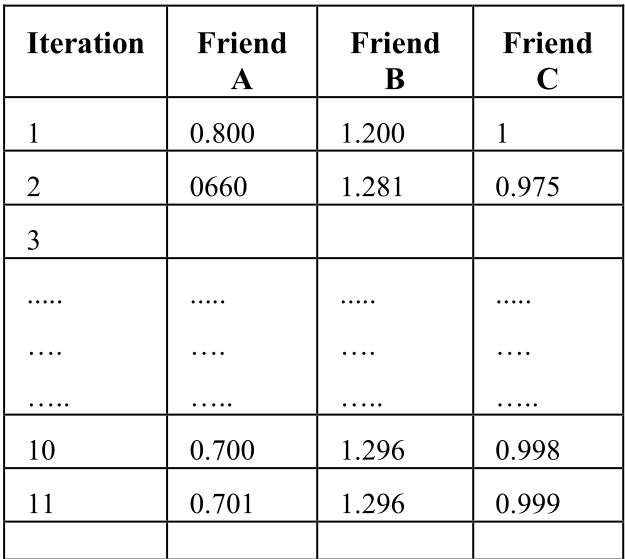
As shown in the table, the algorithm reaches a stable state (convergence) relatively quickly. For example, Friend B emerges as the most "trusted" node with a PR value of 1.296, which is then used to weight the final recommendation score ($R$).
## Critical Analysis & Conclusion
### The Takeaway
The core contribution of this work is the **bridging of NLP and Graph Theory**. By treating a comment not just as text but as a "weighted edge" in a social graph, the system achieves a more holistic view of consumer trust than simple collaborative filtering.
### Limitations
While the "Improved TF-IDF" is effective, it remains a "Bag-of-Words" approach. It may struggle with complex linguistic features like:
* **Sarcasm**: "Oh, great quality!" (meaning poor quality).
* **Context Shifting**: Users discussing trust in a non-product context.
### Future Outlook
The authors suggest that future iterations will incorporate more sophisticated review analysis. Transitioning from TF-IDF to Transformer-based embeddings (like BERT or RoBERTa) could significantly improve the "Weight" calculation by capturing semantic nuance, while keeping the PageRank backbone for the social graph propagation.