
Your Closest Friends Aren't That Popular: Re-evaluating the Friendship Paradox
9719_Which friends are more popular than you Contact strength and the friendship paradox in social networks.
This study investigates the "friendship paradox" (your friends have more friends than you) by incorporating contact volume and tie strength in Twitter and mobile phone datasets. The authors reveal that the paradox is significantly mitigated or even reversed among an individual's most frequently contacted social ties (close friends).
TL;DR
The "Friendship Paradox" famously claims that your friends are more popular than you. However, new research analyzing Twitter and mobile phone data suggests a nuanced correction: while your average friend might be a social butterfly, your closest friends—those you actually talk to every day—are likely no more popular than you are. The "hubs" of the social network are actually hiding in your circle of distant acquaintances.
Background: Strength in Weakness
In social network theory, the Friendship Paradox (Feld, 1991) is a mathematical certainty in skewed networks: people with many friends appear in more social circles, leading to the statistical illusion that everyone else is less popular. But this classic view treats every "link" as equal. In reality, we have a limited attention budget. We cannot interact with 500 followers with the same intensity as we do with a spouse or a best friend.
The authors of this paper bridge the gap between structural topology and the "Attention Economy," asking a vital question: Does the friendship paradox hold when we account for how much we actually talk to people?
Methodology: Ranking the Inner Circle
The researchers analyzed two distinct datasets to ensure their findings weren't platform-specific:
- Twitter: Egos (users) and their top 15 "at-mentioned" alters.
- Mobile Phone Records: Nine months of billing data, ranking alters by call/text frequency.
By ranking friends from 1 (most contacted) to (least contacted), they could see if "Popularity" (Outdegree) was tied to "Intimacy" (Contact Volume).
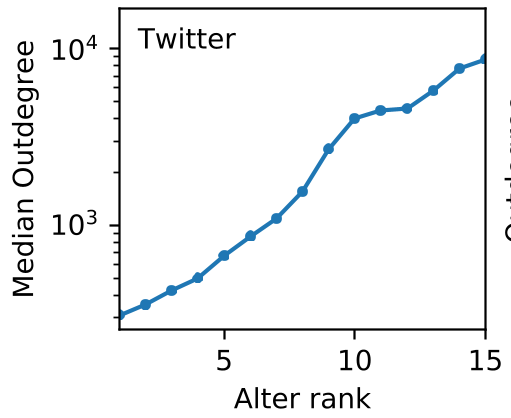 Fig 1: As friendship rank increases (moving from best friends to acquaintances), the popularity of those friends skyrockets.
The Core Insight: The Paradox of the "Best Friend"
The results were striking across both platforms:
- The Reversal: In the mobile phone dataset, the rank-1 alter (the person you call most) often has a lower degree than the ego. The friendship paradox effectively vanishes for your inner circle.
- The Hub Discovery: Where do the "social hubs" live? Not in your frequent contacts. The "most popular" friend you have is statistically likely to be someone you rarely interact with (high rank, low contact).
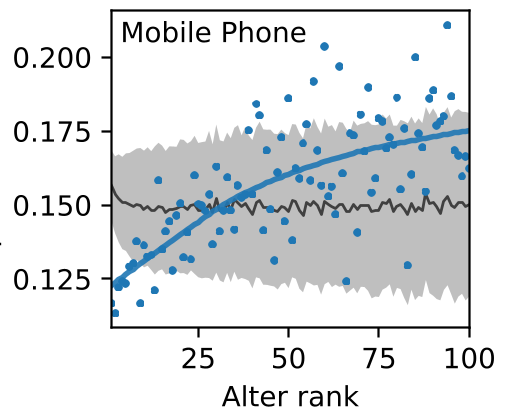 Fig 2: The probability of a friend being a "Hub" (the most popular in your network) increases as your contact with them decreases.
Why This Matters: Information Cascades
The paper doesn't just stop at statistics; it explores dynamics. If we mostly talk to people who aren't that popular, what happens to "viral" information?
Using a Susceptible-Infected (SI) model, the authors simulated information spread. They found that because we prioritize contact with lower-degree nodes (our close friends), the overall "speed" of information propagation in a network is much slower than traditional models suggest.
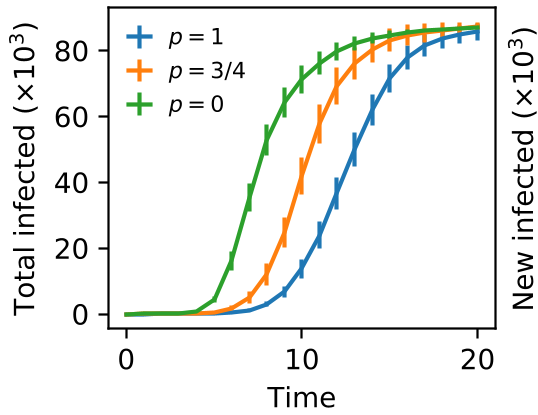 Fig 3: Epidemic curves showing that contact-strength dependence (blue) significantly slows down spreading compared to uniform transmission (red).
Critical Analysis & Conclusion
Takeaway
The study provides a necessary "human" layer to social network physics. It confirms Dunbar's Number and the Strength of Weak Ties in a new light: our strongest emotional ties are with people who, like us, have limited social reach. The "Paradox" is driven by our weak acquaintances—the famous people we follow but rarely engage with.
Limitations
- Directionality: The Twitter data was limited to 15 alters due to API constraints, which may truncate the "long tail" of acquaintances.
- Context: The study doesn't distinguish between the type of contact (e.g., professional vs. personal), which could influence degree distribution differently.
Future Outlook
For marketers and epidemiologists, the message is clear: Targeting the most-contacted individuals (the "best friends") might be a poor strategy for virality. Instead, the real bridges for information are those distant, high-degree hubs that we only whisper to once in a while.