
CovidCrowd: Solving the Contact Tracing Paradox via Crowdsourcing Incentives
Contact Tracing Incentive for COVID-19 and Other Pandemic Diseases From a Crowdsourcing Perspective
This paper introduces CovidCrowd, an incentive framework designed to boost participation in pandemic contact tracing systems by treating data collection as a crowdsourcing task. By modeling the interaction as a Stackelberg game, the system computes an optimal reward to reimburse users for privacy and data processing costs, achieving an improvement in user participation level by at least 13.2%.
TL;DR
The effectiveness of contact tracing for COVID-19 is crippled by a direct conflict: systems need precise data, but users fear privacy loss. CovidCrowd reframes this public health challenge as a crowdsourcing incentive problem. Using a Stackelberg game model, it treats privacy as a cost and offers financial rewards to reach a Nash Equilibrium, resulting in a 13.2% to 133% boost in user engagement across various metrics.
Context: Why Traditional Tracing Fails
Most contact tracing apps (like Singapore's TraceTogether or China’s health codes) operate on two ends of a flawed spectrum: either mandatory participation with high privacy intrusion or voluntary participation that lacks the density to be effective.
The technical "fix" has historically been better encryption. However, the authors argue that the barrier isn't just security—it is utility. Rational users won't participate if the cost (battery, data, privacy risk) outweighs the reward (none). To bridge this gap, they propose a system where the government buys the data.
Methodology: The Game Theory Engine
The core of this paper is the transformation of contact tracing into a two-stage Stackelberg Game:
- Stage 1 (The Leader - Government): Sets a total reward .
- Stage 2 (The Followers - Users): Observe and decide their participation level (time/quality of data) to maximize their own utility.
Quantifying Privacy as Cost
Unlike standard crowdsensing models that focus solely on data volume, the authors define a unit cost that integrates:
- Privacy Cost (): The subjective "pain" of sharing location.
- Processing Cost (): Communication and power usage.
- Encounter Density (): The frequency of contacts.
The system uses these to calculate the Nash Equilibrium of Users, ensuring that no user can increase their utility by unilaterally changing their participation duration.
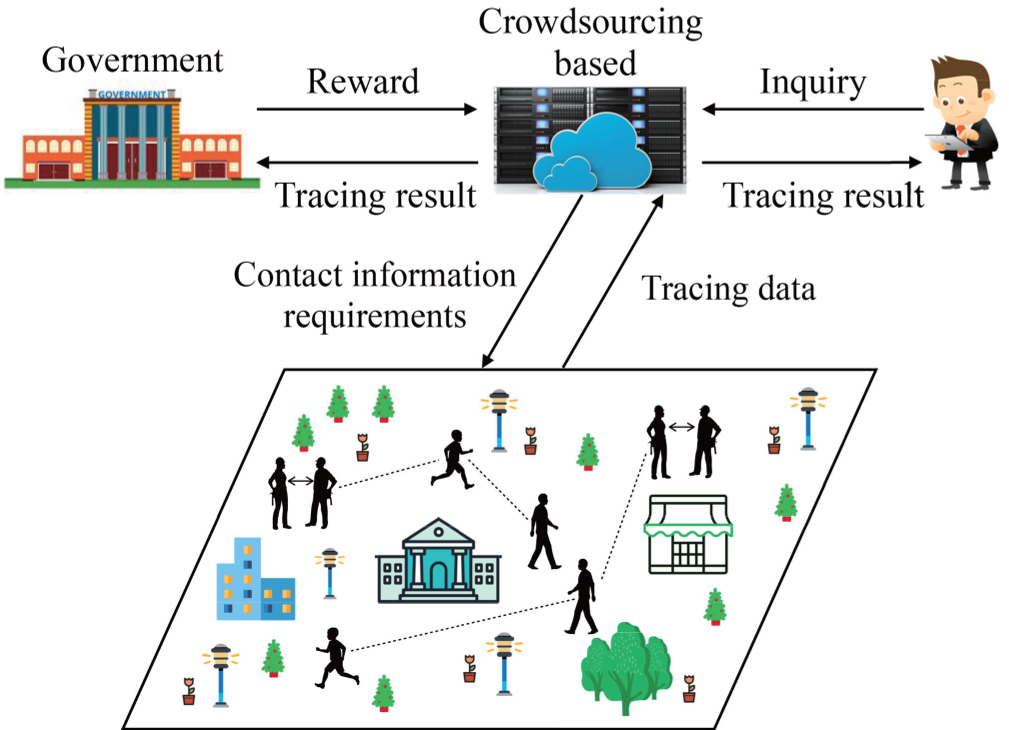 Figure 1: The Crowdsourcing perspective of the Contact Tracing Workflow.
Experimental Validation
The authors tested CovidCrowd against two baselines:
- Best Effort: Users maximize participation if profit > 0.
- Random: Users participate based on varying internal preferences.
Key Findings
- Participation Volume: In a real-world dataset evaluation, CovidCrowd improved total participation levels by 13.2% over Best Effort.
- User Retention: The number of active participants was 133% higher than Best Effort scenarios because the algorithm finds a reward point that makes it "worth it" for a wider variety of cost profiles.
- System Utility: The government (data consumer) achieves maximum information gain per dollar spent.
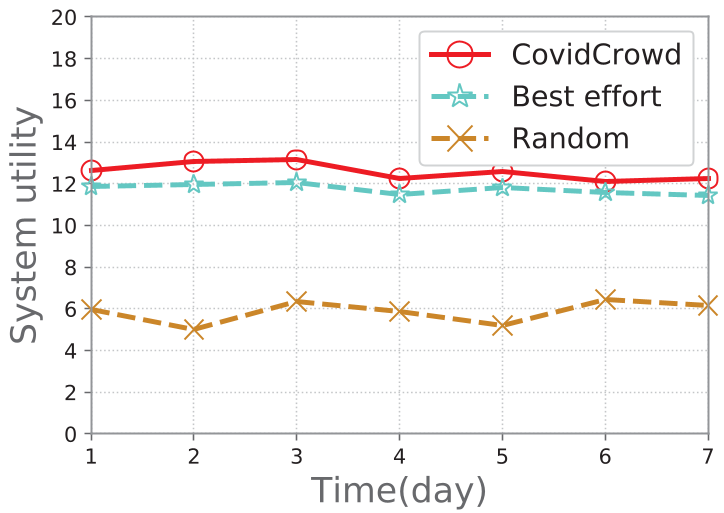 Figure 2: Performance metrics over 7 days show CovidCrowd consistently leading in system utility and participant numbers.
Critical Insight: The Value of Rationality
Usually, we treat "selfishness" in a pandemic as a social failure. This paper suggests that treating it as an economic certainty allows for better system design. By mathematically ensuring that the marginal benefit of data sharing meets the marginal cost of privacy loss, we can build more resilient public health tools.
Conclusion & Limitations
CovidCrowd successfully demonstrates that incentives can overcome the privacy-accuracy trade-off. However, the model assumes that unit costs follow a Gaussian distribution—a simplification that might not reflect diverse socioeconomic realities where privacy "value" varies wildly. Future work should explore how these incentive models hold up against "forged sensing attacks" where users might upload fake data to harvest rewards.
Takeaway for the Industry: To achieve SOTA participation in sensitive data tasks, stop asking for volunteers; start calculating the Nash Equilibrium.