
Bridging the Gap: A Hybrid Approach to Cross-Domain Bibliometrics
A content and social network approach of bibliometrics analysis across domains
This paper presents a hybrid bibliometrics analysis framework that integrates content similarity (TF-IDF) and social network similarity (Co-authorship networks). Using the DBLP dataset, it evaluates the convergence of Information Retrieval (IR) and World Wide Web (W3) domains, demonstrating a consistent SOTA-level upward trend in inter-domain synergy.
TL;DR
This research tackles the challenge of quantifying how different scientific fields merge and interact over time. By combining TF-IDF content analysis with social network metrics of co-authorship within the DBLP dataset, the authors demonstrate that the Information Retrieval (IR) and World Wide Web (W3) domains are effectively "fusing" due to shared technological goals like web-based search engines.
Background & Motivation
How do we measure the "distance" between two scientific fields? In the past, researchers looked at Citations or Keywords. However, the authors argue these are flawed:
- Citations are "cold" relationships; you can cite a paper from 50 years ago without ever interacting with the author.
- Content can be deceptive because different fields use different jargon for the same concepts (Vocabulary Mismatch).
The research intuition here is that Collaboration (Co-authorship) is a "warm" relationship. If the same groups of people are publishing in both IR and W3 conferences, those fields are inherently linked, regardless of the specific words they use.
Methodology: The Best of Both Worlds
The authors propose a dual-layer similarity model:
1. Content Similarity (The "What")
Each publication is transformed into a TF-IDF term vector based on its title. A domain (e.g., IR) is represented by the "centroid" of all its publication vectors. Similarity is then measured via Cosine Similarity.
2. Network Similarity (The "Who")
The core innovation lies in the Overlap formula. It doesn't just count common authors; it weights them by their Degree Centrality (how many people they collaborate with). If influential "bridge" authors exist in both domains, the similarity score spikes.
3. The Hybrid Score
By introducing a weight factor , the model allows for a flexible balance between text and social ties:
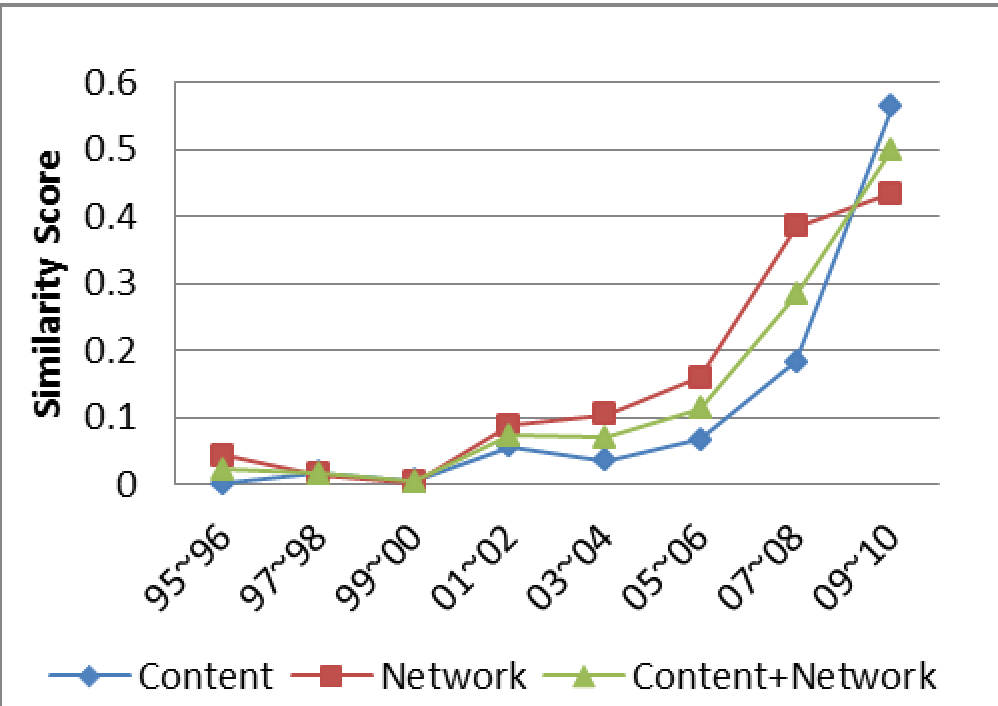 Figure: The Hybrid approach (green) vs. pure content (blue) and pure network (red) metrics.
Experimental Insights
The study analyzed DBLP data from 1995 to 2010, focusing on major conferences like SIGIR (IR) and WWW (W3).
- The Convergence Trend: All metrics (Content, Network, and Hybrid) show a positive slope. This confirms the physical reality that IR systems became Web-based, and W3 research became focused on search and knowledge discovery.
- Collaboration Density: The authors found that IR researchers have historically had more components and higher author-per-component ratios than the W3 community, suggesting a more "tight-knit" social structure in Information Retrieval.
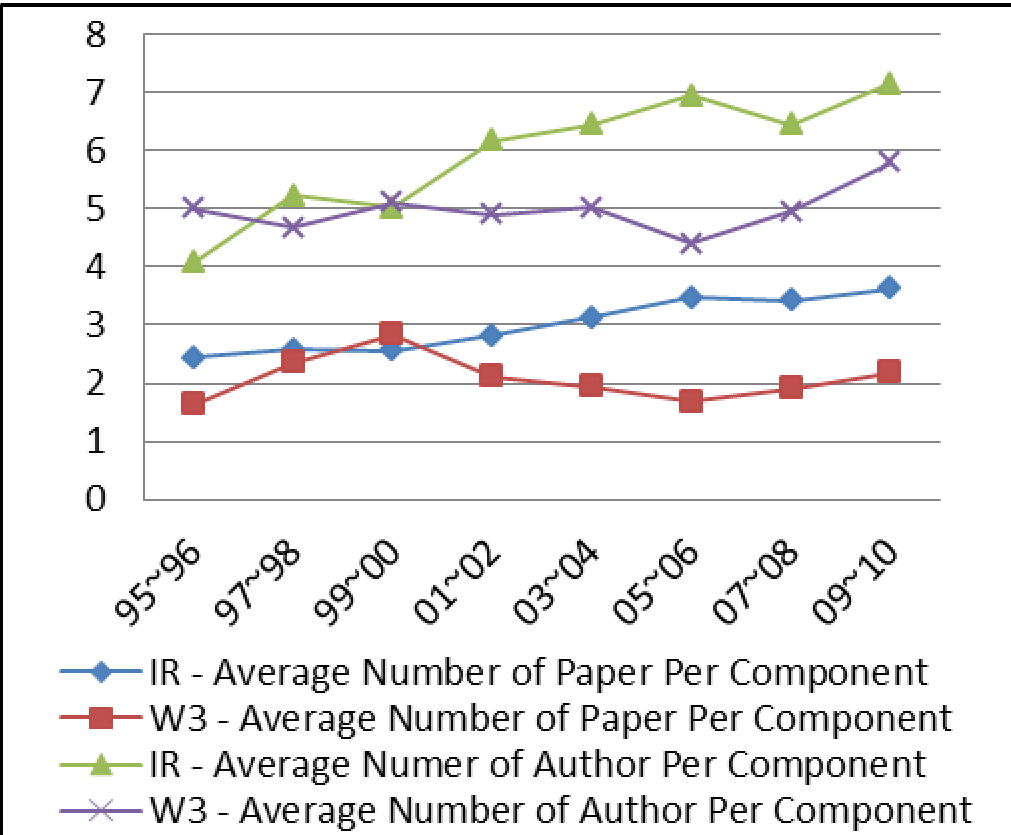 Figure: Analysis of Author/Component and Paper/Component ratios across domains.
Critical Analysis & Future Outlook
While this work provides a solid foundation, there are notable limitations:
- Title-only Content: Using only titles for TF-IDF is a major data bottleneck. Incorporating abstracts or full-body text would significantly refine the content similarity.
- Weight Sensitivity: The factor is currently a manual hyperparameter. Dynamic weighting based on domain sparsity could be more robust.
Takeaway: This paper is a precursor to modern "Graph Embedding" approaches. It reminds us that in the academic world, who is working together is often just as informative as what they are writing.
Conclusion
The fusion of IR and W3 is no longer just a hypothesis—it's a measurable bibliometric fact. This hybrid methodology provides a blueprint for tracking the birth of interdisciplinary fields as they emerge from the intersection of social networks and semantic overlap.