
Content-Aware Galaxies: Deciphering the DNA of Social Media Conversations
Content-Aware Galaxies: Digital Fingerprints of Discussions on Social Media
This paper introduces a novel framework for analyzing social media conversational dynamics by shifting the unit of analysis from user-to-user networks to tweet-to-tweet discussion threads. It proposes "Content-Aware Galaxies"—a multi-modal visualization system that integrates a new "Twitter Energy" metric with deep learning-based NLP (BERT, XLM, and VADER) to quantify engagement, sentiment, stance, and coherency across large-scale social streams.
TL;DR
Researchers have moved beyond simple follower counts to analyze the "Energy" and "Geometry" of social media debates. By treating every tweet as the center of a "Star" and its replies as orbiting nodes, this study introduces Content-Aware Galaxies: a framework that combines graph theory with BERT and XLM models to visualize not just what we are saying, but the depth, sentiment, stance, and coherence of how we interact.
Background: Beyond the Follower Graph
Traditionally, social media analysis has been "User-Centric." We look at who follows whom or who retweets whom. However, this ignores the actual conversation thread. A single tweet can spawn a massive, complex tree of arguments, jokes, and diversions. The authors argue that to truly understand public opinion, we must look at the Reply Chain as a physical network.
The Problem: The Noise of the Stream
How do you summarize 300,000 tweets about a political event without losing the context? Current tools give us word clouds or sentiment scores, but they miss the Engagement Topology. They don't tell us if a conversation is a healthy debate (Coherent) or a shouting match of unrelated insults (Low Coherency).
Methodology: Building the Galaxy
The authors propose a hierarchical visualization strategy:
- Metric Energy: A new way to measure a tweet’s "gravitational pull" using a weighted sum of likes, retweets, and replies.
- The Star: A tree structure where the root is the initial tweet. The layout reveals the "generations" of a conversation.
- Content Analysis:
- Topic Extraction: Using neural attention to see which themes (e.g., Economy vs. Abortion) drive the most depth.
- Coherency (BERT): Utilizing BERT’s original "Next Sentence Prediction" training to calculate how relevant a reply is to its parent tweet.
- Stance (XLM): A cross-lingual approach to determine if the crowd is supporting or opposing a controversial topic, like Hydroxychloroquine during COVID-19.
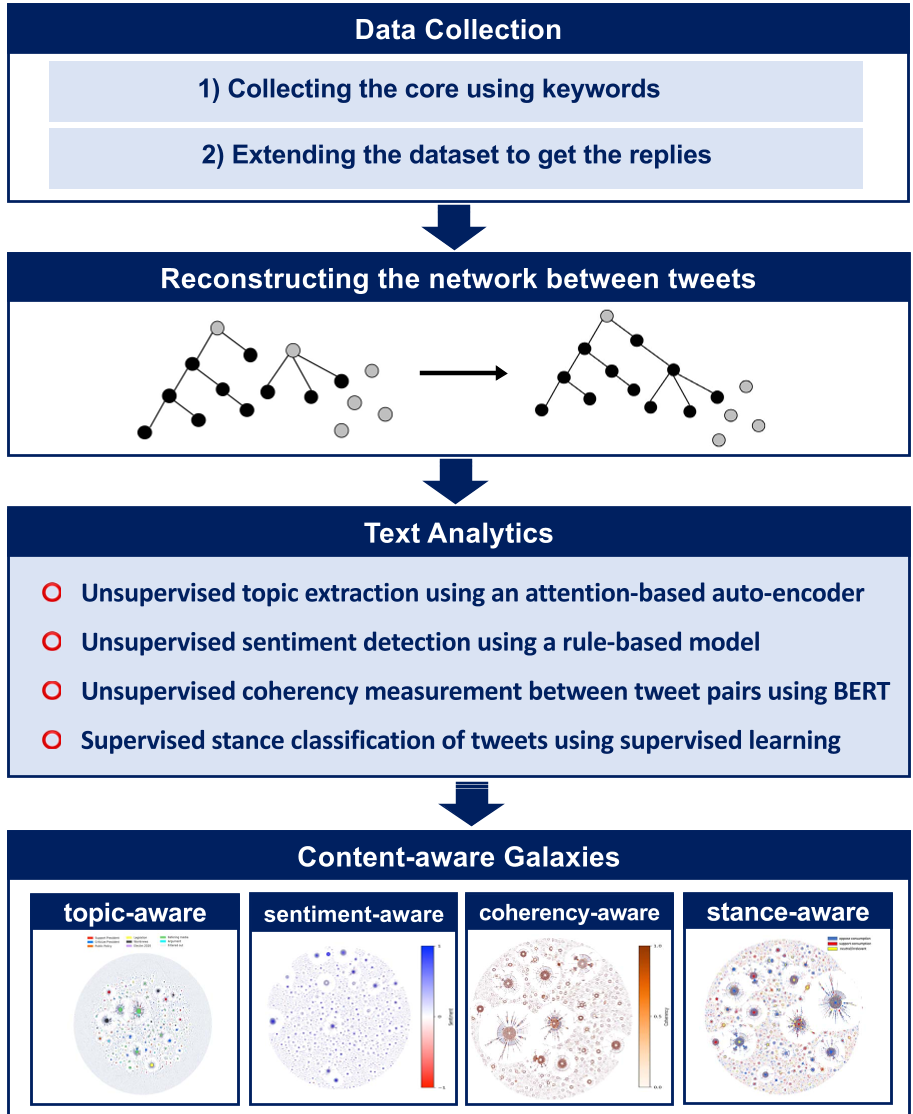 Figure 1: The workflow from data collection to Content-Aware Galaxy visualization.
Key Insights from the Stars
1. The Anatomy of Engagement
The study found that political figures like Donald Trump have very low Discussion Centrality. While this sounds negative, it actually means his tweets are highly effective at "mobilizing" the crowd—the energy of the replies far outweighs the energy of the original post. In contrast, figures like Barack Obama have high centrality, where the original post remains the primary focus.
2. The Coherency Gap
By applying BERT to calculate "Coherency," the authors discovered a fascinating pattern: the larger the conversation (the "Energy"), the lower the coherence. As a thread goes viral, it tends to attract "off-topic" noise, reducing the deliberateness of the conversation.
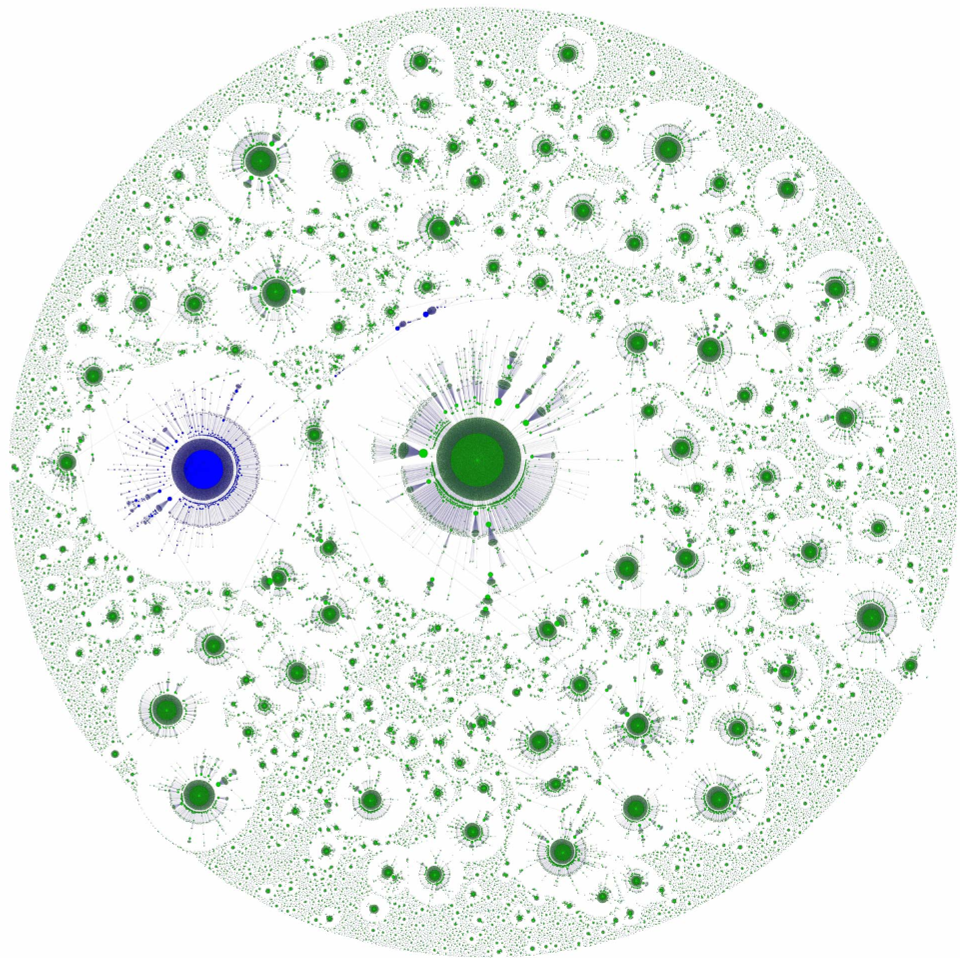 Figure 2: A "Star" generated by Bernie Sanders. The rings represent generations of replies, with node size indicating the intensity of further sub-discussions.
Experimental Performance
The team tested their framework across three distinct domains: Politics (2020 Election), Sport (Super Bowl LIV), and Healthcare (COVID-19 treatments).
- Stance Detection: Their XLM model achieved a 76% accuracy in multi-lingual stance classification, proving that these "Galaxies" can track polarization across language barriers (English, French, Spanish).
- Temporal Decay: They confirmed that 99% of a "Star's" energy is spent within 48 hours, highlighting the extreme ephemerality of social media influence.
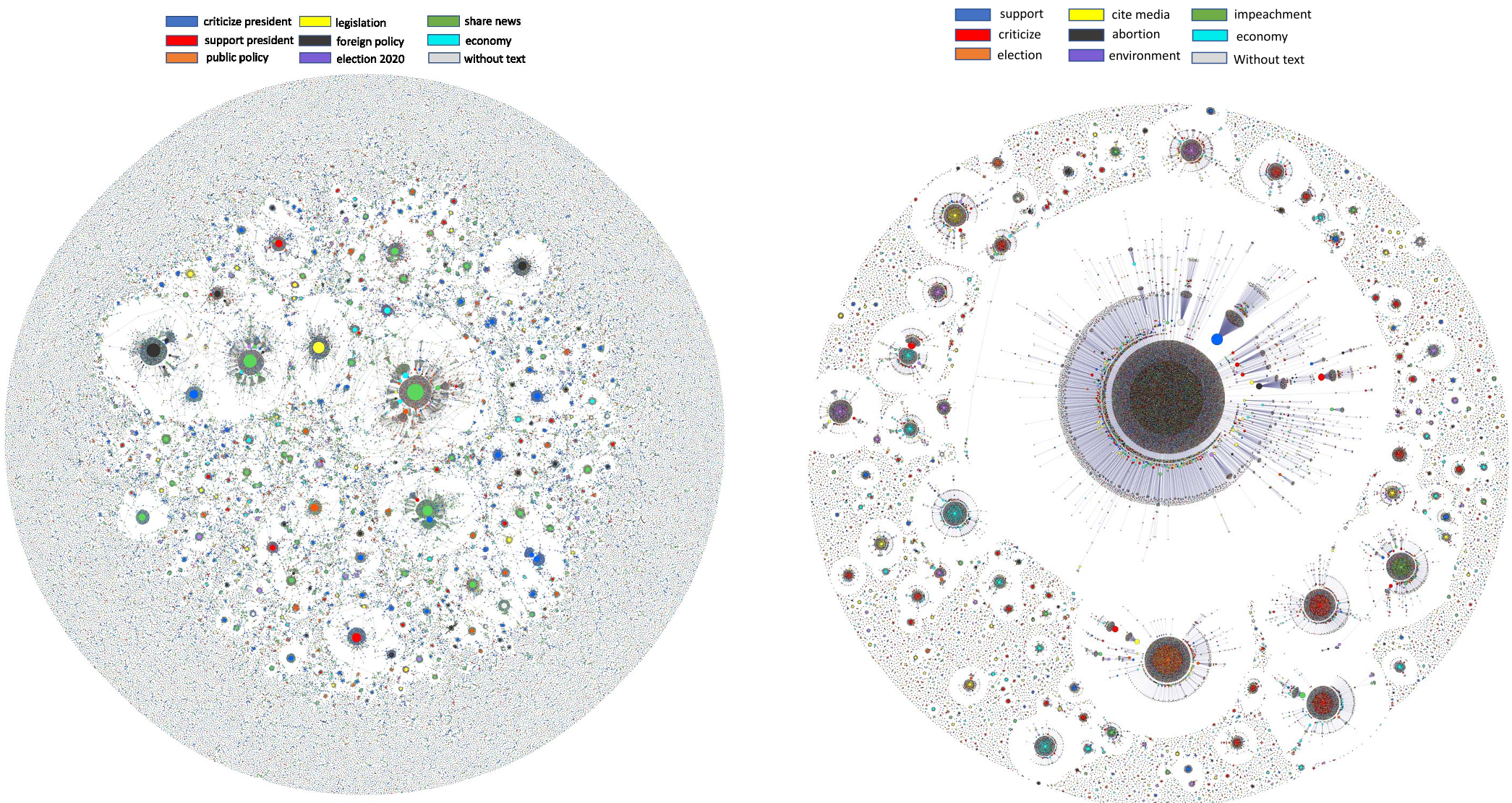 Figure 3: A Galaxy visualizing Trump-related discussions. Different colors represent distinct extracted topics orbiting central tweets.
Conclusion: A New Tool for Digital Sociology
The "Content-Aware Galaxy" is more than a pretty visualization; it is a diagnostic tool. It allows researchers to identify cross-cutting conversations—threads where supporters and opponents actually talk to each other—versus echo chambers.
Limitations: The model currently struggles when users manually edit "reply-to" fields or when tweets are deleted, which can "break" the branches of the star.
Future Outlook: This framework could eventually be used by platform moderators to promote "High-Coherency" threads over viral but "Low-Coherency" shouting matches, potentially pivoting social media toward more deliberate discourse.