
CC-FM: Bridging User Decisions and Short-Text Semantics in Event-Based Social Networks
Content-Based Co-Factorization Machines: Modeling User Decisions in Event-Based Social Networks
The paper proposes Content-Based Co-Factorization Machines (CC-FM), a recommendation framework for Event-Based Social Networks (EBSNs) that jointly models user-event attendance, user-group membership, and textual event descriptions. By integrating Factorization Machines (FM) with probabilistic topic modeling, CC-FM achieves SOTA performance in cross-task recommendations while mitigating data sparsity.
TL;DR
The paper introduces Content-Based Co-Factorization Machines (CC-FM), a unified model designed for Event-Based Social Networks (EBSNs) like Meetup. By sharing latent representations across multiple interaction tasks and anchoring them with probabilistic topic models of event descriptions, the researchers solved the notorious "Cold-Start" and "Sparsity" problems that plague ephemeral event recommendations.
Background & Motivation: The EBSN Dilema
Event-Based Social Networks (EBSNs) are unique. Unlike Netflix or Amazon, where items (movies/books) have long lifespans, EBSNs deal with short-lived events. When a new event is posted, it has zero historical data—a classic Cold-Start problem.
Furthermore, user behavior is fragmented across:
- User-Event (Attendance)
- User-Group (Affiliation)
- Content (Word reviews/descriptions)
Prior SOTA methods separate these tasks, losing the rich cross-domain signals. The authors' insight was simple but powerful: If we can learn a consistent "DNA" (latent factor) for a social group that explains both who joins it and what kind of events it organizes, we can predict attendance for even the newest events.
Methodology: The Core Architecture
The beauty of CC-FM lies in its Shared Latent Space. Instead of training three separate Factorization Machines, the model links them through a shared group vector .
1. Multi-Task Interaction Modeling
The model simultaneously estimates three types of scores:
- User-Event (): Predicts if a user will attend an event by interacting user, event, and group vectors.
- User-Group (): Models the long-term affinity between a user and a social circle.
- Word-Group (): Connects the group’s "latent DNA" to the actual vocabulary used in their event descriptions.
2. Infusing Topic Models
To ensure the latent factors are semantically meaningful, the authors regularize the group vector using a topic distribution derived from a probabilistic topic model (similar to LDA). This ensures that if a group's text is about "Python Programming," its latent factor aligns with users and events in the "Tech" category.
 Figure: The interaction equations showing how latent factors are shared across tasks.
Experiments & Performance
The authors tested CC-FM on three real-world datasets from Meetup (Chicago, Phoenix, San Jose).
Key Findings:
- Precision and MAP: CC-FM consistently beat basic FM and the previous best Co-FM. The improvement was most pronounced in the Event Recommendation task, where sparsity is highest.
- Efficiency: Because the content provides a strong "prior" for the latent factors, CC-FM converged in nearly half the iterations (~12 vs ~23) required by non-content-aware models.
- Sensitivity: The model is robust to the balance parameter , proving that adding content information almost always helps as long as it isn't overwhelming the behavioral data.
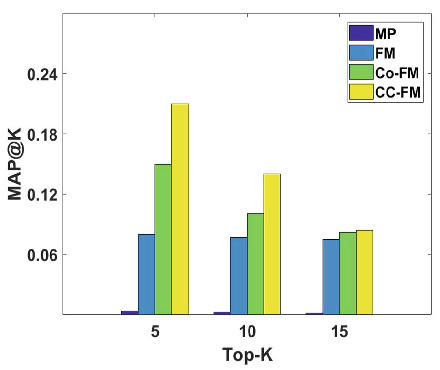 Figure: Performance comparison in Event Recommendation. CC-FM (green line) shows superior Precision@K across different cities.
Critical Insight & Conclusion
The success of CC-FM highlights a transition in recommendation research: moving from "What" to "Why." By incorporating topic models, the system doesn't just know that User A likes Group B; it understands that the content of Group B (e.g., "Outdoor Hiking") matches User A's interests.
Limitations: While CC-FM is effective, it still relies on linear factor interactions. As EBSNs grow more complex, integrating these "Co-Factorization" principles into Graph Neural Networks (GNNs) or Attention-based Transformers could be the next frontier to capture higher-order non-linear relationships between social entities.
In summary, CC-FM is a masterclass in Feature Engineering via Latent Sharing, providing a robust blueprint for any recommendation system dealing with sparse, multi-modal data.