
ECHO Model: Decoding the Emotional Pulse of Social Media Echo Chambers
Content-based echo chamber detection on social media platforms
This paper introduces a content-based framework for detecting and quantifying "echo chambers" on social media. It proposes the ECHO model, which utilizes graph-based Target Stance and Emotion Intensity patterns to determine sentiment resonance between posts and comments, achieving superior performance in echoing detection across Mandarin and English datasets.
TL;DR
Researchers have developed a new method called the ECHO model to detect "echo chambers"—online environments where beliefs are amplified by repetition—without needing a full map of social network connections. By analyzing the stance and emotional intensity of comments relative to their parent posts, the model can quantify how much a Facebook page acts as an ideological silo with over 75% accuracy.
Background: Beyond the Social Graph
Historically, identifying an echo chamber required "Graph Theory"—knowing exactly who follows whom. However, in the era of strict API privacy, researchers often only have access to the text on the page. The core motivation of this study is to treat the textual interaction as a proxy for the network structure. The authors hypothesize that if a comment’s stance and emotion perfectly mirror the post, they are "echoing," and a high frequency of this behavior indicates a robust echo chamber.
Methodology: The Anatomy of an Echo
The researchers broke down the "echo" into two distinct linguistic features:
1. Target Stance (TS) Patterns
Instead of just looking for keywords, the model builds a graph of "Connector Words" (the glue of language like "and", "the") and "Subject Words." It then replaces subject words with emotion labels to see how a specific stance (e.g., pro-Trump or pro-DPP) correlates with emotional triggers.
2. Emotion Intensity (EI) Patterns
On social media, how you say something matters as much as what you say. The model specifically tracks:
- Case Sensitivity: "REALLY" vs. "really."
- Punctuation & Emojis: The presence of "! ! !" or specific emojis like "^_^" to weight the intensity of the resonance.
3. The ECHO Neural Network
The final model uses an Attention Mechanism. This is a critical design choice; it allows the model to decide whether the stance or the emotional volume is more important for a specific post-comment pair when deciding if it constitutes an "echo."
 Note: The model uses dual-feature pairs (Stance and Emotion) filtered through an attention layer for final classification.
Experiments & Results
The model was tested against datasets representing the political spectrums of both the United States and Taiwan.
Stance Detection Performance
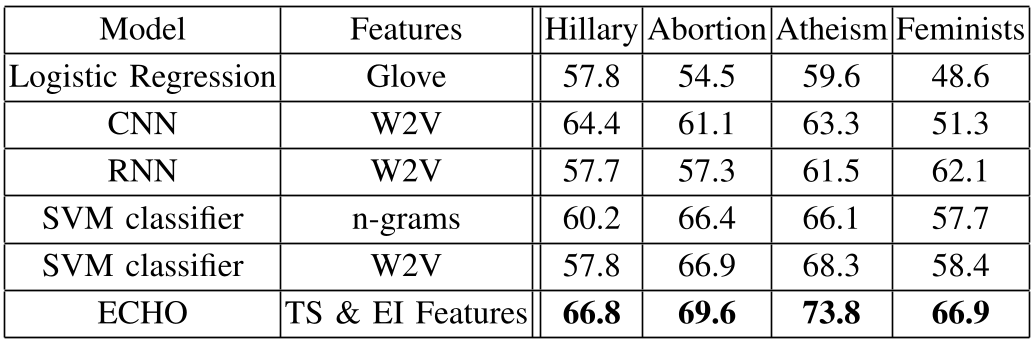
Before detecting chambers, the features were tested on simple stance detection (Agree/Disagree). The TS and EI features consistently outperformed standard NLP baselines like CNNs and SVMs.
Echoing Detection
In the primary task—identifying if a comment was an "echo"—the ECHO model achieved an F1-score of 0.76 in both Mandarin and English. This stability across languages suggests that the linguistic patterns of polarization (emotional intensity and alignment) are a universal human behavior on platforms like Facebook.
Deep Insight: The Extremity Correlation
Perhaps the most striking finding is visualized in the study's analysis of Taiwanese political fan pages. The researchers found a direct correlation between political extremity and the Echo Chamber Index. The further a fan page was from the political center (Blue/Kuomingtan or Green/DPP), the higher the echoing score became.
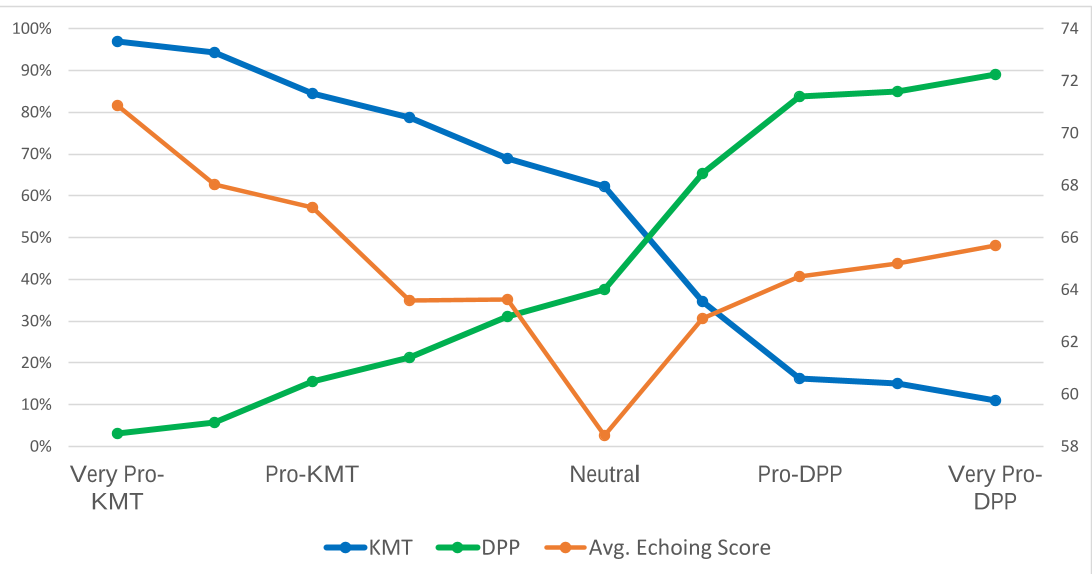 Figure: The U-shaped curve demonstrates that extreme ideological positions are statistically more likely to reside within highly echoing environments.
Critical Analysis & Conclusion
Value: This work provides a "content-first" toolkit for social scientists. By focusing on linguistic patterns rather than user IDs, it offers a more privacy-compliant way to monitor the health of digital discourse.
Limitations: While powerful, the model relies on semi-supervised pattern extraction, which requires some manual seeding of hashtags or topics. Future work could automate the "Subject Word" identification using unsupervised clustering to make it entirely autonomous.
Takeaway: The ECHO model proves that an echo chamber isn't just about who you know—it's about the emotional and ideological "volume" of the conversation. If we want to break these chambers, we must look at how emotional intensity drives the resonance of information.